The phenomenon of paradiplomacy, which is the participation of state governments in foreign policy and ‘competitive federalism’ between states, has been steadily growing in India and is also acquiring several new dimensions.
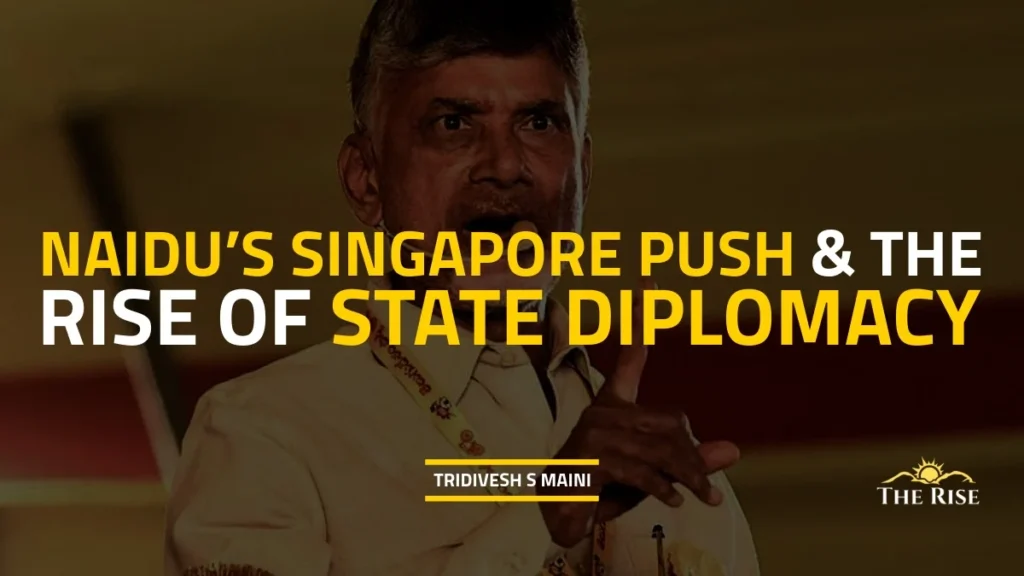
While addressing a CII Partnership road show, Andhra Pradesh (AP) Chief Minister Chandrababu Naidu said: “Singapore has designed a remarkable blue-green capital city plan for Amaravati. We continue to work closely with Singapore on urban infrastructure development. AP is one of the best destinations for investment, and I invite Singaporean entrepreneurs to make Amaravati and AP their second home.”
Naidu highlighted the state’s strengths, including its long coastline, abundance of natural resources and investor-friendly policies. He also underscored the fact that Amaravati will, in the future, be connected with important growth centres of Southern India, including Hyderabad (Telangana), Bengaluru (Karnataka) and Chennai (Tamil Nadu). Further, the Chief Minister also said that Amaravati is an innovation and knowledge hub.
Naidu met with Singapore Prime Minister Lawrence Wong. During his meeting, Naidu pitched for greater cooperation between Singapore and AP not just in technology such as Artificial Intelligence (AI) and semiconductors, but also in infrastructure areas such as the development of ports and airports and urban governance.
Also Read: Myanmar’s Strategic Shift Towards India
He also highlighted steps being taken by the state government to boost agricultural growth.
Naidu also met Professor Tan Eng Chye, President of the National University of Singapore (NUS). Apart from discussing educational and research collaborations, he sought inputs from the NUS Policy Institute for drawing investments for the state and boosting economic growth. Most importantly, he invited NUS to set up a satellite campus or branch in Andhra Pradesh.
In his current stint as CM of AP, Naidu has been pushing for the development of Amaravati and making Visakhapatnam into an important tech hub. Google has already started construction of its AI hub in Visakhapatnam (Vizag). The foundation stone of this hub was laid in April 2026. While speaking at the foundation of the AI hub, the Andhra Pradesh IT Minister, Nara Lokesh (the son of Chandrababu Naidu), said, “We have seen how Cyberabad was transformed into a world-class hub. A similar growth path is now unfolding in Visakhapatnam,” indicating Visakhapatnam would become a ‘data city’.
Naidu, in his address, said that this development is important not just for Visakhapatnam or AP but also for ‘India’s AI journey’.
Naidu’s Singapore visit comes at a time when other states driving India’s economic growth have been wooing investors and setting ambitious economic goals. At a Niti Aayog governing council meeting, Maharashtra CM Devendra Fadnavis set a goal of making Maharashtra a $5 trillion economy by 2047. He said that the state would focus on key areas like education, skill development, health care, and inclusive development. Maharashtra has been the leading state in terms of attracting Foreign Direct Investment (FDI) in recent years, and Fadnavis has highlighted the same on more than one occasion. In 2025-2026, Maharashtra secured $18.4 billion in FDI.
Further, Telangana CM, Revanth Reddy, recently said that his competition is not with other Indian states, but with South Korea, Japan and China. He also said that his main aim was to ensure that Telangana was a beneficiary of the China+1 strategy. He also spoke about his aim of making Telangana a $1 trillion economy in 2034 and a $3 trillion economy by 2047. He has also sought central support for infrastructure projects and for the establishment of an IIM in Hyderabad.
This scenario makes certain points clear. First, states are setting economic goals and competing to woo foreign investments. This is happening in an organic manner. Second, states are now looking to strengthen ties with Southeast Asian countries. Apart from Japan, South Korea, and Singapore, it is important to strengthen linkages with countries like Indonesia, Vietnam, Thailand, and Cambodia, which have not been given the sort of attention they deserve.
States like AP, Telangana, Karnataka, and Maharashtra, apart from AI, also understand the importance of innovation. In a changing international higher education landscape, where getting student and work visas is becoming tougher, states are also likely to reach out to overseas universities to set up campuses in India.
International universities have already begun setting up campuses in Gujarat and Delhi, while several have received approvals for setting up campuses in Karnataka and Maharashtra. AP CM Chandrababu Naidu also invited NUS to set up a satellite campus in the Southern Indian state.
The phenomenon of paradiplomacy, which is the participation of state governments in foreign policy and ‘competitive federalism’ between states, has been steadily growing, acquiring several new dimensions, as discussed earlier. It is important for all stakeholders, not just policymakers, to ensure that state governments are target-oriented and pragmatic in their approach.
Disclaimer: The views expressed in this article are those of the author solely. TheRise.co.in neither endorses nor is responsible for them. Reproducing this content without permission is prohibited.
About the author

Tridivesh Singh Maini is a New Delhi-based Policy Analyst. He is faculty member of OP Jindal Global University, Sonepat, Haryana.