India would also be closely observing the changing geopolitical dynamics within the Gulf. There has been a visible deterioration in ties between the UAE and Saudi Arabia, even before the West Asia conflict began, though India needs to ensure a fine balance, given its ties with both countries.
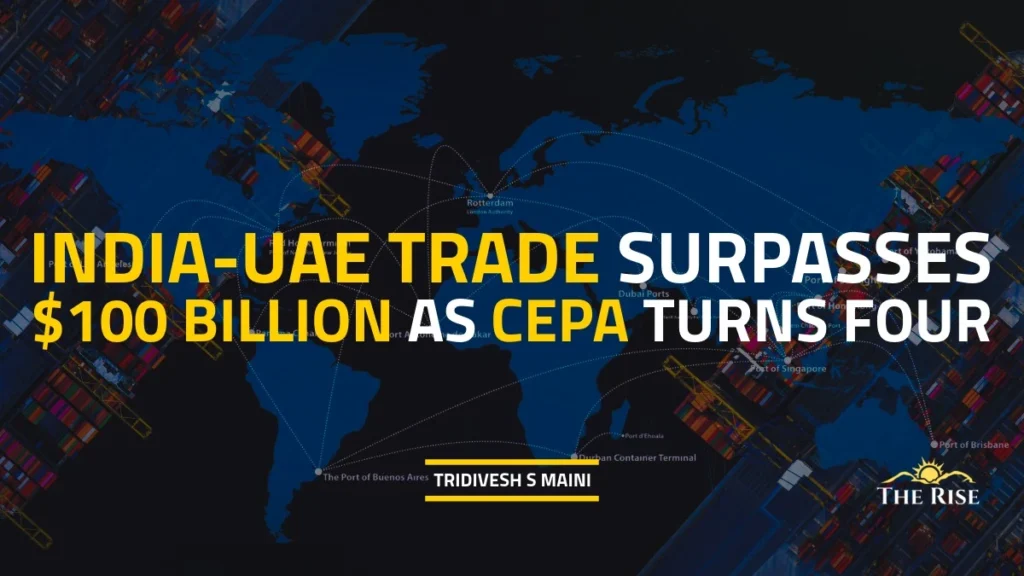
The India-UAE relationship has strengthened immensely in recent years due to growing economic and strategic convergence between both countries. The India-UAE Comprehensive Economic Partnership Agreement (CEPA), which came into effect on May 1, 2022, completed four years on May 1, 2026. The bilateral trade between the two countries has surpassed $100 billion. In 2025-2026, bilateral trade was estimated at $101.25 billion, compared with $100.03 billion in 2024-2025.
Commerce and Industry Minister Piyush Goyal, in a post on X, stated that the CEPA had boosted bilateral trade between the two countries and created immense opportunities for the MSME sector, farmers, and exporters. Goyal also said that trade between both countries had expanded in key areas including gems and jewellery, engineering goods, electronics, and agriculture. The Minister also flagged an important point that the CEPA with the UAE acted as an important gateway to Africa, other Gulf Cooperation Council (GCC) countries, Commonwealth of Independent States (CIS) countries, and some European countries. He also underlined the fact that India’s payments interface, the Unified Payments Interface (UPI), had played a crucial role in giving a strong push to economic relations between both countries.
Trade in local currencies
During PM Modi’s UAE visit in July 2023, both countries also signed an agreement for the promotion of trade in local currencies. An MOU for the promotion of trade in Rupees and Dirham was signed between Shaktikanta Das, then governor of the Reserve Bank of India (RBI), and his counterpart at the Central Bank of the UAE (CBUAE), Khaled Mohamed Balama. Indian Oil Corporation (IOC) made payments in Rupees for the purchase of one million barrels of crude oil from Abu Dhabi National Oil Company (ADNOC).
It would be pertinent to point out that India holds the BRICS+ Presidency, and the UAE had entered BRICS+ as a member in January 2024. BRICS is seeking to promote trade in local currencies.
The Reserve Bank of India has made a recommendation for India to push for the connection of Central Bank Digital Currency (CBDCs) of the BRICS countries. Such a step could help in reducing dependency upon the SWIFT network. Both the UAE and India have been pushing for trade in local currencies with other countries. During recent talks with the United States for a US dollar currency swap line, the UAE had stated that if dollar liquidity were to tighten, then the Gulf nation would be compelled to use the Yuan for oil transactions.
India-UAE engagement amidst the West Asia conflict
Amidst the West Asia conflict, PM Modi spoke to the UAE President, Sheikh Mohamed bin Zayed Al Nahyan, on more than one occasion. Modi expressed his solidarity with the UAE and criticised attacks on civilian infrastructure in the UAE. During his conversations, he had pushed for ‘de-escalation’ and thanked the UAE for taking care of the Indian expat community. Modi and the UAE President also agreed on the need for safe and free navigation via the Strait of Hormuz.
After the announcement of the Iran-US ceasefire, External Affairs Minister S Jaishankar visited the UAE (April 11-12) and met with the UAE President and other senior officials. In a post on X, while commenting on his meeting with the UAE President, Jaishankar said, ‘Conveyed warm greetings of Prime Minister @narendramodi and our gratitude for ensuring well-being of the Indian community during the West Asia conflict’.
PM Modi is also likely to make a brief stopover at the UAE during his Europe trip later this month.
UAE’s exit from OPEC: Possible benefits for India
India would also be closely observing the changing geopolitical dynamics within the Gulf. There has been a visible deterioration in ties between the UAE and Saudi Arabia, even before the West Asia conflict began, though India needs to ensure a fine balance, given its ties with both countries. UAE’s announcement to pull out of Organization of the Petroleum Exporting Countries (OPEC), dominated by Saudi Arabia, is also significant. UAE accounts for an estimated 14% of OPEC’s oil production.
Due to OPEC oil quotas, UAE’s oil production was restricted to 3.2 -3.5 million barrels per day (bpd), which was well below its potential of well over 4.5 million bpd. The UAE Energy Minister, Suhail al-Mazrouei, while commenting on the decision of his country to pull out of OPEC, said, “It reflects a policy-driven evolution aligned with long-term market fundamentals.”
It has been argued that another important reason for the UAE pulling out of OPEC is Riyadh’s influence over the Gulf’s energy policy. UAE is seeking to reorient its foreign policy in the aftermath of the West Asia conflict. Abu Dhabi has been critical of the GCC as well as the Arab League for the weak response to Iranian attacks on the UAE. Presidential Adviser Anwar Gargash, while commenting on the same, said, ‘The GCC’s stance was the weakest historically, considering the nature of the attack and the threat it posed to everyone.’
The UAE has consistently ranked amongst the top five oil suppliers to India. In 2024-2025, the UAE accounted for 10% of India’s oil imports. While it is premature to comment on how this decision will impact India, if oil prices drop due to the UAE increasing its daily oil production, then India’s import costs will be reduced significantly. UAE is geographically closer than many of India’s other oil suppliers, and India could source crude from Fujairah Port, which is located outside the Strait of Hormuz, reducing transit risks associated with the chokepoint. Further, purchasing oil from the UAE would also help India in achieving its aim of diversifying its crude oil sources. Finally, with its exit from OPEC, the UAE can explore trade in local currencies with other countries, including India.
Conclusion
India and UAE have a multi-faceted relationship. Economic factors, strategic interests in a changing geopolitical landscape, and robust people to people ties have played a crucial role in bolstering the bilateral relationship. The exit of the UAE from OPEC could be beneficial for India, as discussed earlier, in more than one way.
Disclaimer: The views expressed in this article are those of the author solely. TheRise.co.in neither endorses nor is responsible for them. Reproducing this content without permission is prohibited.
About the author

Tridivesh Singh Maini is a New Delhi-based Policy Analyst. He is faculty member of OP Jindal Global University, Sonepat, Haryana.