The prevailing education system design begins with curriculum design, followed by teaching-learning-assessment, the award of degree, and employment, assuming that good quality education rolls out competent graduates. However, the skill deficit, unemployment, and employer concerns point to something being fundamentally wrong with this approach.
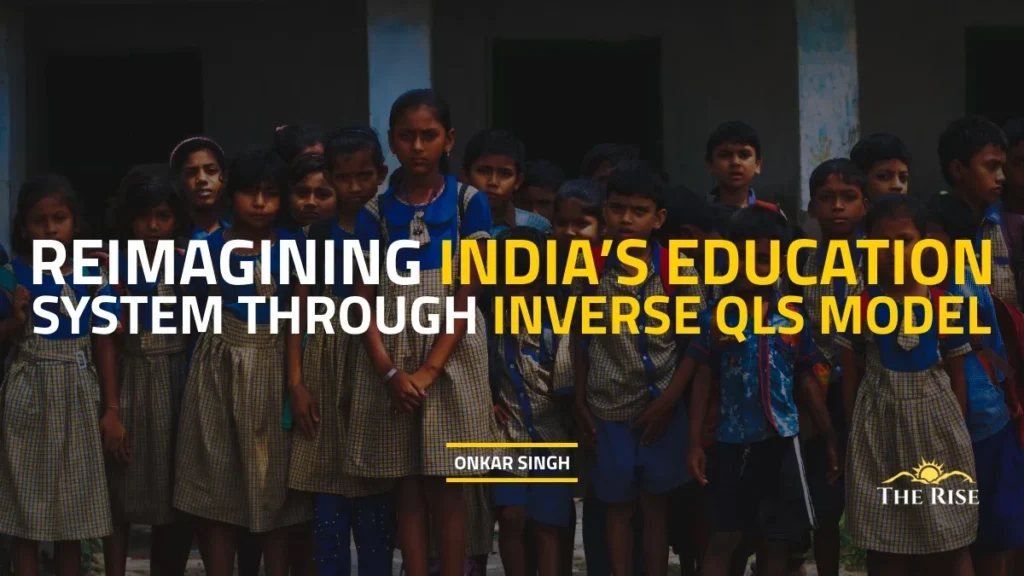
The Indian education system is reeling under the paradox of being the largest education system in the world, producing a large number of degree holders, but with competencies that do not match their qualifications. There are so many reforms being envisaged on the premise that good education quality leads to good learning outcomes, requisite skills and good employability. The education quality is gauged by the inputs like infrastructure, teachers, syllabus, assessment processes, etc. Nevertheless, this approach fails to answer the central question as to what kind of educated individuals the country will require in future and to what extent the graduating students attain the prescribed learning standards and societal outcomes.
Present system
The prevailing education system design begins with curriculum design, followed by teaching-learning-assessment, the award of degree, and employment, assuming that good quality education rolls out competent graduates. However, the skill deficit, unemployment, and employer concerns point to something being fundamentally wrong with this approach. It can be perceived through the persistent complaints of outdated curriculum, rote learning-based assessment, degrees without competence, retraining requirement from employers, and higher education institutions worried about their rankings instead of feeling concerned about student learning outcomes.
Need for change
Apparent weaknesses call for repurposing the education system in the context of what knowledge base and skills are required by industry and society in future. This calls for creating an outcome centred framework in which the learning outcomes are well laid out and remain coherent to the curriculum, pedagogy, and assessment while quality assurance ascertains the attainment of desired competencies. Accordingly, it is proposed to have an inverse QLS (Quality, Learning, Skills) model that starts with the ‘future employment needs’ contrary to the traditional model that places ‘employment’ at the end of the education process.
Quality, Learning, and Skills Model
Sequentially, this inverse QLS model may start with future employment needs followed by desired skills and then national learning standards followed by the curriculum, teaching and assessment, all backed by quality assurance. The reversal of the conventional education planning takes the future competency requirements into focus and backwardly designs the rest of the things. Hence, the capabilities expected of graduating students in the future would guide curriculum design and institutional practices.
Also Read: India’s Higher Education Crisis: The Rise of Contractual Faculty
The three pillars of inverse QLS- quality, learning, and skills are to be looked at from the perspective as opposed to the generic one.
Firstly, skills have to be the starting point for building the education processes backwardly. There has to be due consideration of domain skills, societal skills, economic skills, civic skills, ethical skills, and contemporary technical skills.
Secondly, learning is not to be relied upon mere completion of the syllabus; instead, learning is ensured by measurable, demonstrable capabilities like critical thinking & problem solving, communication, digital literacy & AI understanding, sustainability concerns, ethical standards, interdisciplinary understanding, and life long learning capacity.
Thirdly, quality should not be assessed solely through the lens of infrastructure, teacher numbers and qualifications, student intake, accreditation and ranking scores. Instead, the quality connotes the graduating students with degrees conforming to national standards. There is a radical shift in quality assurance from input-centric accreditation to outcome-based accountability.
Also Read: India’s Degree Trap: Why Government Jobs Should Look Beyond College Degrees
Thus, education will not be a function of curriculum and teaching alone; rather, the inverse QLS model proposes that education quality is a function of ‘future needs’, ‘teaching-learning-assessment’, ‘learning standards’, ‘competencies’, integrity’, and ‘stakeholder feedback’.
Prima facie, the proposed inverse QLS model will have the following six guiding principles,
- Competency-driven education to supersede syllabus-driven education
- Setting up of national learning standards from the start of education to the terminal stage of education
- Assessment of knowledge and critical thinking instead of rote-learning
- Graduate outcome measurement in accreditation
- Market forces to decide the periodical curriculum revision, may be after three years
- Higher education institutions to be centres of knowledge creation and innovation instead of being factories for producing degree holders.
Way forward
Undoubtedly, this will also call for tweaking of the roles of the present regulators such as NCERT, UGC, and other domain-specific regulating bodies. Also, the accreditation process must revolve around employability, competencies, innovation, ethics, entrepreneurship, ethical standards and civic responsibility in graduating students along with the other routine attributes to assess the education outcome. Employers need to recognize the competency of graduating students along with the traditional examinations.
In the inverse QLS model, the graduating student is not the objective, but it is the consequence of the educational processes. Thus, the basic question of what a student should study? will be replaced by what kind of educated individuals are required in future in the proposed model.
At the conceptual stage, such a model may be quite relevant for confronting the rapid technological changes, AI interventions, changing labour-market dynamics, sustainability concerns and a perennial push to align education with societal needs.
Disclaimer: The views expressed in this article are those of the author solely. TheRise.co.in neither endorses nor is responsible for them. Reproducing this content without permission is prohibited.
About the author

Prof. Onkar Singh is the former Vice Chancellor of Veer Madho Singh Bhandari Uttarakhand Technical University, Dehradun, He has been the Founder Vice-Chancellor of the Madan Mohan Malaviya University of Technology, Gorakhpur (U.P.). He is a Professor of Mechanical Engineering at Harcourt Butler Technical University, Kanpur (U.P.).