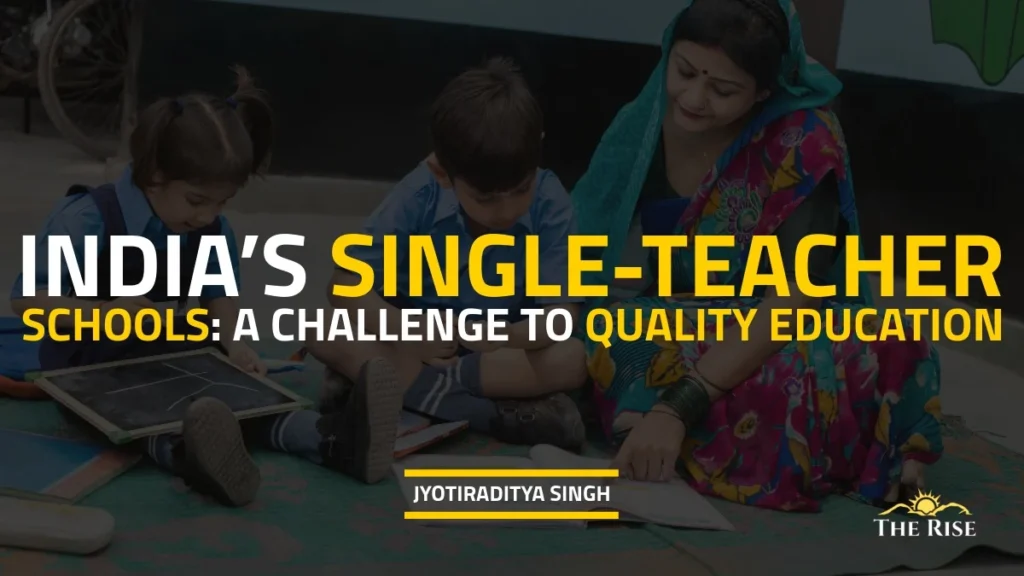
The promise of education is not fulfilled merely because a school building exists or a child’s name appears on an enrolment register. It is fulfilled when a child has a genuine opportunity to learn. One teacher carrying the responsibility of an entire school may reflect dedication, but it should not become a permanent model of public education.
India has more than one crore school teachers. It also has 1,04,125 schools where the entire teaching responsibility rests with just one teacher. Both figures come from the Ministry of Education’s UDISE+ 2024–25 data. When put in together, they reveal a contradiction that deserves far more attention than it receives. A country can have a large teaching workforce on paper and still leave thousands of individual schools with only one person to teach every child.
The number is not a minor administrative detail. The latest UDISE+ report records 1,04,125 single-teacher schools among 14,71,473 schools covered by the data, which is a little over seven per cent. These schools together had 33,76,769 students enrolled. In simple terms, more than 33 lakh children were studying in schools that reported only one teacher. That works out to roughly 32 students per single-teacher school on average, although the actual number of children varies widely from one school to another.
Though there has been some improvement, when compared to previous year’s data. In 2023–24, India reported 1,10,971 single-teacher schools, compared with 1,04,125 in 2024–25. The reduction is 6,846 schools, or around 6.2 per cent. That is a meaningful decline, but it should not be mistaken for the end of the problem. More than one lakh schools still depend on a single teacher. A falling number is encouraging; but the remaining number is still substantial.
Also Read: Reimagining India’s Education System Through Inverse QLS Model
The state-level figures make the issue even harder to ignore. Jharkhand reported 9,172 single-teacher schools, with 4,36,480 students enrolled in them. Bihar reported 1,865 such schools, with 1,75,500 students enrolled in them. These numbers matter because the national average can hide very different realities across states. In Jharkhand, the report also records an overall pupil-teacher ratio of 36, compared with the national figure of 24. The pupil-teacher ratio is an aggregate measure, not a count of teachers in every school, but it adds context to the staffing challenge in the state.
Having only one teacher does not necessarily mean that students are unable to learn. Teachers in these settings often work with commitment and resourcefulness, even if schools may have low enrolments or difficult geographical conditions. The data alone cannot tell us whether every single-teacher school is failing, or how well children are learning. It would be unfair to turn a staffing statistic into a judgement on an individual teacher. However, the real question remains whether the system is giving that teacher and those students a fair chance.
Imagine a school where children from different grades arrive in the same classroom. One teacher has to divide attention between early reading, mathematics, writing and lessons meant for older students. The same person may also have attendance records, administrative work, school-level reporting and other responsibilities. While one group works independently, another may need direct explanation. Teaching across grades is possible, but it demands time, planning and support. When one adult is responsible for the whole school, the scope for individual attention is inevitably constrained.
This is where the debate must move beyond the headline number. The Right to Education framework sets norms for pupil-teacher ratios and teacher availability, but the lived reality of a school cannot be judged by a national average alone. A national pupil-teacher ratio of 24 may appear manageable, yet it can coexist with schools where a single teacher handles every grade. Averages describe the system as a whole, but children experience education one classroom at a time.
Also Read: Macaulay to NEP 2020: How India’s Education System Changed
The answer is not simply to announce recruitment targets. Governments need school-wise staffing plans that identify where vacancies are concentrated, how many grades a teacher is handling, and whether difficult-to-reach schools are receiving adequate support. Teacher appointments should be based on actual classroom needs, not only on district-level totals. Where enrolment is low because communities are remote or scattered, the response should protect access to a nearby school while ensuring that teachers are available. Any consolidation or merger of schools must also consider the distance children would have to travel and the effect on the most disadvantaged families.
Support matters alongside recruitment. Multi-grade teaching requires suitable lesson plans, teaching materials, mentoring and regular academic support. Technology may help teachers access resources, but it cannot replace another trained adult in a classroom. Nor should digital tools become an excuse to leave a school understaffed. The first responsibility is to ensure that every child has meaningful access to a teacher, and that teachers have the time and resources to teach.
Also Read: India’s Higher Education Crisis: The Rise of Contractual Faculty
India often measures educational progress through enrolment, infrastructure, examination results and national averages. These indicators are important, but they do not always show what happens during an ordinary school day. The figure of 1,04,125 single-teacher schools asks a more direct question: how much attention can one teacher realistically give to children of different ages and learning levels? The answer will vary by school, but the question cannot be dismissed.
The promise of education is not fulfilled merely because a school building exists or a child’s name appears on an enrolment register. It is fulfilled when a child has a genuine opportunity to learn. One teacher carrying the responsibility of an entire school may reflect dedication, but it should not become a permanent model of public education. The challenge for policymakers is clear: reduce the number of such schools, strengthen those that remain, and make sure that a child’s chance to learn does not depend on how many teachers happen to be posted in their village.
References
1.Ministry of Education, Government of India, UDISE+ 2024–25, Table 2.2: State-wise highlights of schools, enrolment and teachers. https://dashboard.udiseplus.gov.in/report-new-v.11-demo2025/static/media/UDISE%2B2024_25_Booklet_existing.118ba29d4773e6372f72.pdf
2.Ministry of Education, Government of India, UDISE+ 2023–24, Table 2.2: State-wise highlights of schools, enrolment and teachers. https://dashboard.udiseplus.gov.in/report2025/static/media/UDISE%2B2023_24_Booklet_existing.309eabf9e4889db93bcb.pdf
Disclaimer: The views expressed in this article are those of the author solely. TheRise.co.in neither endorses nor is responsible for them. Reproducing this content without permission is prohibited.
About the author

Jyotiraditya Singh is a youth leader and social activist passionate about youth participation, public policy, education, employment and political accountability. He is actively involved in student and youth initiatives.