A sustainable temple economy must go beyond recycling waste. It should ensure that women at both ends of the flower journey benefit from Varanasi’s growing temple economy through dignified employment, financial security and greater financial independence.
When Chanda Devi’s husband was diagnosed with a brain tumour a few years ago, the family’s financial troubles worsened. It was then, 40-year-old Chanda Devi took the financial charge of the house. Five years down the line, she now makes ₹5,000 a month working with Easy Help, a Varanasi-based NGO that recycles discarded temple flowers to create products such as incense sticks and compost. She now hopes to use part of her income for her children’s education.
The Precarious Economics of Garland Making
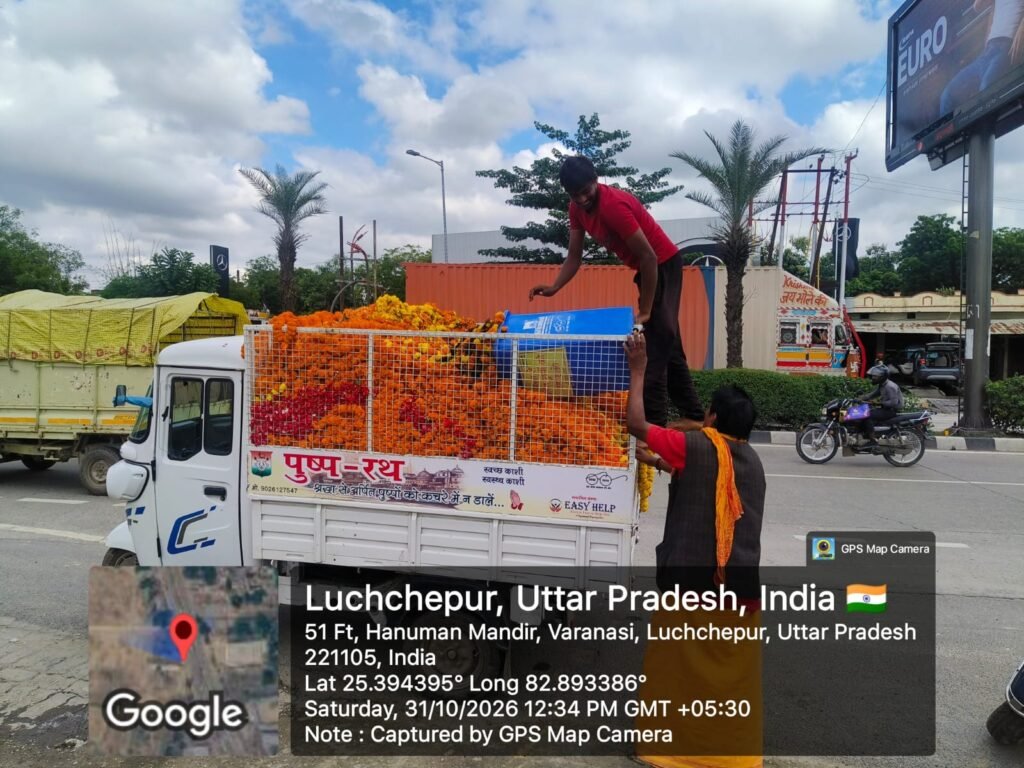
Flower offerings are considered essential to faith. People visiting temples for darshan offer garlands to the deity. Those garlands begin in the fields. Vivek Dubey, who manages a flower mandi in Varanasi, says that farmers from villages in Varanasi and districts close to Varanasi like Chandauli, Ghazipur, Jaunpur, and Robertsganj sell flowers and garlands in the mandi directly. These farmers have to pay a nominal mandi fee of Rs 30. “Over 600 to 700 traders come to the market on a regular day and around 10,000 garlands are traded daily, with nearly half going to temples,” Vivek told TheRise. Since the opening of Kashi Vishwanath Corridor in December 2021. more than 26.23 crore pilgrims have visited so far, thereby boosting the market economy of garlands[1].
Prices of these garlands vary considerably. While a small marigold garland might be sold for ₹15 – ₹20 on an ordinary day, its price may double during festivals like diwali.
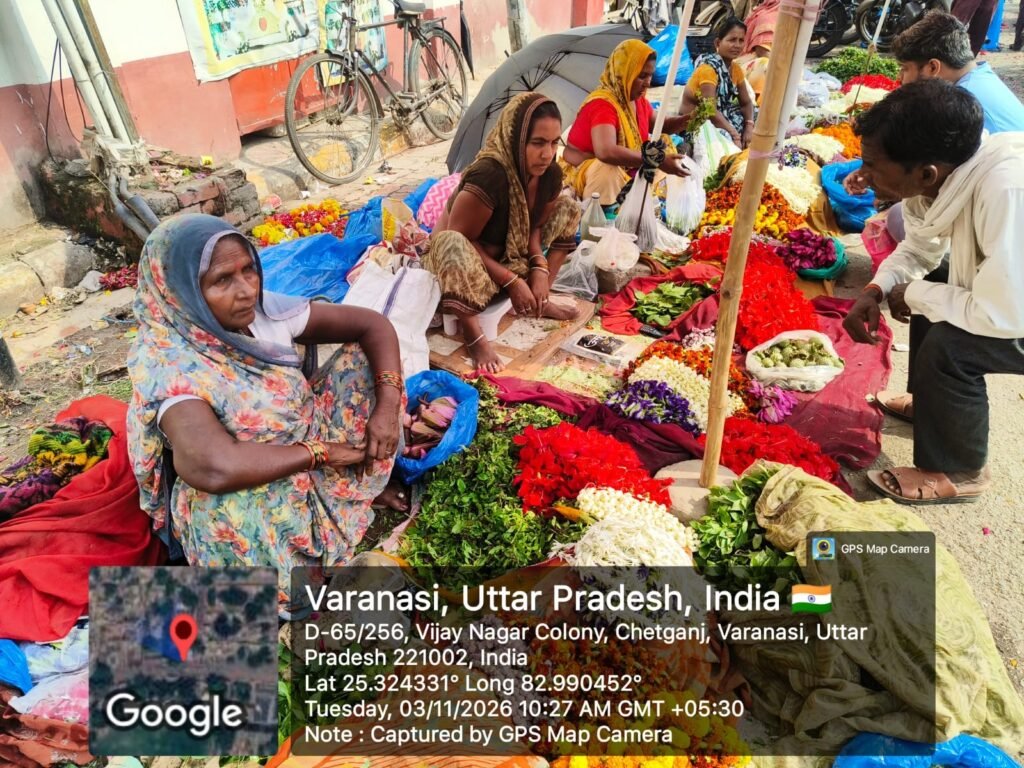
But for the women weaving the garlands, the growing demand does not translate into higher income. Among the women garland makers interviewed, the majority reported earning less than Rs. 500 a day. Most of the women Garland makers set up their shops outside the mandi as they do not want to pay the mandi fees. Neelavati,70, told TheRise that she continues selling garlands despite earning less than Rs. 250 a day, with a margin of Rs. 1-2 on each garland. “These flowers get wasted if not sold timely. The competition has risen numerous times with the Kashi Vishwanath corridor,” said Neelavati. With rising inflation and limited earnings, these women have little left to save after meeting their household expenses, often leaving them dependent on borrowing to make ends meet.
Burden of Informal Debt
The survey findings reflect this financial vulnerability. Of the 80% of garland makers who had bank accounts, more than 60% had borrowed from moneylenders on one or multiple occasions. Lack of institutional credit due to unavailability of collateral, complex procedures, and paperwork compels these women to seek refuge to moneylenders providing immediate credit at higher interest rates, pushing them into poverty and aggravating their socio-economic conditions.
Without collateral, securing a bank loan is difficult, leaving many dependent on moneylenders. Rising household expenses add to her worries.
For a 28-year-old Sunita Bind, who reported earning Rs.1000-1200 a day, reconstruction activities and uncertainty over trading space have created difficulties. She hopes for her daughter to complete her education and become financially independent.
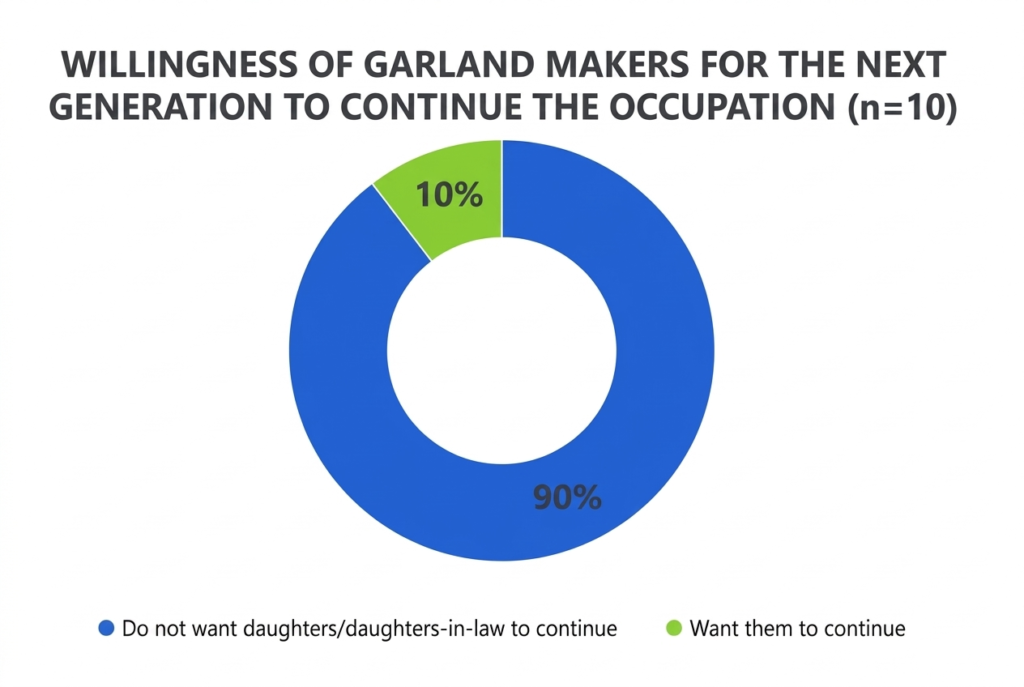
Among the surveyed garland makers, 90% of them did not want their future generation to continue this occupation. Most hoped that the next generation would pursue education and acquire a financially secure profession.
When Sacred offerings become waste
While the flowers sustain livelihoods around Varanasi’s temples, their disposal has long posed an environmental challenge. In 2012, flower traders estimated that the city generated at least 10 tonnes of floral waste daily, although municipal estimates were considerably lower [2]. Also, a 2021 BHU study of nine ghats found that while flowers made up 47.5% of the solid waste, plastic accounted for 26.55% of the wastes [3].
In this regards, attempts to put discarded temple flowers to productive use have been underway for several years. In 2019, ITC’s Mangaldeep collaborated with the Kashi Vishwanath Temple Trust to make incense sticks from discarded flowers [4]. Further, in 2021, the Uttar Pradesh State Rural Livelihood Mission(UPSRLM) supported women’s self-help groups in making herbal gulal from temple offerings by providing temple flowers free of cost. [5].
A Second Life for Flowers and Women
Building on these efforts, NGO Easy Help is attempting to address the challenge of flower waste while creating livelihood opportunities for women through its Pushp Rath initiative. The organisation reports collecting approximately 1500kg of discarded flower offerings and associated waste from 110 city temples every day and processing it into eco-friendly products.
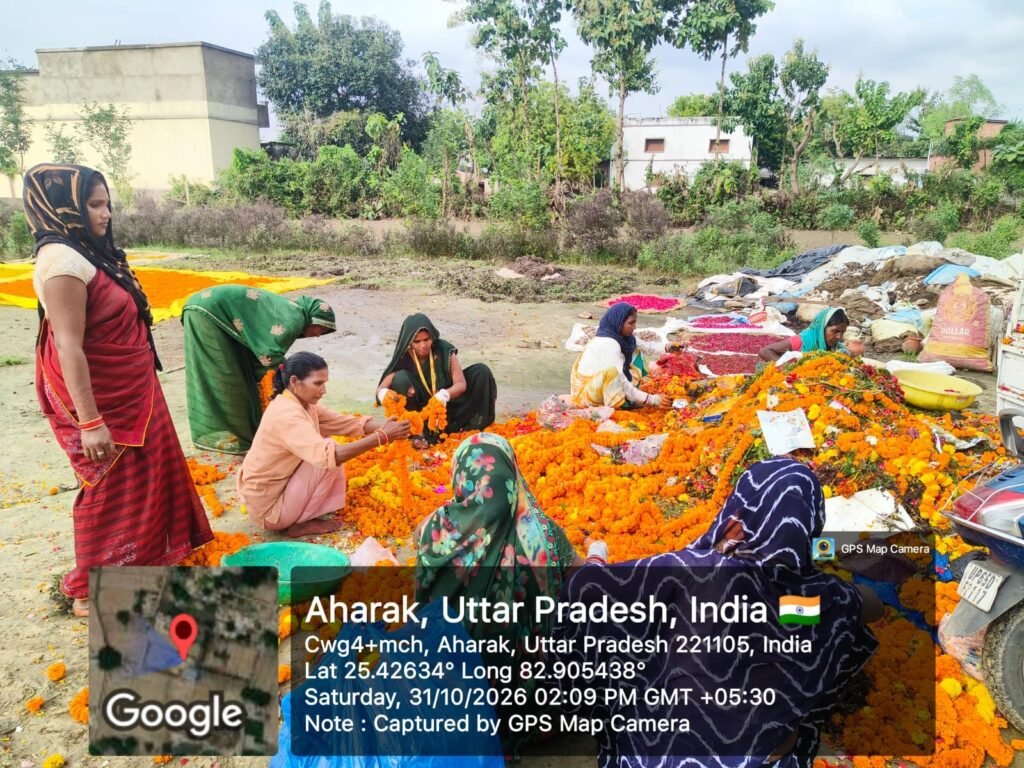
According to NGO representative Vivek Singh, “60-70% of the collected waste consists of plastic plates, diyas, plastic and glass bottles and other waste. Separating flowers from this is therefore not only the crucial part, but also the most difficult and expensive part of the process. The usable flowers are sorted, dried and processed into incense sticks, dhoop, herbal gulal, hawan samagri, organic compost and other products“. The NGO Easy Help currently employs 70 women and wants to reach 1000 women, prioritising those in need of employment like widows, destitute women, and older women with no one to rely on, he further added.
Among the 16 women surveyed, all reported earning between Rs. 3000-8000. All women described the work as better than their previous employment or circumstances. They valued contributing to their household expenses and hoped the organisation’s growth would bring higher wages.
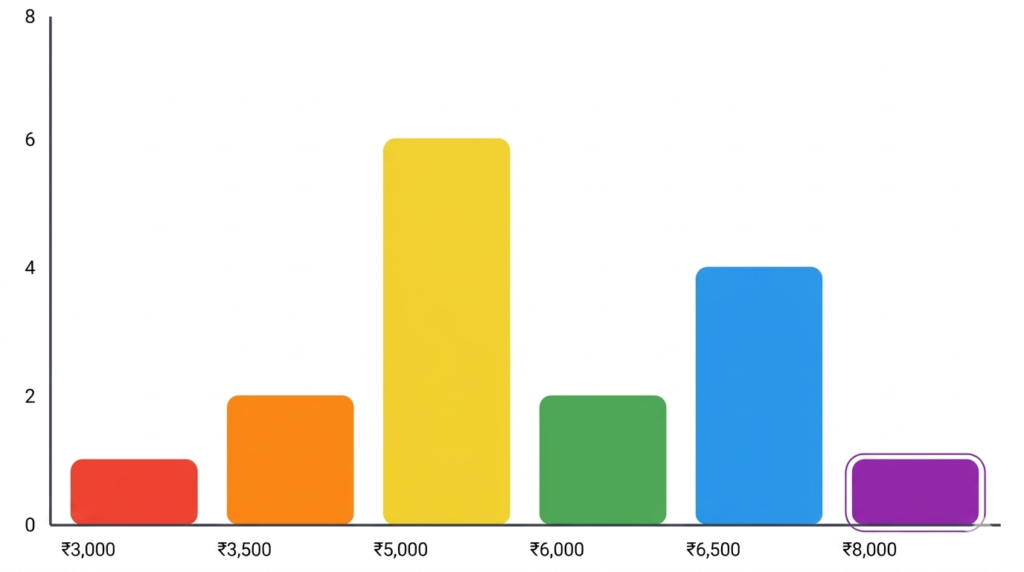
For some, the work also offers an opportunity to pursue aspirations beyond their immediate household responsibilities. Komal Gupta, a 19-year-old first-year BA student told TheRise that she works in the packaging department and earns Rs. 6,500 a month. She is pursuing her ambitions by saving to buy a scooty while also contributing towards household expenses. She also hopes to prepare for UP Police Recruitment Examinations.
Like Komal, Chanda Devi, another employee in the NGO told TheRise, “This income is more than just a contribution to household expenses; it offers us financial independence and the means to pursue our aspirations.”
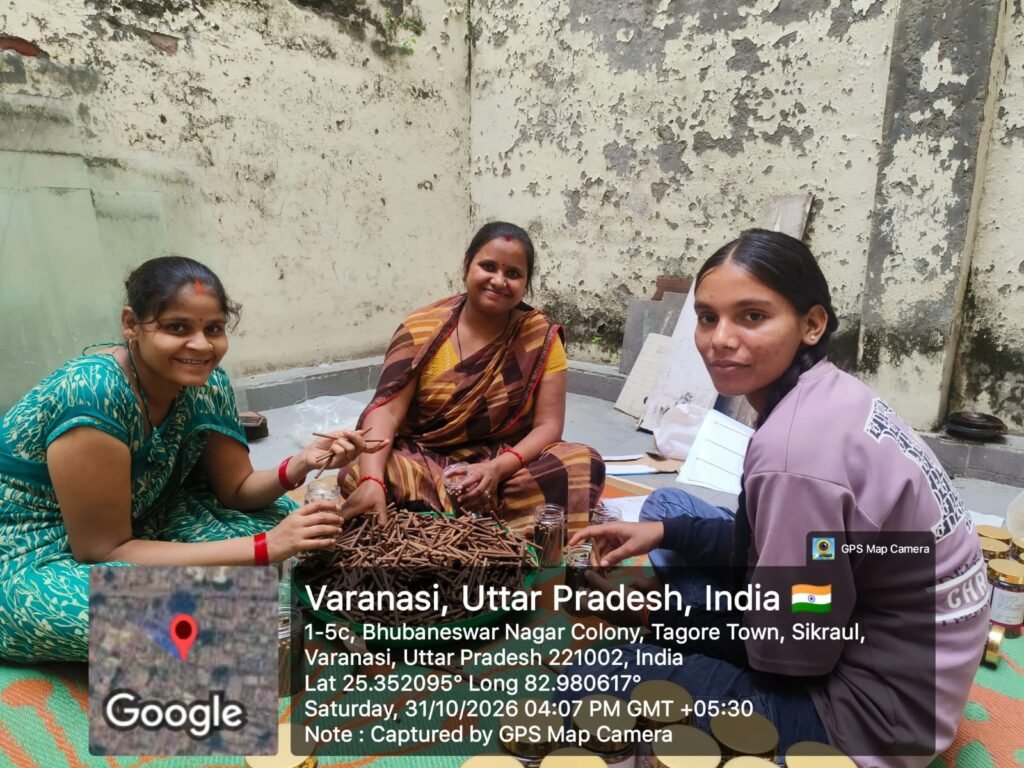
However, creating livelihood opportunities through flower recycling comes with operational costs of its own. According to estimates shared by the NGO representative, the NGO faces challenges of its own. It costs approx. Rs. 2 lakh per month in collection and sorting operations alone. Without government support or private sector CSR funding, the organisation is currently facing difficulties in expanding its operations.
Building a Fairer Temple Economy
For Varanasi’s temple economy to be sustainable and for the women to reap benefits from its boon, a coordinated approach is needed that treats flower recycling and women’s livelihoods as interconnected public policy.
For women garland makers’ dependence on moneylenders can be addressed by providing them access to affordable credit. They should be encouraged to join or form Self-Help Groups, allowing them to save collectively, buy in bulk, negotiate better prices and access loans through banks and microfinance institutions. Financial literacy programmes could also help them understand the procedures involved, terms and conditions of the loan, and digital payments. Workshops can be conducted by the SHGs in collaboration with NGOs, banks and microfinance institutions to increase their awareness of government schemes.
Beyond access to credit, the concerns raised by women during our interviews also point to the need for better market infrastructure. The women interviewed in the survey by TheRise also spoke about flowers deteriorating before sale and uncertainty over vending spaces. Better storage facilities and designated market areas could help address these concerns.
For the flower recycling sector, Temple trusts and municipal authorities could collaborate with such organisations and facilitate the collection of floral offerings from the temples. Targeted CSR partnerships and greater market access could help recycling organisations expand their operations, enabling them to employ more women and improve their earnings.
A sustainable temple economy must go beyond recycling waste. It should ensure that women at both ends of the flower journey benefit from Varanasi’s growing temple economy through dignified employment, financial security and greater financial independence.
Methodology: The article draws its findings from a purposive field survey conducted TheRise during the months of October-November 2026 to explore the flower lifecycle and the socio-economic conditions of the women in Varanasi. It comprises interviews with garland makers, stall owners, women employed in flower recycling, and flower mandi administrator and one response from Easy Help (NGO).
Mehek Singh is an intern under TRIP.
References
- Over 26 crore visit KV Dham in four years since inauguration. Times of India [Internet].2025, December 5 (cited on 2026, November 17). Available from https://timesofindia.indiatimes.com/city/varanasi/over-26-crore-visit-kv-dham-in-four-years-since-inauguration/articleshow/125792912.cms
- Varanasi Nagar Nigam considers proposal for proper disposal of waste. Times of India [Internet]. 2012 Jun 12 (cited on 2026, November 17). Available from: https://timesofindia.indiatimes.com/city/varanasi/varanasi-nagar-nigam-considers-proposal-for-proper-disposal-of-waste/articleshow/14041095.cms
- Krishna V, Maurya SS, Soren C, Gupta T. Generation, composition and management of waste generated along the riverfronts (ghats) of River Ganga in Varanasi City, India. Indian J Environ Prot.; Vol 41, Issue 9:1046-1053. September, 2021. Available from: https://www.e-ijep.co.in/41-9-1046-1053/
- Incense sticks made of KV temple flower waste helping SHG women: Yogi. Hindustan Times [Internet]. 2019, Sep 29 (cited on 2026, November 17). Available from: https://www.hindustantimes.com/varanasi/incense-sticks-made-of-kv-temple-flower-waste-helping-shg-women-yogi/story-wW0wfXBJuyCnyGeBTWVpoO.html
- UPSRLM helping SHGs prepare herbal gulal from flowers. Hindustan Times [Internet] 2021 Mar 27 (cited on 2026, November 17). Available from: https://www.hindustantimes.com/cities/lucknow-news/upsrlm-helping-shgs-prepare-herbal-gulal-from-flowers-101616785470883.html
About the author

Mehek Singh is an aspiring public policy researcher currently pursuing a Postgraduate Diploma in Labor Law. She is currently a TRIP intern.