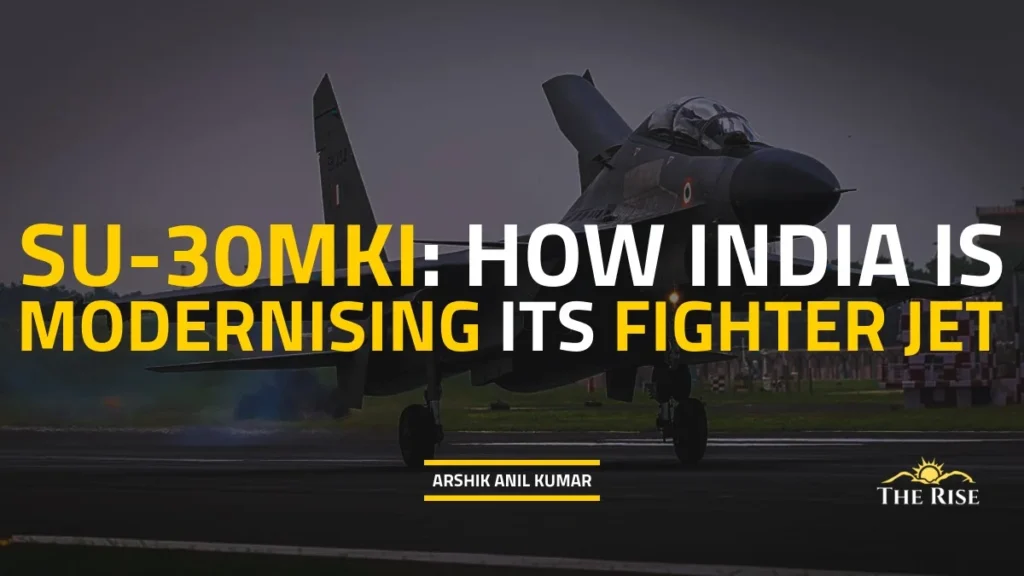
Nobody in the Indian Air Force calls it the Flanker-H. That is NATO’s label for the Su-30MKI, the “H” marking a build made only for India, with forward canards and thrust-vectoring AL-31FP engines. Pilots just say “the Sukhoi” or “the MKI”. The nickname is warm. The question behind it is colder: how much of this jet does India actually own?
India first started looking for a heavy, long-range fighter in the 1990s. It needed a platform that could carry substantial weapons, that could operate over long distances and remain relevant across multiple combat roles. After a long search, they found the answer in an ally, Russia, in the form of the Sukhoi Su-30.
The Su-30 is more than a fighter aircraft; it represents India’s long-running attempt to turn foreign defence technology into domestic industrial capability. Yet it tells a story of the limits of self-reliance when critical resources remain dependent on overseas partners.
From Kits to Know-How
Later in the 2000s, India and Russia agreed to licensed production, which involved transfer of technical documentation and production rights to India, allowing HAL to manufacture the aircraft, engines and associated components. This began to move beyond assembly, towards the development of specialized manufacturing skills and maintenance capacity.[5]
The distinction between the Russian Su-30 and Indian Su-30MKI is clear, as the Ministry of Defence has explained that the MKI incorporates modifications to meet the requirements of the Indian Air Force. Its higher cost reflects technology-transfer fees, lower volumes and imported parts. Its defining feature is its customised configuration, incorporating Indian, Russian, French and Israeli systems.[6][11]
Then came the orders, and the money. The Su-30 programme has expanded throughout these decades, from the 2010 order for 42 aircraft worth ₹15,000 crore [7] to the recent order of additional 12 aircraft worth ₹13,500 crore with more than 62% of indigenous content.[2]
Table 1. Su-30MKI financial timeline, 1996 to present
| Phase | Scope | Approx. value (₹ crore) | Approx. per unit (₹ crore, nominal) |
| 1996 (initial deal) | First direct contract for design, development and supply of 40 baseline airframes (later 50) | 5,122 (airframes); 6,310 (with associated equipment) | ~126 |
| 2000 (ToT framework) | Transfer of technology for licensed manufacture of 140 Su-30MKIs by HAL at Nashik | ~22,000-25,000 | ~157-179 |
| 2007(follow-on batch 1) | 40 additional aircraft kits to cover fleet deficits and expand squadrons | ~7,300 | ~183 |
| 2010-12(follow-on batch 2) | 42 more aircraft kits, structure optimised for heavier payloads such as BrahMos | 15,000 | ~357 |
| Sep 2024 (sustainment) | 240 AL-31FP aero-engines built at HAL Koraput with over 54% local content | 26,964.41 | ~112 (per engine) |
| Dec 2024(attrition order) | 12 new Su-30MKIs with 62.6% indigenous content to replace crash losses | 13,500 | ~1,125 |
| Planned(Super Sukhoi) | DRDO-led Phase 1 upgrade of 84 fighters: Virupaksha AESA radar and advanced EW suite | 60,000-66,829 | ~715-795 (per upgrade) |
Sources: [1,2,3,5,7]. Per-unit figures are the author’s own arithmetic on nominal rupees, not adjusted for inflation or scope.
The Sword Under the Wing
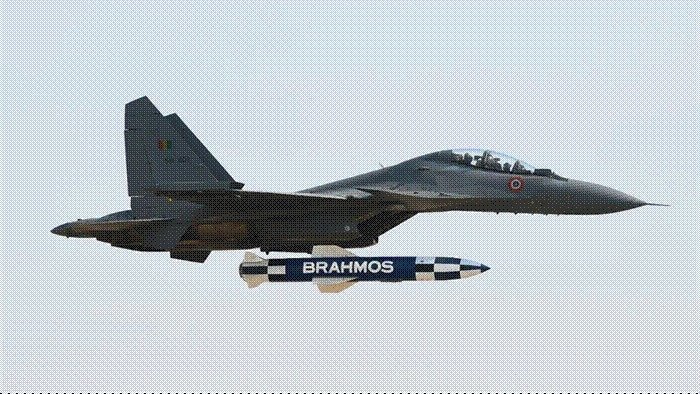
One of the Su-30’s most significant transformations came from integrating India’s celebrated BrahMos air-launched cruise missile. At 2.5 tons, it demanded several modifications to the aircraft. This heavy-weight combination gave India a strategic “sword” capable of striking heavily defended aircraft carriers and land bunkers day or night.[9][14]
Balakot operation in 2019, became a turning point. India, then fast-tracked integration of the indigenous Astra Mark-1 beyond-visual-range (BVR) missile (110 km). DRDO chairman Samir V. Kamat stated that the BrahMos launched from the Su-30MKI was the primary offensive weapon used during Operation Sindoor in 2025.[10]
A Glowing Bulb on Radar
Despite its capabilities, the Su-30MKI was never designed as a stealth aircraft; its large airframe, external weapon-mounted system and overall design make it look like a ‘glowing bulb’ on radars, so full stealth would mean building an entirely new aircraft. India is chasing survivability instead: less radar visibility where possible, better electronic warfare and sharper threat detection through the proposed Super Sukhoi.
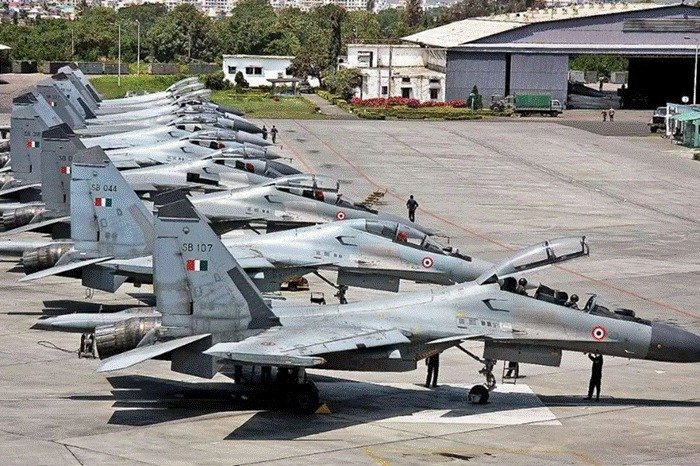
The Super Sukhoi programme represents the most ambitious upgrade planned for the Su-30MKI fleet. Estimated to cost between ₹60,000 and ₹66,829 crore, the project is expected to begin with 84 aircraft, improving radar, avionics, electronic warfare, sensors and weapons. A major feature of the upgrade is the indigenous Virupaksha AESA radar, which could extend detection ranges compared with the aircraft’s current Bars PESA radar. Jammer pods, the Dhruti warning receiver and better missile-approach warnings complete it.[3]
The Engine: Where Independence Stops
The engine is the hardest constraint. A significant development came in September 2024, when the Ministry of Defence ordered 240 AL-31FP engines from HAL under a contract valued at more than ₹26,000 crore.[1] Local content starts above 54% and should reach about 63% by the end of the programme. Engine life is also being stretched from 2,500 to 3,000 flying hours.
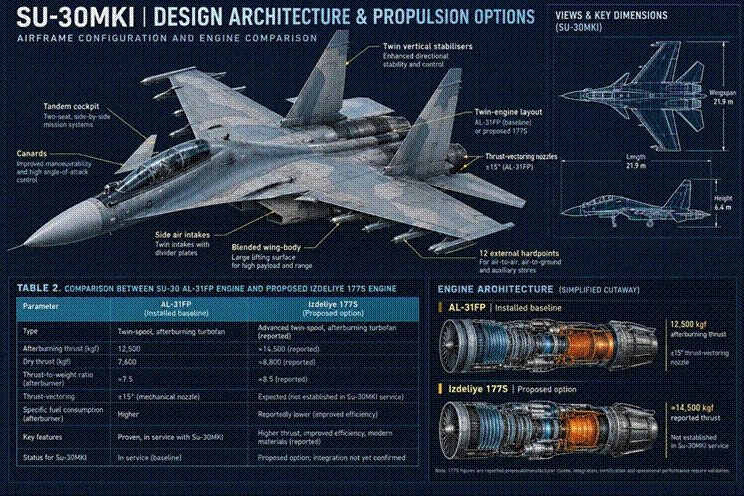
Recently, Russia’s Izdeliye 177S has attracted attention as a possible future propulsion option. Its maker says it keeps the AL-31F/FP dimensions and weight, so it fits a Su-30MKI without many changes. Reports credit it with up to 14.5 tonnes of thrust, a 6,000-hour life and lower fuel burn.[4] However, India hasn’t decided on it yet, as certification, cost, maintenance infrastructure and long-term supply that need to be considered.
Table 2. Comparison between Su-30 AL-31FP engine and proposed Izdeliye 177S engine
| Parameter | AL-31FP (installed baseline) | Izdeliye 177S (proposed, reported) |
| Afterburning thrust | ~12,500 kgf | ~14,500 kgf (about 16% more) |
| Dry thrust | ~7,600 kgf | ~8,800 kgf |
| Service life | ~2,500 hours(extension to 3,000 under way) | 6,000 hours |
| Fuel efficiency | Baseline | Reported lower consumption (about 7%) |
| Weight and inlet | Standard AL-31FP footprint | ~1,530 kg / 905 mm, drop-in fit claimed |
| Thrust vectoring | ±15° mechanical nozzle | Not established in Su-30MKI service |
| Status for Su-30MKI | In service | Proposed option; integration not confirmed |
177S figures are manufacturer and press claims, not validated for Indian service. Sources: [4,15].
Here sits the irony. HAL builds the AL-31FP at home, yet India lacks authority over its thermodynamic core. A stronger engine could mean a deeper tie, not a freer one.
Can AI Keep Them Flying?
As AI becomes more widely used across sectors, defence organisations are also exploring new ways to incorporate it, from manufacturing to operational planning. AI is entering maintenance too. In 2024, an IAF pilot project with IIT Bombay highlighted the use of digital tools and artificial intelligence to improve parts identification and inventory management.[13] In 2026, the initiative was formalised to develop an AI-driven predictive-maintenance model for the Su-30MKI, described as a “virtual engine” that can anticipate faults.[12]
If it works, crews spot trouble earlier, and more jets stay ready. But the system will only be as reliable as the data fed into it. Incomplete maintenance records or gaps in data sharing could reduce its effectiveness. Hardware can be bought. Clean data habits have to be built.
Self-Reliance Without Isolation
The Su-30MKI is only one example of India’s long-standing defence partnership with Russia, while others include the S-400 air-defence system, T-90S Bhishma tanks, Russian-origin frigates and the AK-203 rifles.[15] BrahMos remains the brightest success. India now wants more control over software, engines, sensors and manufacturing. The objective is not to erase the jet’s Russian origins, but to ensure that the next stage of its life depends increasingly on Indian technology, Indian industry and Indian control.
Table 3. Where India’s control stands, layer by layer
| Layer | India’s access and sovereignty status |
| Mission software and computers | Russia long guarded core code. India has built indigenous open-architecture mission computers and tools such as the Weapon Integration Tester, so it can map data buses without foreign source code. |
| Airframe | HAL Nashik holds full manufacturing rights. Structural changes are reinforcing the underbelly and wing hardpoints to carry BrahMos and Rudram missiles. |
| Engine core | HAL builds the AL-31FP with over 54% local content, but design authority over the thermodynamic core stays with Russia. |
| Sensors and electronic warfare | Indigenous Virupaksha AESA radar and a new EW suite are planned under the Super Sukhoi, still awaiting clearance. |
India buys from many countries now, but Russia still sits close to the centre of its defence plans. The S-400 guards the skies, the 11356M frigates serve the Navy, and AK-203 rifles are made in Amethi by the hundred thousand. Russia also lets India build under licence and share know-how, which the West rarely does. Even the gifts say a great deal. Modi once handed Putin a Russian copy of the Tamil Thirukkural, a book on ethics and rule. Small things, but they show trust built up over decades.[15]
So, who owns the Sukhoi? Layer by layer, the answer changes. Software is moving home. The airframe is already there. The engine core is not. A jet is only as free as its weakest layer, and the next decision will show which way India leans.
(Arshik Anil Kumar is TRIP intern)
References
1. Ministry of Defence, Government of India. Aatmanirbharta in defence: MoD signs Rs 26,000 crore contract with HAL for 240 AL-31FP aero engines for Su-30MKI aircraft. Press Information Bureau; 2024 Sep 9. https://www.pib.gov.in/PressReleaseIframePage.aspx?PRID=2053088
2. Ministry of Defence, Government of India. Ministry of Defence signs contract with HAL for procurement of 12 Su-30MKI aircraft. Press Information Bureau; 2024 Dec 12. https://www.pib.gov.in/Pressreleaseshare.aspx?PRID=2083948
3. Rana J. As Super Sukhoi awaits clearance, IAF turns to Russia for parallel Su-30MKI upgrade. The New Indian Express. 2026 Feb 25. https://www.newindianexpress.com/amp/story/nation/2026/Feb/25/iaf-looks-at-parallel-russian-upgrade-as-super-sukhoi-awaits-nod
4. Rostec. UEC first demonstrated the fifth generation 177S aircraft engine in the Middle East. 2025 Nov 19. https://www.rostec.ru/en/media/news/uec-first-demonstrated-the-fifth-generation-177s-aircraft-engine-in-the-middle-east/
5. Ministry of Defence, Government of India. Manufacturing of Sukhoi-30 MKI by HAL. Press Information Bureau; 2011 Nov 23. https://www.pib.gov.in/newsite/PrintRelease.aspx?relid=77406
6. Ministry of Defence, Government of India. SU-30 MK JET: Factors for indigenous manufacturing costs and life cycle cost advantages. Press Information Bureau; 2019 Jan 2. https://www.pib.gov.in/PressReleasePage.aspx?PRID=187051
7. Joseph J. Rs 15,000 crore Sukhoi deal cleared. The Times of India. 2010 Jun 26. https://timesofindia.indiatimes.com/india/rs-15000-crore-sukhoi-deal-cleared/articleshow/6092315.cms
8. Joshi S. How Pakistan planned to hit India back for Balakot – the mission, the fighters, the tactics. ThePrint. 2019 Sep 14. https://theprint.in/defence/how-pakistan-planned-to-hit-india-back-for-balakot-the-mission-the-fighters-the-tactics/291522/
9. Ministry of Defence, Government of India. Successful firing of BrahMos air-launched missile from Su-30 MKI aircraft. Press Information Bureau; 2017 Nov 22. https://www.pib.gov.in/newsite/PrintRelease.aspx?relid=173744
10. Kulkarni S. Sukhoi-30-launched BrahMos was the primary offensive weapon in Op Sindoor: DRDO chief. The Indian Express. 2025 Aug 10. https://indianexpress.com/article/cities/pune/sukhoi-30-brahmos-operation-sindoor-drdo-chief-10179931/
11. Barrie D, Solanki V. Purchasing from a pariah: India’s arms-acquisition dilemma. International Institute for Strategic Studies. 2022 Mar 22. https://www.iiss.org/online-analysis/online-analysis/2022/03/purchasing-from-a-pariah-indias-arms-acquisition-dilemma/
12. Choudhary A. From reactive repairs to predictive power: An AI digital-twin ‘health index’ for the Su-30 MKI. MP-IDSA Issue Brief. 2026 Jul 1. https://idsa.in/publisher/issuebrief/from-reactive-repairs-to-predictive-power-an-ai-digital-twin-health-index-for-the-su-30-mki
13. Singh D. IAF moving towards automation of aircraft maintenance. The Hindu BusinessLine [Internet]. 2024 Nov 3. See also: The Hindu. AI big focus of Su-30MKI upgrade; IAF taking up pilot projects with IIT Bombay, says officer. 2024. https://www.thehindu.com/news/national/ai-big-focus-of-su-30mki-upgrade-iaf-taking-up-pilot-projects-with-iit-mumbai-says-officer/article68826449.ece
14. Gady FS. India test-fires nuclear-capable cruise missile from fighter jet. The Diplomat. 2017 Nov 22. https://thediplomat.com/2017/11/india-test-fires-nuclear-capable-cruise-missile-from-fighter-jet/
15. Firstpost. Russia-India Su-30MKI 177S engine: Super Sukhoi upgrade. 2026 Sep 12. https://www.firstpost.com/business/russia-india-su30mki-177s-engine-super-sukhoi-14045149.html
About the author

Arshik Anil Kumar is an aspiring policy professional with an M.A. in Public Policy, Law & Governance from Central University of Rajasthan. He is currently a TRIP intern.