While some restrictions may be necessary and lawful to protect national security and public order, their scope and application must remain constitutionally justified to prevent the suppression of legitimate dissent. The distinction, therefore, lies between what the government is legally permitted to do and what it can reasonably justify.
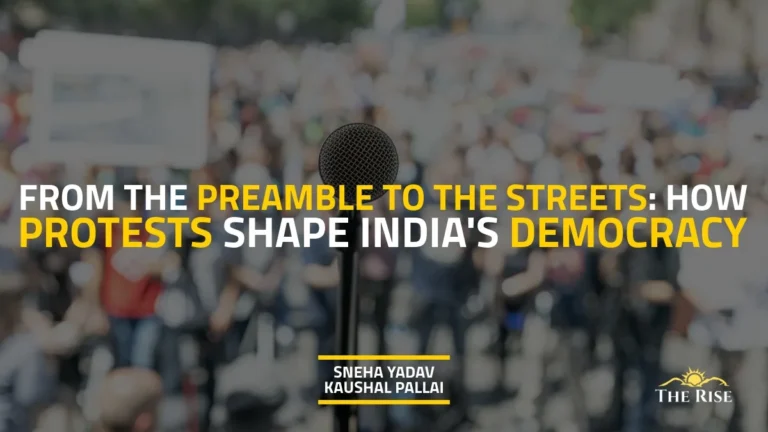
In his Gettysburg Address in 1863, Abraham Lincoln described democracy as a government “of the people, by the people, for the people” (1). Democracy is not just about elections. It is much more than that. Basu and Sen emphasise that democracy requires not only freedom to participate, but also the freedom to criticise or disagree with the government (2). But a key question does remain: what is the level of dissent a country can accomodate within itself?
The form of dissent we see today is different from what it was decades ago. Dissent was once largely associated with the streets and universities campuses, it has now reached social media. While self-censorship continues to exist in one form or another, the harder question that concerns is the dilemma that the state faces in balancing two core values, that is, security and liberty. On the one hand, freedom of expression must be protected, but at the same time, the state needs to ensure that this expression does not raise concerns with regards to security and public order.
That is where the Unlawful Activities (Prevention) Act (UAPA), 1967, enters the debate. It faces critical evaluation due to a potential chilling effect, as the strict provisions as well as the prolonged proceedings can discourage legitimate dissent. The tension between constitutional safeguards and the expansive operation of anti-terror legislation that points towards the unresolved questions within the legal and judicial spheres(3).
Further, there are concerns about the implications of stringent anti-terror laws for individual liberty, particularly when cases involve prolonged pre-trial detention. Contradictions are also visible in Supreme Court judgments, which open up multiple dimensions to this ongoing debate. In National Investigation Agency versus Zahur Ahmed Shah Watali (2019), the Supreme Court examined the stringent bail standard under the UAPA, highlighting the implications that such provisions can have regarding individual liberty (5).
In countries like the United Kingdom, counter-terrorism powers also exist. But the major challenge that remains is to safeguard civil liberties through judicial oversight as well as proportionality. Beyond the UAPA, other forms of state restrictions including internet shutdowns, which are increasingly used in the name of public order and national security has also become a matter of concern.
The policy gap remains the real problem. The challenge is how the government maintains a balance by ensuring that dissent does not threaten the public order or national security, while upholding the Constitution and protecting the liberty of citizens.
The main emphasis of courts have remained upon upholding proportionality as a vital element of the constitutional standard for ultimately reviewing the state restriction (12). The actions that are undertaken by the government should not be harsher than necessary, because a legitimate objective alone does not make a restriction constitutionally justified. Proper due process, must be followed before restricting someone’s freedom.
This brings us to one of the questions that is very important: the question of legitimate versus excessive restrictions. Because while some restrictions may be necessary and lawful to protect national security and public order, their scope and application must remain constitutionally justified to prevent the suppression of legitimate dissent. The distinction, therefore, lies between what the government is legally permitted to do and what it can reasonably justify.
Institutions are an arena for testing the promise of constitutional freedom. Courts, Parliament, the police, universities and the media all have roles in this process. The role of these institutions is not merely limited to implementing restrictions on the freedom of expression, but also acting as safeguards to uphold the constitutional rights.
The digital frontier presents a new paradox for contemporary dissent. Social media has democratised speech by allowing people’s dissenting views to reach a wider section of society. But what is the paradox? Is all this information on the social media genuine? Can it create misinformation? What policy challenges arise in regulating these digital spaces?
The main prevailing danger is not only the restriction of speech, but also its consequences. Individuals may begin restricting their own expression out of fear, creating a chilling effect that undermines participatory democracy. Choosing between liberty and security is not the real issue. Rather, the challenge is to ensure that one is not used as pretext for undermining the other one. Restrictions are necessary in today’s world where genuine security threats exist, but they must be used in a proportionate and justified manner.
Dissent is much more than simply allowing disagreement. It does require creating spaces, institutional and social, where every citizen can express themselves freely without any fear. Thus, the strength of Indian democracy will be tested not only by the absence of dissent, but by its ability to accommodate this disagreement while at the same time maintaining public order and upholding constitutional values.
References
- Lincoln A. Gettysburg Address [Internet]. 1863 Nov 19 [cited 2026 Oct 16]. Available from: https://www.abrahamlincolnonline.org/lincoln/speeches/gettysburg.htm
- Basu S, Sen S. Silenced voices: unravelling India’s dissent crisis through historical and contemporary analysis of free speech and suppression. Information & Communications Technology Law. 2024;33(1):42-65. doi:10.1080/13600834.2023.2249780.
- Sethi M. Tenuous legality: tensions within anti-terrorism law in India. Socio-Legal Review. 2017;13(2):139-158. doi:10.55496/YLPX5170.
- Suresh M. The slow erosion of fundamental rights: how Romila Thapar v. Union of India highlights what is wrong with the UAPA. Indian Law Review. 2019;3(2):212-223. doi:10.1080/24730580.2019.1640593.
- National Investigation Agency v. Zahoor Ahmad Shah Watali [Internet]. Supreme Court of India; 2019 Apr 2 [cited 2026 Oct 16]. Available from: https://indiankanoon.org/doc/117627977/
- Justice K.S. Puttaswamy (Retd.) v. Union of India [Internet]. Supreme Court of India; 2017 Aug 24 [cited 2026 Oct 16]. Available from: https://api.sci.gov.in/supremecourt/2012/35071/35071_2012_Judgement_24-Aug-2017.pdf
- Ministry of Home Affairs, Government of India. Unlawful Activities (Prevention) Act cases: cases registered, persons under trial and persons convicted [Internet]. New Delhi: Government of India; 2022 Jul 20 [cited 2026 Oct 16]. Available from: https://www.mha.gov.in/MHA1/Par2017/pdfs/par2022-pdfs/RS20072022/383.pdf
- Puneeth P. The law of ‘sedition’ in India: a looming threat to freedom after speech. Social Change. 2023;53(4):543-549. doi:10.1177/00490857231203351.
- Bhardwaj S, Nayak N, Dandamudi RVK, Singh S, Handa V. Rising internet shutdowns in India: a legal analysis. Indian Journal of Law and Technology. 2020;16(1):122-158. doi:10.2139/ssrn.3758553.
- Momen MN, Harsha S, Das D. Mediated democracy and internet shutdown in India. Journal of Information, Communication and Ethics in Society. 2021;19(2):222-235. doi:10.1108/JICES-07-2020-0075.
- Sahoo S. India’s internet shutdowns as biopolitics: the formation of political will and opinion through collective action under attack. Critical Studies in Media Communication. 2023;40(5):291-305. doi:10.1080/15295036.2023.2265995.
- Chandrachud A. Wednesbury reformulated: proportionality and the Supreme Court of India. Oxford Journal of Commonwealth Law. 2013;13(1):191-208. doi:10.5235/14729342.13.1.191.
About the author

Kaushal Pallai is pursuing his Master’s in Political Science at the University of Delhi. He is currently a TRIP intern.