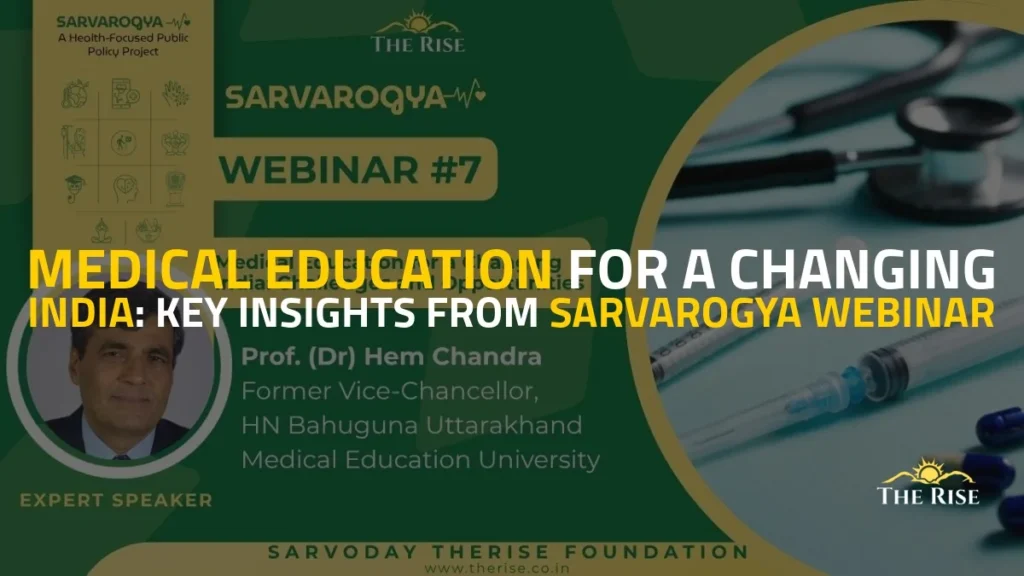
The webinar titled “Medical Education for a Changing India: Challenges and Opportunities” was organized by Sarvoday TheRise, a public-policy think tank based in Lucknow, under its initiative SarvArogya, which is a public-health-focused research initiative.
Medical education cannot be measured only by the number of colleges we build or the number of graduates we produce. The success must ultimately be measured by the quality of care that reaches the patient. While India has made remarkable progress in expanding medical education, there still exists a gap.
This was the core argument at the webinar titled “Medical Education for a Changing India: Challenges and Opportunities” organized by Sarvoday TheRise Foundation, a public-policy think tank based in Lucknow under its initiative SarvArogya, which is a public-health-focused research initiative. Prof. (Dr) Hem Chandra, former Vice-Chancellor, HN Bahuguna Uttarakhand Medical Education University, graced the webinar as a speaker. The webinar was attended by the Project Director, Sneha Yadav, and the foundation’s interns.
The webinar began with a key emphasis on the evolving landscape of medical education in India. Dr. Chandra started his talk by providing a foundational overview of the regulatory landscape of medical education in India, noting the transition from the Medical Council of India to the National Medical Commission (NMC) as a step towards streamlining governance.
He highlighted that despite remarkable expansion in the number of medical colleges and doctors, India continues to grapple with inadequate access to quality care. Dr. Chandra noted that a significant part of the challenge lies in recruitment and deployment. In several states, lower government budgets, poor infrastructure, and inadequate residential facilities for doctors have made public health postings unattractive.
Dr. Chandra further pointed out that a significant shortage of skilled faculty, particularly in pre-clinical and para-clinical departments like anatomy, physiology, and pathology, threatens the quality of foundational learning. This shortage is exacerbated by the tendency of talented professionals to migrate toward the corporate sector, where compensation and infrastructure are often better. “In our time, the top MBBS student selected pediatrics or medicine as their specialization. For women, it was gynecology and obstetrics. Now generally the top rankers select radiology. The reason it is a highly paid branch, where you are picked up by the corporate world,” he said, emphasizing the shifting aspirations of medical graduates. With rapid technological advancement and increasing specialisation, while some doctors are gravitating towards super-specialisations, others are entering administrative services.
Dr Chandra also highlighted that the teacher-student relationship was once rooted in the traditional guru-shishya model, where teachers could mentor students without fear. Today, that relationship has weakened. Increasing politicisation, unionisation, and external interference have made it difficult for faculty to even correct or discipline students.
He further observed, “People are not coming to join the medical faculty. Why are they not joining? The reason is that in the corporate world, after specialization immediately receive much higher salaries compared to being a faculty member in a medical college, emphasizing that new medical colleges are facing a deficit in terms of faculty members. “Of the 22–23 AIIMS institutions currently operational, all except the Delhi AIIMS are functioning with only about 50 percent of their required faculty strength,” he added. Prof. Chandra attributed this not only to structural factors, but also to a cultural shift: growing intolerance, tough legal pressures, and social and political threats have pushed faculty away from teaching, eroding the traditional guru-shishya relationship that once defined medical education in India.
The webinar concluded with an interactive Q&A session where participants and attendees had the opportunity to engage directly with Dr. Hem Chandra. He argued that what India needs is not just more medical colleges, but better-equipped institutions with adequate faculty, functional infrastructure, and an environment that nurtures both learning and service.
(Article by Ayushi Nigam)