
India will probably see several transitions in the coming years. Electric mobility, biofuels, renewable energy, digital payments and other technologies will all move from early adoption towards mass use. The lesson is simple. Do not measure a transition only by how quickly people adopt the new thing. Look at how quickly the ecosystem around that choice is becoming ready. In economics, the strongest change is the one that sustains itself after the initial push is over.
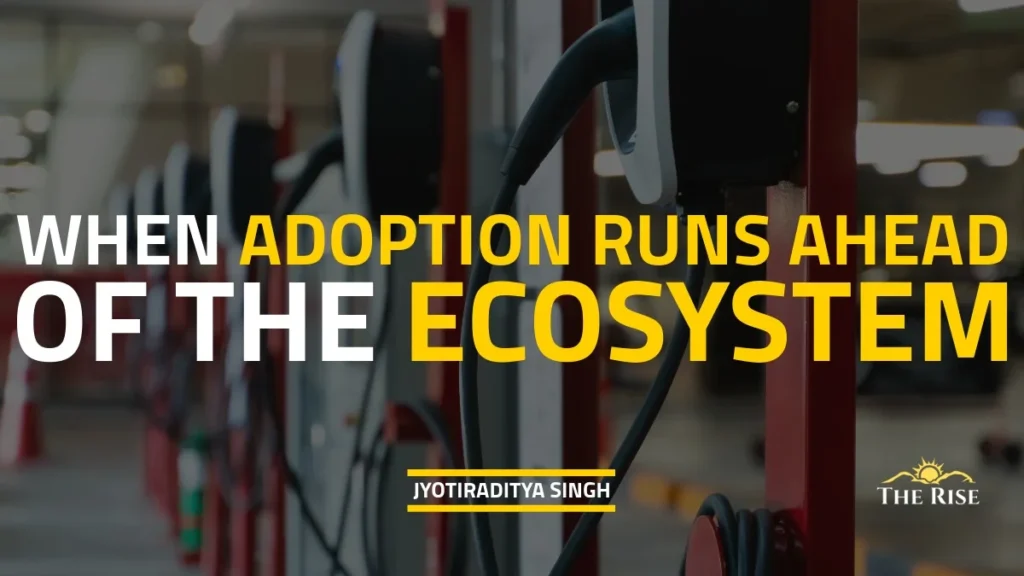
As a student of economics and a marketing graduate I have always found one question more interesting than the headline number. What happens after the consumer says yes? A new technology can attract buyers quickly. A policy can create a target quickly. But the ecosystem around that decision takes much longer to mature. That is why the recent discussion around Electric Vehicle (EV) adoption and charging infrastructure caught my attention. The real story is not simply that more Indians are buying EVs. The real story is the gap that can emerge between adoption and the infrastructure needed to make that adoption comfortable.
As per statistics, this gap is visible across the country. While some states have seen strong EV adoption, the charging infrastructure and its usage remain uneven. The Bureau of Energy Efficiency also identifies adequate charging infrastructure as a key requirement for accelerating electric mobility. This matters because a vehicle is never just a vehicle. It is part of a larger consumption system involving electricity supply, charging points, financing, service networks, batteries, parking and consumer confidence.
From a basic economics perspective, this is a coordination problem. Consumers wait for infrastructure before they fully commit. Businesses wait for enough consumers before investing heavily in infrastructure. Governments then try to push both sides at once. This can create a familiar situation. Demand begins moving first while supply around that demand catches up later. The result can be impressive adoption figures alongside an experience that still feels inconvenient in many places.
Also Read: The Hidden Carbon Cost of Electric Vehicles: A Life-Cycle Look at India’s EV Revolution
There is an interesting parallel in the ethanol transition. Ethanol blending has moved steadily upward to 12.06% in ESY 2022-23, 14.60% in ESY 2023-24 and 17.98% in ESY 2024-25. But unlike EV charging, the challenge here is less visible to the consumer because the infrastructure already exists in the form of petrol pumps and fuel distribution networks.
But that does not mean ethanol required no ecosystem building. It did. The transition required changes in fuel supply chains, production capacity, vehicle materials and engine calibration. The NITI Aayog roadmap specifically discussed the need for E20 compatible vehicles and a gradual transition from older fuel standards. It has also stated that material compatibility with E20 was achieved from April 2023 and that E20 tuned vehicles were to be rolled out from April 2025. In other words, the ethanol story is also a story about sequencing technology with the system around it.
This is where a larger economic lesson lies. A policy target is only one part of a market transition. The other part is capacity. If demand is pushed faster than capacity, the consumer eventually experiences the mismatch. If capacity is created too early without enough demand, businesses carry the cost of unused investment. The efficient path sits somewhere between these two extremes. It requires enough confidence for companies to invest and enough infrastructure for consumers to trust the new technology.
Marketing teaches a similar lesson in a different language. A customer does not buy a promise forever. They buy an experience. An EV advertisement can talk about lower running costs and cleaner mobility but the customer still might want to know where the next charger is. An ethanol policy can set a blending target but the driver still wants a vehicle and fuel system that work as expected.
This is also why state level differences deserve more attention. India is a large and uneven market. The economics of electric mobility in a dense metropolitan region is very different from a smaller city or a rural district. Income levels, travel patterns, electricity availability, parking arrangements and commercial activity all shape the viability of infrastructure. A single national target can create direction. The actual market outcome depends heavily on local conditions.
There is another point worth remembering. Infrastructure is not simply about quantity. It is also about location, reliability and utilisation. A thousand charging points concentrated in places where people rarely travel may create a very different outcome from a smaller network placed along high demand routes. The same principle applies to energy supply and fuel distribution. Capacity becomes economically useful when it is available at the right place and at the right time.
The EV and ethanol examples therefore should not be treated as arguments for one technology over another. They are better understood as examples of how transitions work. EVs require charging networks and power systems that grow with adoption. Ethanol requires production capacity, distribution, compatible vehicles and clear standards that move together. The technologies are different but the economic question is similar: can the supporting ecosystem keep pace with the policy ambition and consumer demand?
This gap between adoption and ecosystem is important to understand. Growth looks impressive when measured through registrations, sales or blending percentages but sustainable growth is visible only when the surrounding system starts working naturally. That is when consumers stop thinking about whether the infrastructure exists and simply use it. That is when a transition moves from being a policy project to becoming an ordinary part of the market.
India will probably see several such transitions in the coming years. Electric mobility, biofuels, renewable energy, digital payments and other technologies will all move from early adoption towards mass use. The lesson from EVs and ethanol is simple. Do not measure a transition only by how quickly people adopt the new thing. Look at how quickly the ecosystem around that choice is becoming ready. In economics, the strongest change is rarely the one that happens fastest. It is the one that can sustain itself after the initial push is over.
Disclaimer: The views expressed in this article are those of the author solely. TheRise.co.in neither endorses nor is responsible for them. Reproducing this content without permission is prohibited.
References
About the author

Jyotiraditya Singh is a youth leader and social activist passionate about youth participation, public policy, education, employment and political accountability. He is actively involved in student and youth initiatives.



A very insightful perspective on India’s ongoing transition towards EVs and ethanol. The point that adoption alone does not define the success of a transition is particularly relevant. A technology can grow rapidly, but without the right infrastructure, capacity, reliability and consumer confidence, that growth may not be sustainable.
The comparison between EV charging infrastructure and ethanol’s supporting ecosystem also highlights an important economic principle: policy ambition and market readiness need to move together. Sustainable transitions are ultimately built not just on adoption, but on the strength of the ecosystem supporting it.
A thought-provoking read with a strong economic and policy perspective.
The author has done an excellent job of connecting economic theory with real-world developments in India’s energy transition. What particularly stands out is the ability to look beyond adoption numbers and highlight the importance of infrastructure, market readiness and consumer confidence. The comparison between EVs and ethanol makes the argument even more compelling. A well-researched piece, reflecting the author’s clarity of thought, analytical depth and strong understanding of economics and public policy. Truly appreciate this perspective
A very insightful piece. What stands out is the way the article goes beyond adoption numbers and looks at the ecosystem required to make a transition sustainable. The comparison between EVs and ethanol makes the economic argument especially clear policy ambition, consumer demand and infrastructure have to grow together. A thoughtful perspective on how India’s energy transitions should be measured.
A very insightful and well structured piece. I particularly liked how the article moves beyond adoption numbers and focuses on the ecosystem required to make technological transitions sustainable. The comparison between EVs and ethanol makes the economic argument very clear. A strong perspective on how policy, infrastructure, consumer confidence and market readiness need to move together.
This piece hits the nail on the head. We get so caught up chasing headline numbers whether it is EV sales milestones or blending percentages—that we completely overlook whether the ground reality can actually support the surge.
The comparison between electric vehicles and ethanol is spot-on. EVs stall out because drivers are left scrambling for functional charging stations, whereas ethanol hides its growing pains behind pre-existing petrol pump networks, even if the real grind is happening quietly behind the scenes in engine manufacturing and supply chains.
At the end of the day, a flashy policy target or a quick adoption spike means nothing if the underlying ecosystem isn’t keeping pace. True progress isn’t about how fast a trend catches on; it’s about whether the system has the legs to sustain it once the initial hype fades.
A very insightful piece jyotiraditya . I really liked how you moved beyond adoption numbers and focused on the ecosystem needed to sustain real change. The EV and ethanol comparison makes the economic argument simple and relevant.