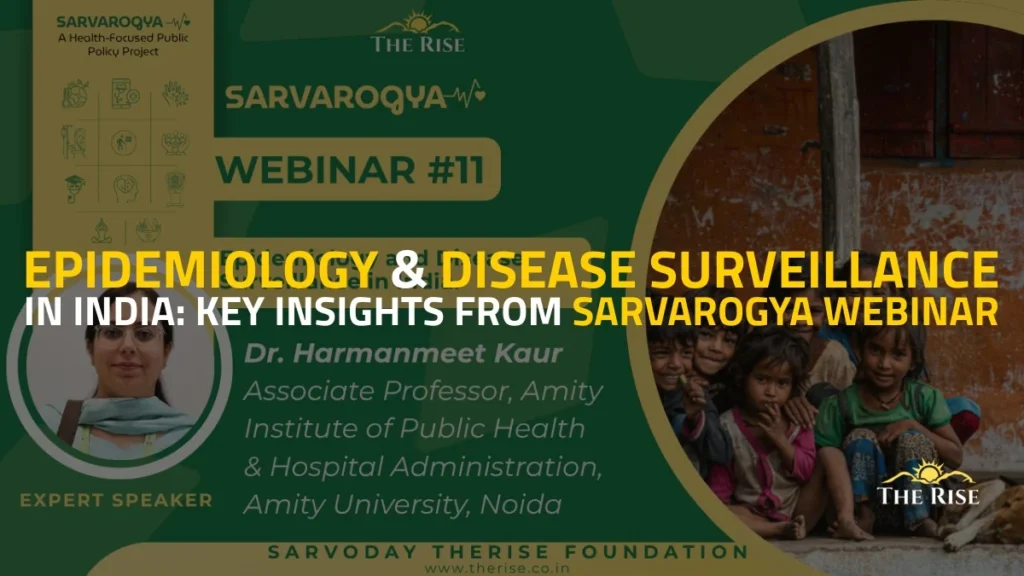
The webinar titled “Epidemiology and Disease Surveillance in India” was organised by Sarvoday TheRise Foundation, a public-policy think tank based in Lucknow, under its initiative SarvArogya, which is a public-health-focused research initiative.
When was the last time we wondered how a disease outbreak was first detected? Before a health crisis makes headlines, a clinician may offer the first warning, while recognising how that individual case connects to a wider community is central to the work of epidemiologists, whose expertise is vital to safeguarding public health. This includes effective surveillance and reliable data collection, which has helped India overcome diseases such as polio and smallpox. These contributions and the detailed know-how are exactly what formed the focus of the recent webinar by Dr Harmanmeet Kaur, Associate Professor at the Amity Institute of Public Health & Hospital Administration, Amity University, Noida. The expert enlightened the audience on the topic Epidemiology and Disease Surveillance in India.
The webinar began with simply defining epidemiology as the study of how diseases are distributed and what determines health status in specific populations. In everyday terms, it is the practice of looking at the “community as a patient“, said Dr. Kaur emphasizing on the concept of the epidemiological triad, which connects the agent (the germ or pathogen), the host (the person and their immunity/age), and the environment (sanitation, water, and climate).
Dr Kaur also explained how the Integrated Disease Surveillance Program (IDSP) tracks disease patterns while Intergrated Health Information Platform (IHIP) enables faster digital reporting. She gave the example of Nipah outbreaks in Kerala and how tracing contacts, enabling rapid response teams, helped to contain the spread significantly.
Further, Dr Kaur drew attention to structural gaps that limit effective surveillance. One needs to be aware not only of medical surveillance but also of the gaps that are yet to be met. Private Healthcare facilities often leave incomplete reporting outside the system, which creates an incomplete and unclear picture of disease spread. Secondly, there is a shortage of trained personnel, further affecting the capacity to collect and act on health data significantly. Meanwhile, disease programs operating through separate reporting systems make it difficult to bring information together as the data is fragmented, which was alarmingly noticed during COVID times. These gaps can delay the identification of outbreaks and the response they require, highlighting the need of a digital ecosystem with stronger coordination.
Looking ahead, Dr Kaur noted the importance of a One Health approach, thereby connecting human, animal and environmental health. There was an interactive Q&A session after the enlightening lecture discovering the potential of artificial intelligence, citing its use in diabetes care, and the greater integration of digital health systems as remarkably shown in the pandemic. Additionally, the discussion further highlighted training for ASHA and Anganwadi workers, whose community presence is vital for early, ground-level detection of cases. Building this capacity requires sustained investment in people, reporting systems and cooperation across institutions, strengthening India’s preparedness for future health emergencies.
(Article by Dishita Pandhi)