
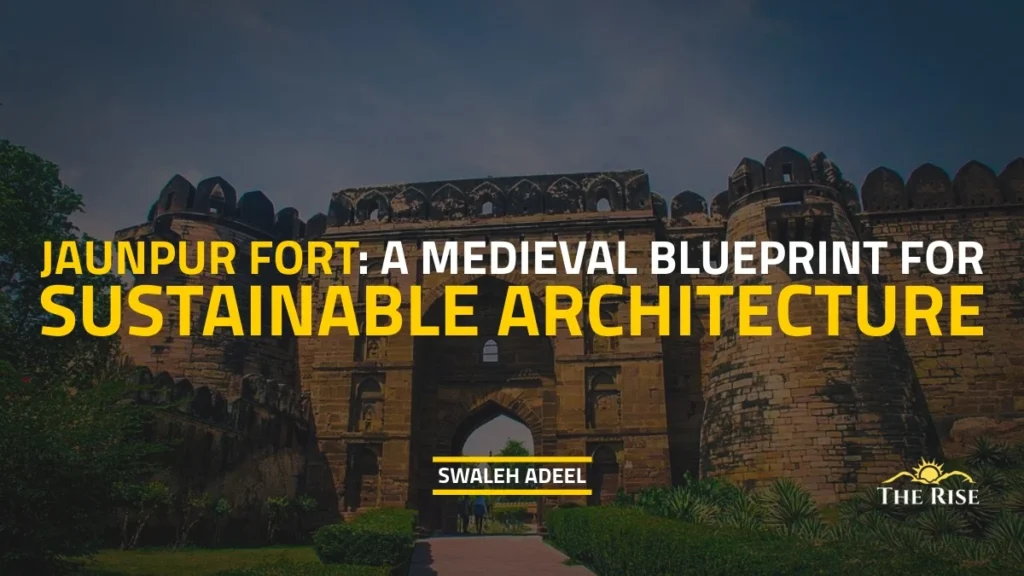
As architects across the globe search for more sustainable ways to build, monuments like Jaunpur Fort remain a classic example of enduring architectural solutions that existed in the past.
Long before sustainability became a global concern, centuries-old monuments were designed to work with nature rather than against it. One such example is Jaunpur Fort, a fourteenth-century monument situated on the banks of the Gomti River, where the local climate and environmental conditions were integrated into the architectural designs.
The relevance of such climate-responsive architecture has grown in recent decades, as the environmental impact of the building sector has come under scrutiny. According to the Global Status Report for Buildings and Construction 2023 published by the United Nations Environment Programme (UNEP), the building and construction sector accounts for nearly 37% of global energy- and process-related carbon dioxide (CO₂) emissions.
As architects across the globe search for more sustainable ways to build, monuments like Jaunpur Fort remain a classic example of enduring architectural solutions that existed in the past.
Climate-Responsive Architecture
Positioned along the banks of the Gomti River, the Jaunpur Fort, which is also known as the Shahi Qila, was built by Ibrahim Naib Barbak in 1362 CE, a chieftain of Firuz Shah Tughlaq. The Fort was built on an elevated artificial mound. This elevated site not only provided a better vantage point for surveillance and defence but also protected the fort from degradation due to seasonal flooding of the Gomti River.
The medieval architects further extended this climate-responsive approach to the fort’s construction materials and structural design. The fort’s stone walls served more than a defensive function. Their high thermal mass features absorbed heat slowly during the day and released it gradually after sunset, thus naturally regulating indoor temperature. The internal layout of the fort further enhanced its environmental performance. The arrangement of gateways, open courtyards, and spacious internal areas provided passage for natural air circulation, improving thermal comfort. At a time when modern buildings rely on energy-intensive air-conditioning systems, Jaunpur Fort demonstrates how architecture itself can become a cooling mechanism.
Moreover, construction techniques were adopted to improve the fort’s durability. Locally available stone and lime mortar were used in the construction. Lime mortar allowed the walls to breathe by permitting moisture to escape, reducing trapped dampness and enhancing the structure’s longevity. This approach was complemented by the use of battered or sloping walls. Instead of rising vertically, these walls slope outward at the base. While this design distributed the fort’s weight more evenly, improving structural stability, it also enabled rainwater to drain away, preventing water accumulation around the foundations and reducing the risk of erosion and weathering.
Conclusion
However, the monument today faces growing threats from natural erosion, illegal soil excavation, encroachment, and inadequate conservation efforts. These challenges not only threaten the fort’s structure, but also risk erasing centuries of architectural knowledge embedded within its architecture.
As the world seeks more sustainable approaches to construction, Jaunpur Fort serves as a reminder that, despite enduring centuries of environmental stress, it continues to demonstrate the effectiveness of climate-responsive architecture. In an era of rising temperatures and increasing carbon emissions, these lessons from the past may prove invaluable for building a more sustainable future.
(Swaleh Adeel is an intern under TRIP)
About the author

Swaleh Adeel is a student of Spanish and Latin American Studies at Jamia Millia Islamia, with a minor in History. He is currently a TRIP intern.
-
This author does not have any more posts.

Sneha Yadav is an electronics engineer with a postgraduate degree in political science. Her interests span contemporary social, economic, administrative, and political issues in India. She has worked with CSDS-Lokniti and has been previously associated with The Pioneer and ThePrint.
-
Sneha Yadav

-
Sneha Yadav
-
Sneha Yadav
-
Sneha Yadav
-
Sneha Yadav
-
Sneha Yadav
-
Sneha Yadav
-
Sneha Yadav
-
Sneha Yadav
-
Sneha Yadav
-
Sneha Yadav
-
Sneha Yadav
-
Sneha Yadav
-
Sneha Yadav
-
Sneha Yadav
-
Sneha Yadav
-
Sneha Yadav
-
Sneha Yadav
-
Sneha Yadav
-
Sneha Yadav
-
Sneha Yadav
-
Sneha Yadav
-
Sneha Yadav
-
Sneha Yadav
-
Sneha Yadav
-
Sneha Yadav
-
Sneha Yadav
-
Sneha Yadav
-
Sneha Yadav
-
Sneha Yadav
-
Sneha Yadav
-
Sneha Yadav
-
Sneha Yadav
-
Sneha Yadav















































































A very informative article, beautifully written.
Proud to see Jaunpur’s architectural legacy being highlighted. Our heritage truly holds timeless wisdom.