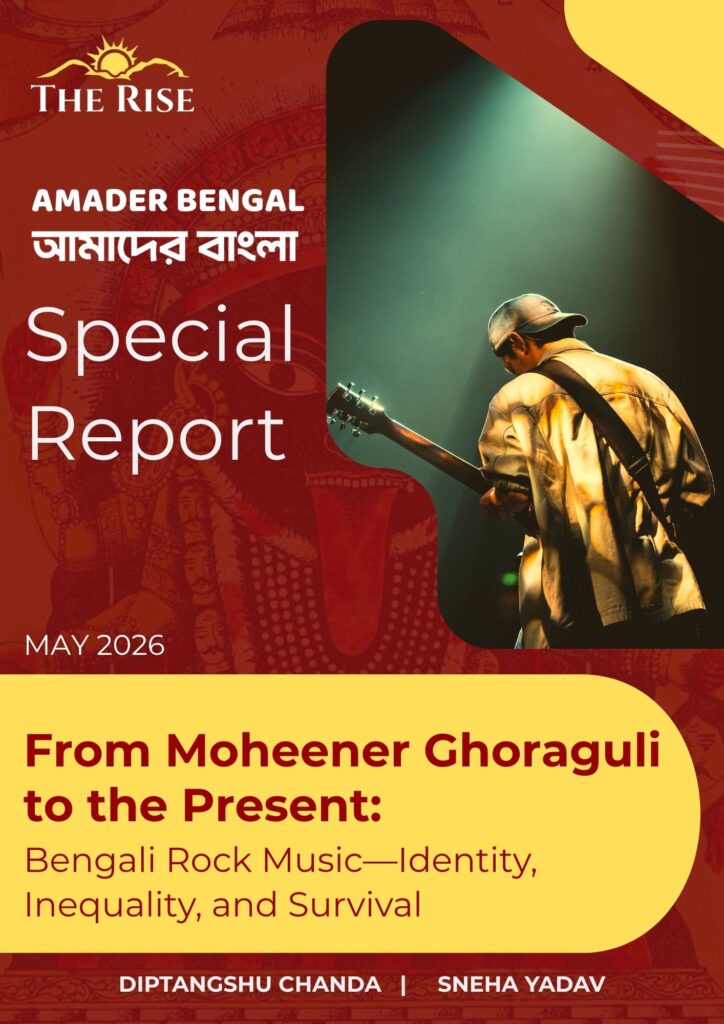
An expression of struggle, an act of rebellion, a voice of defiance; in one word – revolution. That is what rock music stands for. Throughout history, rock music has often been the most romantic and violent, comforting and outrageous, beautiful and gruesome form of art. Over time, it has been symbolic of challenging the status quo, fighting for justice, and raising a voice against societal norms.
Rock music has the distinct characteristic of being both global and local. Drawing our focus to the Indian subcontinent, rock music had its inception in the 1970s in West Bengal. Bengal has had a long history of rigid cultural forms rooted in Rabindra Sangeet, Hindustani classical traditions, and diverse folk genres, which primarily talked about local lives and spiritual connections. These forms had been widely accepted as the markers of Bengali refinement and intellectual identity, enjoying institutional patronage and social prestige. The emergence of rock against this backdrop thus served as a cultural rupture.
This study examines the evolution, socio-economic dynamics, and policy environment of Bengali rock music in West Bengal, situating it within broader debates on culture, identity, and creative labour. Beginning with the emergence of Moheener Ghoraguli in the 1970s, the study traces how rock music developed as a counter-cultural response to dominant musical traditions and later evolved into a distinct urban subculture.
The analyses highlight that despite cultural visibility and a dedicated audience base, Bengali rock operates within fragmented income structures, limited institutional support, persistent gender imbalances, and unequal access to digital and global music markets.
Further, the study evaluates the existing cultural and music policy framework in West Bengal and India, identifying a significant gap between the institutional support extended to traditional art forms and the relative exclusion of contemporary genres such as rock. It argues that this imbalance, combined with market and infrastructural constraints, has limited the genre’s growth and global reach.
In response, the study proposes the BRIDGE framework—a policy model that focuses on financial backing, rights access, infrastructure development, digital integration, global outreach, and ecosystem development to support the rock music industry. This framework aims to address systemic gaps and enable more equitable participation in the cultural economy.
By integrating historical analysis, socio-economic inquiry, and policy evaluation, the study concludes that Bengali rock represents a form of cultural resilience sustained amid economic precarity, and that its future depends on more inclusive and adaptive cultural policy frameworks.
Get a hard copy delivered at your doorstep:
Terms & Conditions:
- Order cancellation procedure: Mail at support@therise.co.in requesting order cancellation with a valid reason within the first 24 hours of order placement. The payment receipt must be mandatorily attached, without which no order cancellation request will be entertained.
- Returns/Replacement: No return/replacement is possible
- Refunds: The complete amount is refundable if the order cancellation request is received at support@therise.co.in within the first 24 hours of the order placement. Refund will be issued in 5-7 working days.
About the author
Diptangshu has completed his MSc in Economics with a specialization in Geopolitics and Geoeconomics at the Gokhale Institute of Politics and Economics and holds a BA (Honours) in Economics from Jadavpur University. He is currently an Amader Bengal intern.
-
This author does not have any more posts.

Sneha Yadav is an electronics engineer with a postgraduate degree in political science. Her interests span contemporary social, economic, administrative, and political issues in India. She has worked with CSDS-Lokniti and has been previously associated with The Pioneer and ThePrint.
-
Sneha Yadav

-
Sneha Yadav
-
Sneha Yadav
-
Sneha Yadav
-
Sneha Yadav
-
Sneha Yadav
-
Sneha Yadav
-
Sneha Yadav
-
Sneha Yadav
-
Sneha Yadav
-
Sneha Yadav
-
Sneha Yadav
-
Sneha Yadav
-
Sneha Yadav
-
Sneha Yadav
-
Sneha Yadav
-
Sneha Yadav
-
Sneha Yadav
-
Sneha Yadav
-
Sneha Yadav
-
Sneha Yadav
-
Sneha Yadav
-
Sneha Yadav
-
Sneha Yadav
-
Sneha Yadav
-
Sneha Yadav
-
Sneha Yadav
-
Sneha Yadav
-
Sneha Yadav
-
Sneha Yadav
-
Sneha Yadav
-
Sneha Yadav
-
Sneha Yadav
-
Sneha Yadav