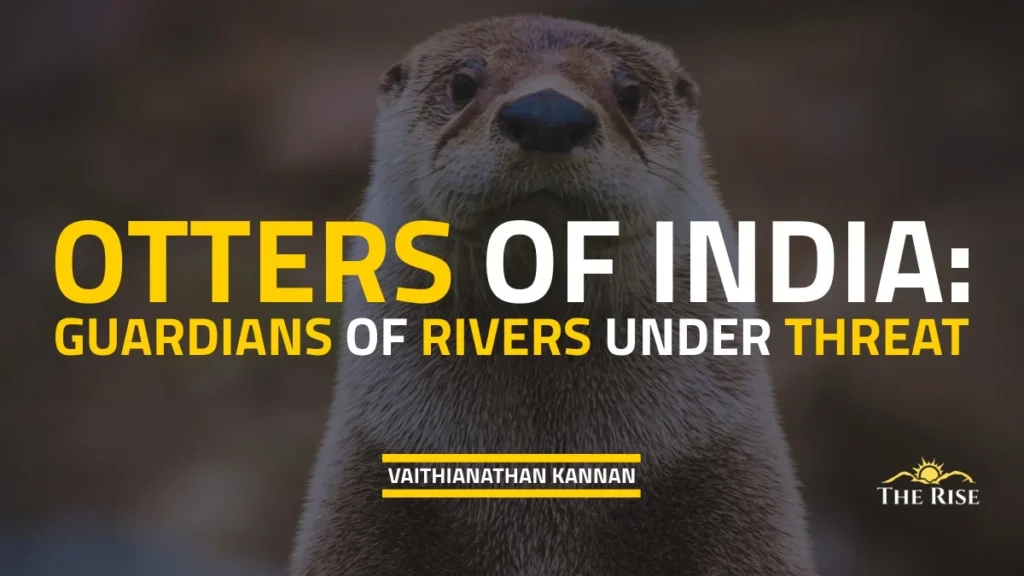
Healthy otter populations usually indicate clean water, abundant fish populations, stable riverbanks, thriving wetlands, and balanced ecosystems. Yet unlike elephants, tigers, peafowl, or snakes, otters never became central symbols in mainstream Indian culture. Perhaps that is part of the problem. Conservation often follows visibility. Animals that remain hidden from public imagination are easier to neglect.
At dawn, along a mist-covered river in the Western Ghats, the water suddenly breaks into laughter. A sleek brown head appears for a second, then disappears. Another follows. Ripples spread like rings of silver. A fish leaps. There is a whistle, a chirping sound, and then complete silence again. Most people walking past such a river may never notice it. But the river knows. The river remembers its otters.
Otters are among the most charismatic and intelligent mammals on Earth. They slide on muddy banks, crack open shells, wrestle with siblings, and swim with an elegance that makes them appear born from flowing water itself. Across the world, otters have fascinated people for centuries. In India too, they once flourished in rivers, mangroves, lakes, estuaries, and wetlands from the Himalayas to the coastal backwaters. Today, however, these secretive guardians of freshwater ecosystems are vanishing quietly.
Few Indians realise that our rivers still shelter three species of otters. Even fewer understand that these animals are warning signals of ecological collapse. Where otters disappear, rivers are usually already dying. This is the story of India’s otters, their beauty, mystery, ecological importance, and the urgent need to save them.
Otters: Nature’s River Engineers
Otters belong to the family Mustelidae, which also includes weasels, martens, ferrets, and badgers. But unlike many of their terrestrial relatives, otters evolved into highly specialised aquatic hunters. Their bodies are masterpieces of hydrodynamic engineering, with streamlined forms for swimming, dense fur that traps air for insulation, webbed feet for propulsion, sensitive whiskers capable of detecting prey underwater, powerful tails that function like rudders, and sharp teeth designed for catching slippery fish. Otters are semi-aquatic mammals, meaning they depend both on land and water. Rivers are not merely places where they hunt; they are entire living landscapes where otters rest, breed, communicate, and travel. Healthy otter populations usually indicate clean water, abundant fish populations, stable riverbanks, thriving wetlands, and balanced ecosystems. In many ways, otters are the “tigers of rivers.” Just as tigers indicate healthy forests, otters indicate healthy freshwater ecosystems.
India’s Three Otter Species
India is home to three remarkable otter species: the Smooth-coated Otter (Lutrogale perspicillata), the Asian Small-clawed Otter (Aonyx cinereus), and the elusive Eurasian Otter (Lutra lutra). Each species occupies a different ecological niche and has evolved fascinating adaptations.
The Smooth-coated Otter: The Social Fisher of Indian Rivers
The Smooth-coated Otter is India’s most widespread and commonly seen otter species. It occurs in rivers, lakes, irrigation canals, mangroves, reservoirs, and coastal wetlands across much of the country. Unlike many solitary carnivores, smooth-coated otters are highly social animals. Families often move together in groups of five to fifteen individuals. They communicate constantly. They whistle. They chirp. They snort. They leave scent marks on rocks and muddy banks. To observers, they appear playful. But every movement has purpose. A coordinated group can herd fish into shallow water before attacking collectively. Such cooperative hunting demonstrates remarkable intelligence and social coordination.
Appearance and Behaviour
The smooth-coated otter is large, muscular, and sleek. Its short, velvety fur distinguishes it from other otters. Adults can grow over a meter long, including the tail. Their flattened tails help them steer powerfully through water. They are especially active during dawn and dusk, when rivers become quieter, and fish are easier to catch. The Smooth-coated Otter occurs across the Gangetic plains, the Western Ghats, the Brahmaputra basin, the Sundarbans, several central Indian rivers, coastal wetlands, and reservoirs of southern India. Important strongholds for the species include the Chambal River, the Cauvery River, the Periyar landscapes, the Coringa mangroves, and the vast mangrove forests of the Sundarbans. In recent years, researchers have also documented otters surviving in human-dominated landscapes where rivers still retain some ecological integrity.
The Asian Small-clawed Otter: Tiny but Extraordinary
The Asian Small-clawed Otter is the smallest otter species in the world. Cute appearance often causes people to underestimate it. That would be a mistake. This species is remarkably intelligent, adaptable, and socially sophisticated. Its partially webbed paws with reduced claws provide exceptional dexterity. Unlike larger otters that mainly catch fish, small-clawed otters often feed on crabs, molluscs, insects, frogs, and shellfish. They can manipulate prey with astonishing precision.
A Creature of Wetlands
This species prefers marshes, swamps, rice fields, shallow streams, mangroves, and peat wetlands where water remains calm and food is plentiful. In India, the species occurs mainly in Northeast India, parts of the Western Ghats, and some Himalayan foothill regions. Because they are elusive and nocturnal, many populations remain poorly studied.
Family Bonds
Asian small-clawed otters live in tight family groups. They groom one another constantly and communicate using an impressive variety of vocalisations. Scientists have compared their social complexity to that of certain primates. Young pups learn by imitation. Adults teach hunting skills gradually. Watching them interact feels less like observing wild carnivores and more like watching a close-knit family.
The Eurasian Otter: The Ghost of Himalayan Waters
The Eurasian Otter is perhaps India’s most mysterious otter. Distributed widely across Europe and Asia, this species survives in parts of northern India, especially the Himalayas and associated river systems. Cold mountain streams, snow-fed rivers, alpine wetlands, and remote valleys provide ideal habitat. But sightings are rare. Many field biologists spend years searching for signs, such as footprints, scat, feeding remains, or scent marks, without ever seeing the animal directly.
Masters of Solitude
Unlike smooth-coated otters, Eurasian otters are usually solitary. They patrol large territories and depend heavily on undisturbed river systems. Their thick fur protects them from freezing temperatures. Their streamlined bodies allow them to move effortlessly through icy waters.
A Survivor Under Pressure
The Eurasian otter once declined severely in Europe due to pollution and habitat destruction. Some populations recovered through strict conservation efforts. In India, however, many Himalayan river systems are increasingly threatened by hydroelectric projects, river channel modification, tourism pressure, sand mining, pollution, and declining fish populations. The ghost of the mountains is becoming even harder to find.
Otters and Indian Culture
Long before modern conservation biology emerged, river communities knew otters well. Traditional fishers in parts of eastern and southern India sometimes worked alongside trained otters in cooperative fishing practices. In Bangladesh and parts of the Sundarbans region, smooth-coated otters have historically been used to herd fish into nets. Indian folklore often portrays otters as clever, agile, and mischievous animals.
Yet unlike elephants, tigers, peafowl, or snakes, otters never became central symbols in mainstream Indian culture. Perhaps that is part of the problem. Conservation often follows visibility. Animals that remain hidden from public imagination are easier to neglect.
Why Otters Matter
Many people ask, “Why should we save otters?” The answer is simple. Because saving otters means saving rivers. They are indicators of freshwater health. Otters occupy high positions in aquatic food chains. They require healthy fish populations, clean water, stable breeding areas, and undisturbed riverbanks in order to survive. If toxic chemicals accumulate in water bodies, otters suffer. If fish disappear, otters disappear. If wetlands are drained, otters vanish. Their presence acts as a biological report card for freshwater ecosystems.
As predators, otters help regulate prey populations. They often remove weak, diseased, or vulnerable fish, contributing to healthier aquatic systems. Otters also influence food web dynamics in subtle ways, and scientists are still trying to understand. Their economic and social Value that support the healthy rivers, such as fisheries, agriculture, groundwater recharge, flood regulation, tourism and human health. Protecting otter habitats ultimately protects human livelihoods. The fate of otters and people is deeply interconnected.
The Great Threats Facing Indian Otters
Despite their ecological importance, otters face immense pressures across India.
- Destruction of Wetlands– India has lost enormous areas of wetlands over the past century. Urban expansion, agriculture, industrialisation, and infrastructure projects have destroyed countless marshes, ponds, floodplains, and mangroves. For otters, this means the disappearance of feeding and breeding grounds.
- Pollution– Many Indian rivers now carry industrial effluents, plastic waste, pesticides, sewage, and heavy metals that slowly poison aquatic ecosystems. These pollutants affect fish populations and accumulate through food chains. Otters consuming contaminated prey may suffer reproductive failure, disease, or mortality.
- Sand Mining– Illegal and unregulated sand mining has emerged as one of the most serious threats to river ecosystems. Riverbanks collapse. Water flow patterns change. Breeding sites disappear. Fish habitats degrade. Otters lose both shelter and food.
- Overfishing– In many regions, intensive fishing leaves little prey for otters. Conflict sometimes arises between fishers and otters, especially where livelihoods are already under pressure. Some fishers wrongly perceive otters as competitors. In reality, declining fisheries usually result from habitat degradation and unsustainable exploitation rather than otter predation.
- Hunting and Illegal Trade– Though legally protected, otters are still hunted in some areas. Their pelts are valuable in illegal wildlife trade networks. Other body parts may also be used in traditional practices or sold as curiosities. Pups are occasionally captured for the exotic pet trade. This is particularly tragic because otters are highly social animals. Removing pups often destroys entire family structures.
- Infrastructure Development– Dams, highways, embankments, and river-linking projects fragment habitats. Rivers are increasingly treated as engineering channels rather than living ecosystems. Otters cannot survive in biologically dead rivers.
The Silent Crisis of Indian Rivers
India’s freshwater ecosystems are among the most threatened habitats on Earth. And yet, freshwater conservation rarely receives the same public attention as forests or charismatic terrestrial wildlife. This is dangerous. Rivers are not pipelines carrying water. They are living systems. A river includes fish, insects, plants, amphibians, reptiles, birds, mammals, microorganisms, floodplains, sediment dynamics, and seasonal rhythms that together create a living ecological system. Otters sit near the top of this complex web. When otters disappear from a river, it often signals deeper ecological collapse. In many parts of India, rivers that once supported thriving otter populations have become polluted drains. The loss happens slowly. Quietly. Almost invisibly. Until one day the river no longer sings.
Conservation Efforts in India
There is still hope. Researchers, conservation organisations, forest departments, local communities, and citizen scientists are increasingly recognising the importance of otters. All three Indian otter species receive legal protection under the Wildlife Protection Act of India. Internationally, otters are also protected under conventions regulating wildlife trade. Camera traps, DNA studies, scat analysis, and ecological surveys are helping scientists better understand otter populations. Discoveries continue to emerge from understudied river systems. In some places, otters are surviving in surprising numbers despite intense human pressures.
Community participation, conservation works best when local people become partners. Some river communities now participate in wetland restoration, sustainable fishing practices, anti-poaching initiatives, and awareness campaigns that support healthier freshwater ecosystems. When communities benefit from healthy rivers, otter conservation becomes more successful. National parks, wildlife sanctuaries, mangrove reserves, and community conservation areas provide refuge to otters. However, many important otter habitats still lie outside protected areas. This means conservation cannot depend solely on isolated reserves. India must protect the entire river landscape.
What Ordinary Citizens Can Do
Many people feel powerless when confronted with environmental crises. But otter conservation is not only the responsibility of scientists or governments. Ordinary citizens matter enormously. Reduce River Pollution. Avoid dumping waste into rivers, lakes, or drains. Reduce plastic consumption. Support cleaner local environments. Every piece of plastic removed from a wetland matters. Support Wetland Protection. Wetlands are often dismissed as “wastelands.” In reality, they are biodiversity treasure houses. Speak up when lakes, marshes, or mangroves are threatened. Encourage responsible tourism; wildlife tourism should never disturb otters. Avoid noisy boating, littering, or chasing animals for photographs. A stressed otter family may abandon breeding sites. Participate in citizen science. Nature enthusiasts can contribute valuable data through wildlife observations and biodiversity platforms. Even documenting otter signs responsibly can help researchers understand distribution patterns. Teach children to love rivers. Perhaps the most important step is emotional. Children who grow up loving rivers are more likely to protect them. A generation disconnected from wetlands may never fight for their survival.
The Future of India’s Otters
The future of otters in India depends largely on one question: Can India save its rivers? This challenge extends far beyond wildlife conservation. It concerns water security, climate resilience, fisheries, agriculture, public health, biodiversity, and ultimately human dignity itself. Otters remind us that rivers are alive. Their sleek bodies slicing through water are symbols of ecological continuity stretching back millions of years. Long before cities rose, highways spread, or concrete dams altered rivers, otters hunted fish in Indian waters. Today, they continue to survive against astonishing odds. But survival alone is not enough. A future where otters exist only in isolated pockets, hidden from human memory, would represent a profound ecological failure.
The River’s Final Question
Imagine standing beside a river fifty years from now. Will children still hear the whistles of otters at dawn? Will muddy riverbanks still carry their footprints? Will wetlands still pulse with hidden life? Or will silence replace movement? The answer depends on the choices being made today. Otters cannot vote. They cannot protest. They cannot speak in courtrooms or policy meetings. But through their disappearance, they send a message. A river without otters is often a river in distress. To save otters is to defend something larger than a single animal. It is to defend the living pulse of India’s rivers. And perhaps, in doing so, we also defend a part of ourselves. Because civilisations may rise beside rivers. But without living rivers, civilisations cannot endure. The next time you stand beside a river, pause for a moment. Look carefully at the water. You may not see an otter. But somewhere beneath the reflection of the sky, one may already be watching you.
Disclaimer: The views expressed in this article are those of the author solely. TheRise.co.in neither endorses nor is responsible for them. Reproducing this content without permission is prohibited.
About the author

Dr Vaithianathan Kannan is a Wildlife Biologist who has worked with Sathyamangalam Tiger Conservation Foundation Tamil Nadu Trust, Erode, Tamil Nadu, Bombay Natural History Society, Mumbai & AVC College, PG Research Department of Zoology & Wildlife Biology, Mannampandal, Tamil Nadu, and various other NGOs. He is a member of the IUCN/WI/SSC Pelican Specialist Group (Old World) and has a voluntary position within the Old World Pelican Specialist Group. His research interests are diverse largely related to Ecology, Biodiversity, Limnology, Mammalogy, Ornithology and Wetlands