
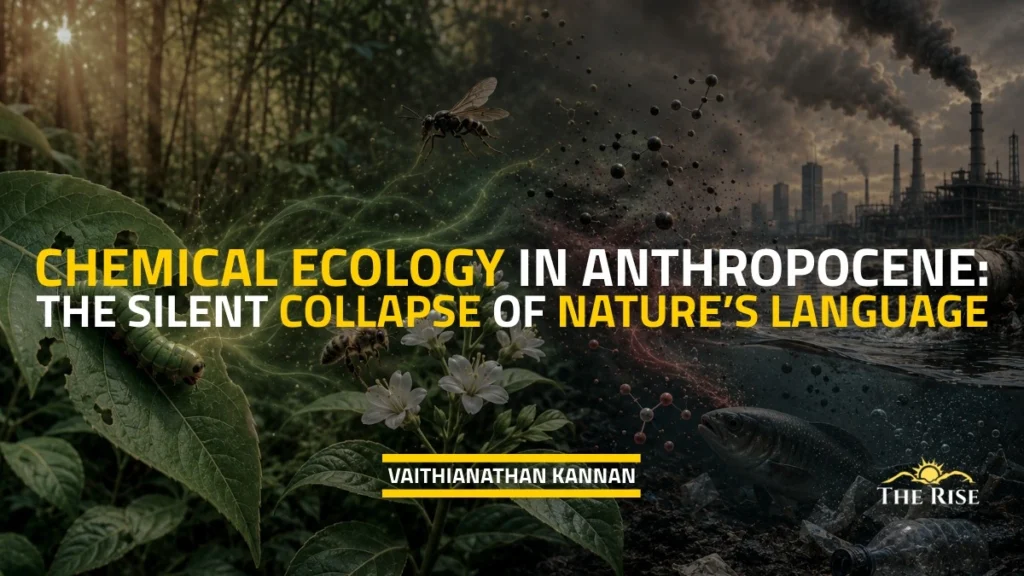
Anthropocene has not simply altered habitats, but has inserted an overpowering, synthetic chemical presence into nearly every ecosystem. Industrial agriculture sprays pesticides over millions of hectares. Urban air carries vehicular emissions, plastics break down into microscopic particles, pharmaceuticals seep into rivers, and synthetic fragrances wash into the oceans through wastewater. These compounds interfere with the language of organisms.
At dawn, in a shrinking patch of tropical forest, a leaf is bitten by a caterpillar. To human eyes, nothing dramatic happens—the insect chews; the plant trembles in silence. But within seconds, the wounded leaf launches an invisible alarm. Molecules, tiny volatile chemicals, rise into the warming air. Neighbouring plants detect them. Some begin producing bitter toxins. Others call for help, releasing scents that attract parasitic wasps, which arrive like winged assassins to attack the caterpillar. This is not science fiction.
It is the secret language of life: chemical ecology, the study of how organisms communicate and interact through chemicals. It is one of the oldest conversations on Earth, older than bird song, older than vision, perhaps older than life on land itself. And now, in the Anthropocene, the age in which human activity has become a planetary force, this language is being distorted, drowned out, and rewritten. To understand the modern ecological crisis, we often look at forests being cut, coral reefs bleaching, and species vanishing. Yet beneath these visible changes lies another crisis: a collapse in the chemistry of relationships. The world is not merely losing species; it is losing the molecular dialogues that bind ecosystems together.
The World as a Chemical Symphony
Every living organism is both a chemist and a listener.
Flowers perfume the air to seduce pollinators. Ants leave pheromone trails to lead nestmates to food. Fish release distress signals into the water. Trees leak warning compounds when attacked. Mammals mark territories, identify kin, and signal reproductive readiness through scent.
These interactions are not accidental emissions. They are evolutionary messages. In chemical ecology, such compounds have names as lyrical as their functions:
- Pheromones: communication between members of the same species
- Allelochemicals: signals between different species
- Kairomones: chemicals that benefit the receiver but not the emitter
- Allomones: defensive compounds benefiting the emitter
- Synomones: mutually beneficial signals
To an elephant, a forest is not only a visual landscape but a cloud of scents layered in time, who passed here yesterday, which fruits are ripe, and where predators lurk. To a moth, a single molecule drifting kilometres away may mean a mate. To a coral reef fish larva, chemical cues in seawater are a map home. Humans, dominated by sight and sound, often ignore these hidden dimensions. Yet life on Earth has always depended on them.
Also Read: Albert Einstein versus Adolf Hitler: The Dangerous Power of Ideas
When Humans Enter the Conversation
The Anthropocene has not simply altered habitats. It has inserted an overpowering, synthetic chemical presence into nearly every ecosystem. Industrial agriculture sprays pesticides over millions of hectares. Urban air carries vehicular emissions, plastics break down into microscopic particles, pharmaceuticals seep into rivers, and synthetic fragrances wash into the oceans through wastewater. These compounds are not passive contaminants; they interfere with the language of organisms. Imagine trying to hear a whisper in a stadium filled with amplified noise. That is what many species now face.
Polluted Air, Silenced Flowers
A flower’s scent plume is a precise message to pollinators. Bees locate nectar by following volatile organic compounds emitted by blossoms. But in polluted air, especially ozone-rich urban atmospheres, these molecules break down rapidly. The scent trail that once travelled hundreds of meters may now survive only a fraction of that distance. A bee flying through smog may fail to find the flower altogether. The plant loses its pollinator; the bee loses food. An ancient mutualism falters because industrial chemistry scrambles the signal. This is not merely an inconvenience. It can reshape plant reproduction, crop yields, and entire food webs.
Insecticides: The Double-Edged Molecules
Pesticides are among the most powerful anthropogenic interventions in chemical ecology. Designed to disrupt insect nervous systems, they often have subtler ecological effects beyond direct killing. Many insecticides interfere with pheromone detection. Male moths may fail to locate females. Ant colonies may lose their trail systems. Pollinators exposed to sublethal doses may become chemically disoriented.
In India, where agriculture supports both millions of people and extraordinary biodiversity, such disruptions can be profound. A cotton field treated for pests may inadvertently alter the chemical communication of beneficial insects, spiders, and soil organisms. The ecosystem becomes a battlefield of unintended consequences. The tragedy is that chemicals designed to simplify ecosystems for agriculture often destabilise them, making pest outbreaks worse in the long run. Predators disappear; resistant pests evolve; more chemicals are applied. The cycle feeds itself.
Oceans of Synthetic Signals
On a moonlit coral reef, fish larvae use chemical signatures dissolved in seawater to identify suitable habitat. They can distinguish between healthy reefs and degraded ones through smell alone. But the Anthropocene is changing the chemistry of the sea. Rising atmospheric carbon dioxide dissolves into oceans, causing acidification. This alters the molecular form of many odour cues.
Fish exposed to acidified water can become unable to recognise predator scents. Some are even attracted to them. A reef fish swimming toward the smell of a predator is like a deer seeking the scent of a tiger. Microplastics add another dimension. These tiny particles absorb pollutants and release synthetic compounds, creating false signals. Sea turtles, seabirds, and fish may ingest plastic because it carries the odour of food-producing algae. A discarded bottle cap becomes chemically disguised as prey.
Plants Under Siege: Chemical Warfare in a Changing Climate
Plants are often seen as passive victims of climate change. Yet they are active participants in chemical warfare. When attacked by herbivores, many plants release volatile compounds that recruit predators of those herbivores. Corn plants summon parasitic wasps. Acacias attract ants. Wild tobacco calls in carnivorous allies. Climate change is shifting these interactions. Warmer temperatures alter the rate of volatile emission. Drought can suppress chemical defences. Elevated CO₂ changes plant metabolism, affecting both the quantity and composition of defensive compounds. A plant under stress may emit weaker warnings, delayed signals, or entirely different chemical cocktails. Herbivores, in turn, may exploit these vulnerabilities. Invasive species often thrive because native plants fail to recognise or defend against their unfamiliar chemical signatures. The battlefield is molecular, but the consequences are visible: forest dieback, crop losses, and collapsing insect communities.
The Chemical Identity Crisis of Animals
Animals depend on scent not only for survival but for identity. A mother seal recognises her pup by smell among thousands. A tiger marks territory with scent. Bats identify colony members through body odour. Even birds, once thought nearly anosmic, use chemical cues in mate selection. Pollution disrupts this. Heavy metals, endocrine disruptors, and industrial pollutants can alter body chemistry, changing how animals smell to one another. A mate may not be recognised. A parent may reject offspring. Social structures can unravel. In aquatic systems, endocrine-disrupting chemicals from sewage and pharmaceuticals mimic hormones, confusing reproductive signals. Male fish may develop female traits. Frogs may fail to breed. The chemistry of attraction becomes chaos. The Anthropocene is not merely destroying habitats; it is altering what it means to be recognisable within a species.
Cities: Laboratories of Chemical Evolution
Urban ecosystems are among the most fascinating frontiers of modern chemical ecology. Cities are dense with synthetic compounds: exhaust fumes, cleaning agents, industrial solvents, perfumes, food waste, and heated asphalt. Yet wildlife persists, sometimes even thrives. Urban mosquitoes may evolve altered host-seeking behaviour due to changed odour landscapes. Rats adapt to human-associated food cues. Pigeons navigate a mosaic of synthetic smells. Some city plants emit stronger floral scents to overcome interference from pollution.
This raises a remarkable possibility: urban evolution through chemical adaptation. Species surviving in megacities may be evolving entirely new sensory thresholds, new pheromone blends, and new detoxification pathways. The city becomes not just a habitat but an evolutionary crucible. In Indian cities like Chennai, Mumbai, and Bengaluru, street dogs, crows, geckos, and insects are already negotiating chemical worlds unlike anything their ancestors encountered.
India: A Chemical Crossroads
India offers one of the richest natural laboratories for chemical ecology in the Anthropocene. From the mangroves of Sundarbans to the rainforests of Western Ghats, species rely heavily on chemical communication. Elephants detect estrus through pheromones. Termites engineer chemical fortresses. Orchids mimic insect pheromones to trick pollinators. Snakes track prey using airborne particles.
Yet India is also a nation of rapid urbanisation, intensive agriculture, industrial expansion, and climate vulnerability. Consider the Indian honeybee. In landscapes sprayed with pesticides and fragmented by highways, its ability to interpret floral chemistry may be compromised. Or consider freshwater fishes in polluted rivers like the Ganges River, where sewage, detergents, and pharmaceutical residues alter breeding cues. The conservation challenge is not only preserving species but also preserving the chemical integrity of ecosystems.
The Rise of Chemical Eavesdropping
Humans are not just disrupting chemical communication; we are learning to manipulate it. Scientists use pheromone traps to monitor invasive pests. Synthetic lures attract mosquitoes for disease control. Conservationists deploy scent cues to guide endangered species toward safe breeding grounds. Farmers use mating disruption techniques, releasing artificial sex pheromones to confuse crop pests without pesticides.
This emerging field offers hope. By understanding ecological chemistry, humans may shift from blunt-force interventions to subtler, more biomimetic approaches. Imagine restoring pollinator corridors by planting scent-compatible species, or protecting coral reefs by identifying and preserving the odour signatures that attract juvenile fish. The future of conservation may depend as much on chemistry labs as on protected areas.
The Forgotten Sense
Why has chemical ecology remained so underappreciated? Partly because humans are sensory outsiders. Our species trusts what it can see. We map forests by satellite, monitor animals with cameras, and count populations with drones. But the crucial interactions often happen invisibly in air currents, soil pores, and droplets of water.
A forest can appear intact and still be chemically broken. A flower may bloom, yet fail to attract pollinators. A stream may look clear, yet its fish cannot smell predators. An elephant corridor may remain open, yet industrial odours may deter movement. The Anthropocene teaches a humbling lesson: ecological collapse is not always dramatic. Sometimes it begins with silence in a language we barely know exists.
Listening to the Molecules
The next great frontier in ecology may not be what we see, but what we smell. Portable mass spectrometers now allow scientists to analyse volatile compounds in real time. Environmental DNA can reveal hidden organisms; environmental chemistry may reveal hidden relationships. The air above a forest could someday be read like a living transcript, stress, herbivory, flowering, and migration all encoded in molecules.
This matters deeply for conservation. Protecting a tiger means more than preserving prey and habitat. It means preserving scent-marking trees, prey trails, and the chemical landscape that defines its world. Saving pollinators means preserving not just flowers but the atmospheric conditions that carry their scents. To restore ecosystems, we must restore communication.
The Anthropocene’s Unseen Legacy
Future geologists may identify our era by plastic sediments, radioactive isotopes, and carbon spikes. But biologists may define it differently: as the age when one species flooded the planet with novel chemicals and altered the sensory reality of life. The Anthropocene is, in part, a chemical experiment without precedent. No previous extinction event introduced endocrine disruptors into rivers, coated oceans with petrochemicals, or filled forests with pesticide aerosols. We are not just changing the climate; we are editing the molecular grammar of evolution.
And yet there is hope in understanding. Chemical ecology reveals that ecosystems are not static collections of species. They are conversations- dynamic, ancient, intricate conversations carried in molecules. If we can learn to hear them, perhaps we can stop interrupting them. Perhaps we can even help them speak again.
The Last Scent
Stand in a forest after rain. The earth releases petrichor. Leaves exhale resin. Flowers send invitations into the dusk. Somewhere, a moth follows a faint trail toward a bloom. Somewhere else, a tree warns its neighbours of a browsing deer. Beneath your awareness, the world is alive with messages.
The tragedy of the Anthropocene is not only that species are disappearing. It is these invisible conversations that may vanish before we ever truly notice them. To conserve life in the 21st century, we must expand our imagination beyond what the eye can capture. We must recognise that the fate of forests, oceans, and grasslands may hinge on molecules drifting in the air, dissolved in rivers, or trapped in the scent glands of an animal in the dark.
The future of the wild may depend on whether humanity learns a forgotten truth: the planet does not merely live. It speaks. And it speaks in chemistry.
Disclaimer: The views expressed in this article are those of the author solely. TheRise.co.in neither endorses nor is responsible for them. Reproducing this content without permission is prohibited.
About the author

Dr Vaithianathan Kannan is a Wildlife Biologist who has worked with Sathyamangalam Tiger Conservation Foundation Tamil Nadu Trust, Erode, Tamil Nadu, Bombay Natural History Society, Mumbai & AVC College, PG Research Department of Zoology & Wildlife Biology, Mannampandal, Tamil Nadu, and various other NGOs. He is a member of the IUCN/WI/SSC Pelican Specialist Group (Old World) and has a voluntary position within the Old World Pelican Specialist Group. His research interests are diverse largely related to Ecology, Biodiversity, Limnology, Mammalogy, Ornithology and Wetlands








The real dilemma is friends of researchers or co-researchers and public at large fail to understand the essence of research by another researcher. When the results of n ivory tower research is not translated in to a language intelligible to the common man the rnew concepts are not actionable. Gor any positive change the masses have to be made aware of new thoughts ot ideas or actionable concepts. This happens in the case of species conservation, from one end some consevationists produce new individuals by captive breeding where as from the other end other conservationists demolish new individuals born. When captive breeding adds new vulture chicks they hit airplane or hightension powerlines or die eating poison in carcasses or taking bullets of poachers and hunters because they never grew with planes or powerlines or poison-laced carcasses or bullets chasing them. Without removing threats to lives conservation of NY species is not possible. Man is the greatest enemy of all other species and Nature herself trying to cut the branch of the tree on which he is comfortably perched!
Dr S M Satheesan,
Smsatheesan2001@gmail.com