The preparedness of the Board’s system involving its schools and teachers for implementing OSM, along with the protocols governing it, does not appear to have been adequately established beforehand. Moreover, an experiment of this kind should not have been done in the final examination of the terminal class in school education, because these class 12 children have to migrate out, and any delay/lapse in the result becomes unaffordable and psychologically burdens the students.
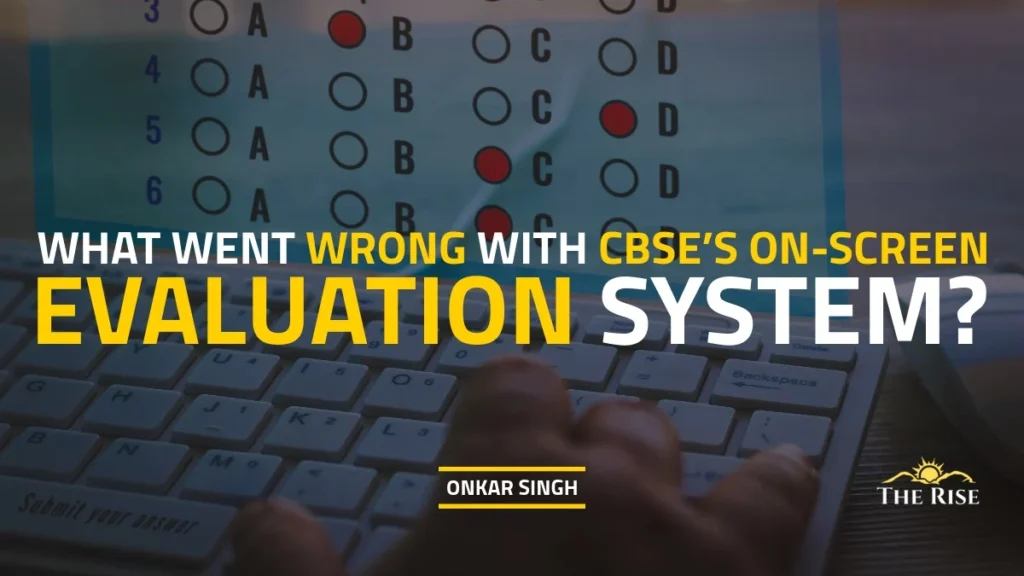
Recent controversy over on-screen evaluation (OSM) in the Central Board of Secondary Education (CBSE) has once again exposed gaps in educational reforms. This time, it is the use of technology in the evaluation of CBSE Class 12 answer books, intended to be faster, transparent, error-free, objective, centrally controllable, and eco-friendly.
In this regard, the news reports of improper scanning quality, i.e. blurred and illegible scans, change of scanned answer books, improper evaluation leading to award of low marks / unevaluated answers, lapses in functionality of the portal for revaluation/scrutiny, etc, have certainly raised eyebrows on the digital evaluation practiced at the school level. It is very unfortunate that the OSM has failed to deliver the expected results, and another major school board examination in the country is engulfed in controversy due to glitches at various levels. Also, there have been certain instances of the digital evaluation not living up to the mark in a few University examinations in the past, besides some success stories of OSM as well in a few universities.
But this cannot lead to the conclusion that the digital evaluation or OSM is not worthwhile in realizing the aforesaid objectives. Because the referred lapses are the culmination of the absence of due diligence before transforming the evaluation system from a hard copy answer book evaluation to a digital answer book evaluation.
Also Read: NEET Computer Based Test Shift: End of Paper Leaks?
As a strong advocate of technology and having successfully used On Screen Marking (OSM) in evaluating answer books at an affiliating University in northern India, I feel that the lack of holistic design in the OSM implementation is the reason for this fiasco. It is not the technology, but rather the humans who have failed to use technology, ignoring the human realities in the examination evaluation.
In view of the above, it is pertinent to delve deeper into the evaluation system, which by and large remains the same except that the pen and answer book-based marking is replaced by a scanned answer book with an on-screen marking system using keyboard/mouse. Therefore, the lapses, if any, are going to be first at the stage of scanning/storage/retrieval of the answer book, followed by making scanned answer books available for evaluation on the computer screen, and lastly, they shall depend on the proficiency of the examiners for on-screen evaluation and the software at the back that facilitates it.
Going by the news reports and confession of certain fallacies by the examining board, it appears that the safeguards and monitoring has not been effective at one or more of the stages like the quality of scanning of answer books, coding of scanned answer books, expertise of evaluators in performing OSM, supervision and sample checking of evaluation carried out by the subject evaluators, capability of software of OSM to perform inherent checks of scanning quality and completeness of the evaluation, etc.
Alongside, the inadequate training of subject teachers for carrying out proper OSM, insufficient testing of mass-scale OSM, and little consideration of the possible risks of the first-time OSM execution seem to be big concerns. It is worth mentioning that the evaluation is not a mechanical exercise with digital rubrics based on matching with model solutions, but it involves academic judgement in descriptive and problem-solving subject answers. The evaluator has to apply their mind to recognize the full/partial/no correctness of the answer with respect to the model solution and award marks suitably.
Prima facie, the preparedness of the Board’s system involving its schools and teachers for implementing OSM, along with the protocols governing it, does not appear to have been adequately established beforehand. Moreover, an experiment of this kind should not have been done in the final examination of the terminal class in school education, because these class 12 children have to migrate out to higher education or to other opportunities; any delay/lapse in the result becomes unaffordable and psychologically burdens the students. Typically, in the highly competitive ecosystem with a larger impact of Board examination outcome on career trajectories and social standing of the students, it is inevitable to have small-scale pilot runs preceding nationwide implementation. Due sensitivity is needed in exercising necessary care and precaution in technology usage, as the inadvertent or systemic errors in implementing technology affect the future opportunities adversely.
Undoubtedly, technology usage in education, being a human enterprise, has the potential to overcome human limitations, but it also has the inherent limitations of being devoid of human intelligence and emotions. This essentially calls for the gradual digitization of processes with safeguards and quality audits evolving in a continuous manner through grievance redressal and academic oversight.
Way forward
Going by the embarrassment faced by both the students and the examining board, a debate has triggered over whether to adopt technology-driven evaluation or continue with the traditional approach of answer book evaluation. Apparently, looking at the volume of answer books and drawbacks in manual evaluation, there seems to be no reason to abandon the OSM. Rather, a detailed remodelling of the procedures, protocols, and monitoring mechanisms is essentially required before implementing digital evaluation. The digital evaluation permits ease of portability and storage, which must be exploited to bring complete transparency to the examination-evaluation system. A serious thought must be given to show the evaluated answer book digitally to the students on their dashboards before the preparation of the results, with stringent timelines. This will not only provide an opportunity to the examinee to raise concerns, if any, but also strengthen the trust between the examination board and examinee.
Before implementing OSM in full swing, a hybrid evaluation should be attempted on a small scale to study the variances and the inconsistencies. This will also help in laying a robust mechanism for setting up stringent quality standards of scanning, evaluator training, provisions for academic judgment in award of marks, software testing, and social acceptance of the change.
The school academics, regulator and government must collectively contemplate evolving a suitable OSM framework and strengthening the credibility and not the speed, of the examination-evaluation system. Every educational reform calls for eliminating the prevailing lapses and wider acceptance among stakeholders, failing which it is no longer a reform.
Disclaimer: The views expressed in this article are those of the author solely. TheRise.co.in neither endorses nor is responsible for them. Reproducing this content without permission is prohibited.
About the author

Prof. Onkar Singh is the former Vice Chancellor of Veer Madho Singh Bhandari Uttarakhand Technical University, Dehradun, He has been the Founder Vice-Chancellor of the Madan Mohan Malaviya University of Technology, Gorakhpur (U.P.). He is a Professor of Mechanical Engineering at Harcourt Butler Technical University, Kanpur (U.P.).