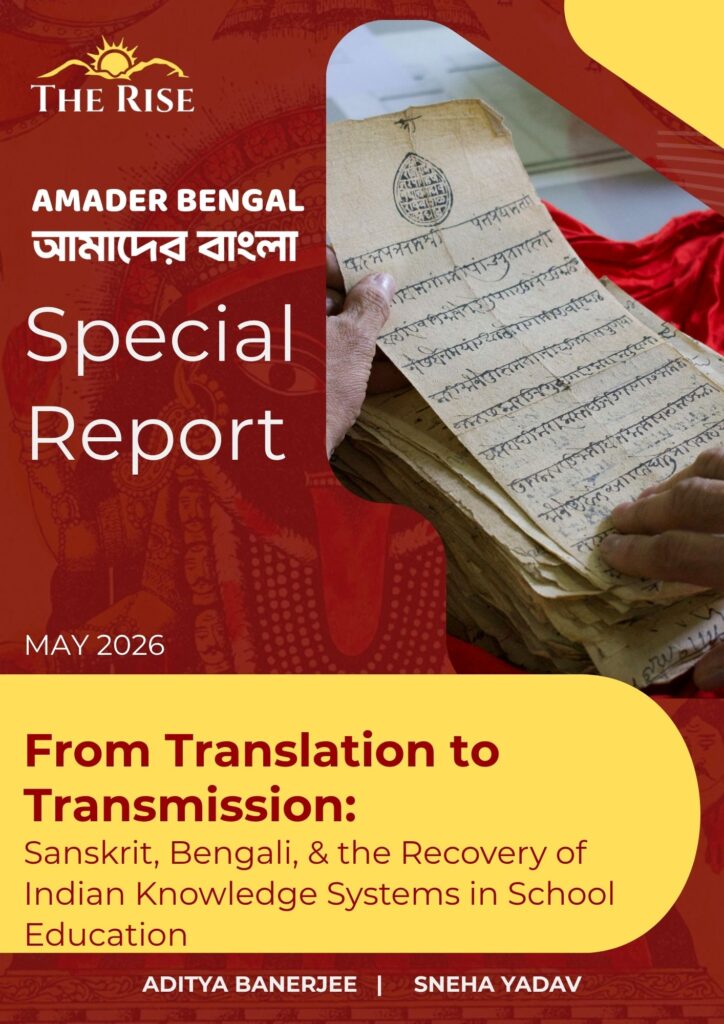
The Indian Knowledge System (IKS) has been transmitted for millennia through indigenous languages that encode its conceptual architecture. Colonial education policy severed this linguistic foundation by installing English as the dominant medium of intellectual and institutional learning and forcing classical Indian concepts into Western categorical frameworks. The result is a persistent gap: stakeholders recognise the value of IKS, yet schools lack the resources, trained teachers, and assessment structures to teach it through the languages that carry its meanings. This study argues that this gap is not a lack of conviction but a lack of institutional architecture, and that it can be addressed through educational redesign.
Drawing on textual analysis of Sanskrit and Bengali sources, policy documents including the National Education Policy 2020, and qualitative survey data from students and academic professionals, the study traces how English-mediated interpretation produces conceptual distortion and how indigenous languages function not merely as communicative tools but as epistemic media that shape modes of reasoning and interpretation. A comparative perspective on China’s maintenance of classical Chinese as a compulsory scholarly medium illustrates the institutional conditions under which linguistic continuity sustains intellectual tradition.
The study proposes a three-tier school-level model: comprising indigenous-language teaching resources in Bengali and Sanskrit, teacher-training programmes that bridge linguistic competence with IKS scholarship, and assessment reform that rewards interpretation, conceptual understanding, and multilingual engagement over rote memorisation and exclusive English-medium fluency.
The study concludes that IKS can be meaningfully integrated into school education only when indigenous languages move from informal pedagogical aids to the formal curricular core of knowledge transmission.
Get a hard copy delivered at your doorstep:
Terms & Conditions:
- Order cancellation procedure: Mail at support@therise.co.in requesting order cancellation with a valid reason within the first 24 hours of order placement. The payment receipt must be mandatorily attached, without which no order cancellation request will be entertained.
- Returns/Replacement: No return/replacement is possible
- Refunds: The complete amount is refundable if the order cancellation request is received at support@therise.co.in within the first 24 hours of the order placement. Refund will be issued in 5-7 working days.
About the author

Aditya Banerjee is pursuing B.A. Political Science from Ramakrishna Mission Vidyamandir, under the University of Calcutta. He is currently a Amader Bengal intern.

Sneha Yadav is an electronics engineer with a postgraduate degree in political science. Her interests span contemporary social, economic, administrative, and political issues in India. She has worked with CSDS-Lokniti and has been previously associated with The Pioneer and ThePrint.
-
Sneha Yadav

-
Sneha Yadav
-
Sneha Yadav
-
Sneha Yadav
-
Sneha Yadav
-
Sneha Yadav
-
Sneha Yadav
-
Sneha Yadav
-
Sneha Yadav
-
Sneha Yadav
-
Sneha Yadav
-
Sneha Yadav
-
Sneha Yadav
-
Sneha Yadav
-
Sneha Yadav
-
Sneha Yadav
-
Sneha Yadav
-
Sneha Yadav
-
Sneha Yadav
-
Sneha Yadav
-
Sneha Yadav
-
Sneha Yadav
-
Sneha Yadav
-
Sneha Yadav
-
Sneha Yadav
-
Sneha Yadav
-
Sneha Yadav
-
Sneha Yadav
-
Sneha Yadav
-
Sneha Yadav
-
Sneha Yadav
-
Sneha Yadav