Lula’s re-election is important for more than one reason. India-Brazil economic ties are likely to strengthen under his leadership as there is a growing convergence between the two countries which happen to be founding members of BRICS, to work jointly for dealing with emerging global economic challenges, particularly in the global south.
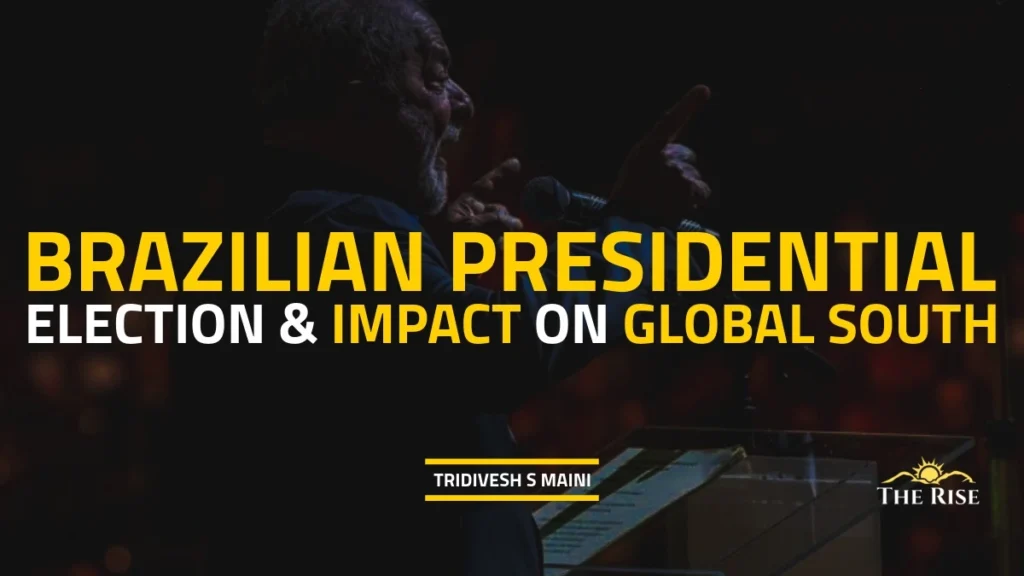
Luiz Inácio Lula da Silva, the Brazilian president defeated his far-right opponent, Flávio Bolsonaro in Brazil’s Presidential election, Lula received 51.79% share of the vote, while Bolsonaro received 48.21%. Significantly, Lula who received 4.4 million votes more than Bolsonaro had lost the first round of the election to Bolsonaro.
PM Narendra Modi in his congratulatory message on X, referred to Lula as a “dear friend” and said: “I look forward to working closely with him to further deepen and expand the multifaceted India-Brazil Strategic Partnership. Together, we will continue to strengthen our cooperation across diverse sectors, advance the shared priorities of the Global South and work towards a more inclusive, equitable and sustainable world”.
Also Read: Iran’s Participation in BRICS 2026 Summit: Key Geopolitical & Economic Takeaways
During Lula’s India visit in February 2026, PM Modi had said that if India and Brazil work jointly then the “voice of the Global South” would become stronger. PM Modi in his post also said that both countries would work jointly to advance the priorities of the Global South and would: “…work towards a more inclusive, equitable and sustainable world.”
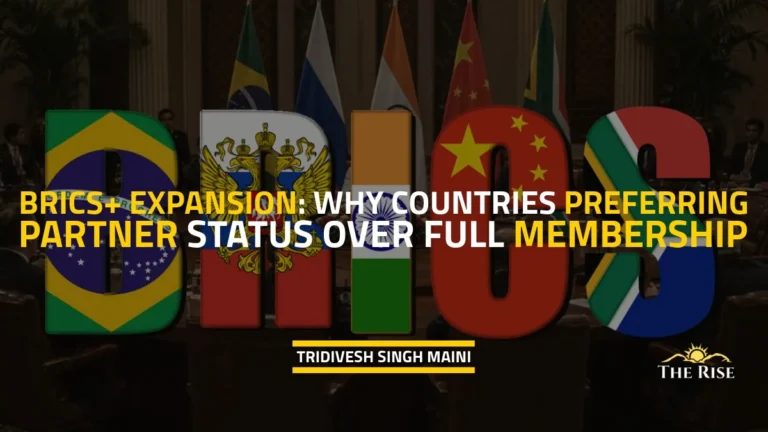
Both countries have been supporting expansion of the United Nations Security Council UNSC and have reiterated their mutual support for each other’s candidature for permanent membership in an expanded UNSC.
Lula’s strong push for greater cooperation within BRICS and trade in local currencies
Lula’s win is significant, because there was talk that Brazil would pull out of BRICS+ if Bolsonaro, who is considered close to US President Donald Trump, wins the presidential election. Donald Trump approved Flávio Bolsonaro entry into the US after the latter left Brazil following his electoral defeat.
Lula, who has been vociferous in his criticism of Trump’s tariffs has been unequivocal in his backing for greater cooperation within the BRICS+ grouping and has also been pushing for trade in local currencies between members of the organisation. He has reiterated the importance of the bloc in shaping the current global order, on more than one occasion.
Senior Congress Leader and Chairperson of the Parliamentary Standing Committee on External Affairs, Shashi Tharoor in a post on X said that Lula’s victory is important, since under his leadership Brazil is likely to remain committed to multipolarity and “strengthening” of BRICS grouping as an important voice of the Global South in “reshaping” international trade and governance.
Also Read: India’s BRICS Presidency in a Shifting Global Order
The Brazilian President did not attend the BRICS Summit held in New Delhi in September 2026, since he was focusing on his presidential campaign.
During his visit to India, in February 2026 Lula had unequivocally pitched for trade in local currencies between both countries. He argued that bilateral trade did not necessarily need to be denominated in US dollars and that both countries could explore using their respective national currencies. Bilateral trade between India and Brazil was $15 billion in 2025-2026 and both countries have set a goal for pushing bilateral trade to $30 billion by 2030.
During the 2023 BRICS Summit, the Brazilian President had pitched for a BRICS common currency saying that it would increase “payment options” and reduce vulnerabilities for BRICS Members. In an interview during his India visit, he had clarified that there was no discussion on the “creation” of a common BRICS currency.
Brazil held the presidency of BRICS in 2025. While speaking at the Summit, Lula criticised protectionism and unilateralism. The Brazilian President while addressing the BRICS Business Forum said, “In the face of the resurgence of protectionism, it is up to emerging nations to defend the multilateral trade regime and reform the international financial architecture”.
Days after the summit, Trump imposed 50% tariffs on Brazil. Lula referred to Trump’s decision to impose tariffs on Brazil as “tariff blackmail” calling them unacceptable. Trump has issued repeated warnings to BRICS member countries in this regard.
During an online meeting of BRICS leaders, in September 2025, Lula, while strongly criticising the use of tariffs said that BRICS member states had the “legitimacy” to reform the existing multilateral order and highlighted the fact that there was a need for rules that aligned with the BRICS member states’ “development needs”.
Russia also welcomed Lula’s re-election and acknowledged the Brazilian President’s important contribution to the BRICS organisation. In his congratulatory message to Lula, the Russian President Vladimir Putin highlighted the latter’s contribution to strengthening bilateral ties between both countries. In his message he further stated that both countries would not only strengthen bilateral relations, but also maintain “constructive” interaction on multilateral platforms including UN, BRICS and G20.
Lula’s re-election is important for more than one reason. India-Brazil economic ties are likely to strengthen under his leadership. As mentioned earlier, there is also a growing convergence between the two countries which happen to be founding members of BRICS, to work jointly for dealing with emerging global economic challenges, particularly in the global south. The Brazil result is thus important not just in the context of Brazil’s politics, but also for India-Brazil ties, the BRICS grouping and the Global South.
Disclaimer: The views expressed in this article are those of the author solely. TheRise.co.in neither endorses nor is responsible for them. Reproducing this content without permission is prohibited.
About the author

Tridivesh Singh Maini is a New Delhi-based Policy Analyst. He is faculty member of OP Jindal Global University, Sonepat, Haryana.