India does not have a single, reliable national figure that tells us what proportion of all young people are protein deficient. Diets differ across states, income groups, age groups and households. Protein intake is not the same as a medical diagnosis, and a person’s health cannot be judged by one nutrient alone. This gap in evidence should encourage better research, not dramatic claims.
India’s young people are often described as the country’s greatest strength. They are expected to study hard, find jobs, build businesses, compete in sports and help India become a stronger economy. But there is a simple question behind all these ambitions: are young Indians getting the nutrition they need to make the most of their potential? Protein may sound like a subject for gyms and fitness influencers, yet it belongs in a much wider conversation about education, public health and equal opportunity.
Protein helps the body build and repair tissues, maintain muscles and carry out many essential functions. It matters to a teenager going through growth, a college student trying to stay healthy and a young worker spending long hours on the job. A healthy diet needs more than protein alone, of course. It also needs enough energy, vitamins, minerals and variety. But when people talk about nutrition, protein is often either overlooked or presented as something that comes mainly from costly supplements. For many families, the real question is more basic: can they afford regular, balanced meals?
India’s nutrition challenge is visible in national data. The National Family Health Survey 2019 to 2021 reported that 35.5 per cent of children under five were stunted, 19.3 per cent were wasted and 32.1 per cent were underweight. These figures are not measurements of protein deficiency among teenagers, but they show that undernutrition remains a serious concern in India and that too many children begin life without the conditions needed for healthy growth. The country needs equally careful attention to what happens as these children become adolescents and young adults.
One difficulty is that India does not have a single, reliable national figure that tells us what proportion of all young people are protein deficient. Diets differ across states, income groups, age groups and households. Protein intake is not the same as a medical diagnosis, and a person’s health cannot be judged by one nutrient alone. This gap in evidence should encourage better research, not dramatic claims. India needs clearer information about what adolescents and young adults actually eat, how their diets compare with nutritional needs, and which groups struggle most to access balanced food.
For young people, the problem often appears in ordinary routines rather than in statistics. A student may leave for college after tea and biscuits because there is no time for breakfast. Someone living in a hostel may depend on a repetitive menu because it is the cheapest option. A young worker may spend most of their income on rent, travel and family responsibilities, leaving little room for varied meals. In some homes, food is filling but lacks variety. In others, people may believe that adequate protein requires expensive powders, shakes or imported products. These are different situations, but they all point towards the need for practical nutrition advice and affordable choices.
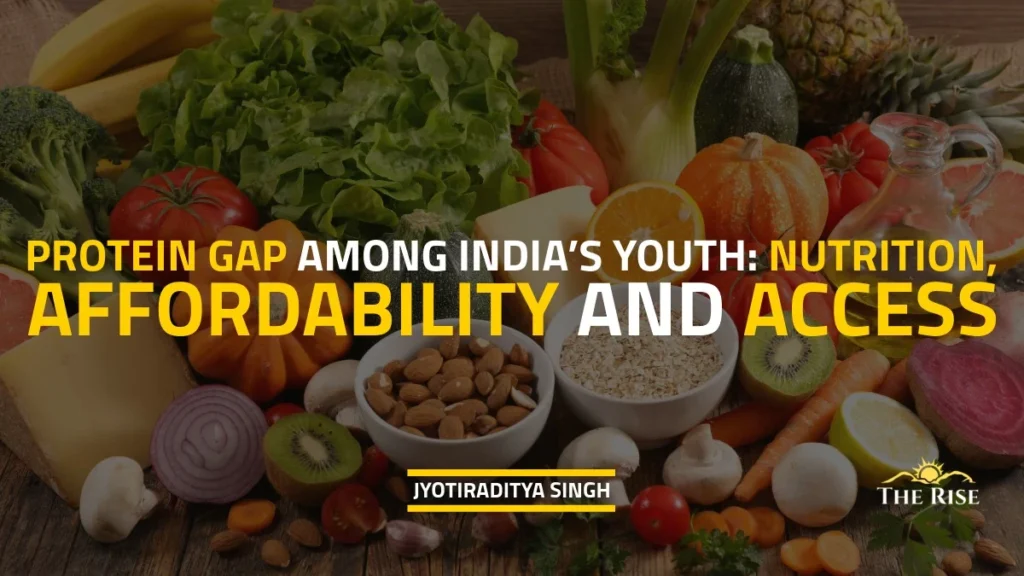
Protein does not have to mean an expensive product. Lentils, chickpeas, kidney beans, peas, soy foods, milk, curd, eggs, fish and meat can all contribute protein, depending on a person’s preferences and circumstances. The most useful advice is often local and simple: improve the variety of everyday meals, include protein rich foods regularly and avoid treating supplements as a substitute for normal food. The challenge is that even affordable foods can be difficult to include consistently when budgets are tight, prices rise or nutritious options are missing from canteens and hostels. Awareness matters, but affordability and availability matter just as much.
This is why schools must remain part of the conversation. India’s PM POSHAN scheme sets nutritional norms for school meals. The prescribed norm is at least 450 calories and 12 grams of protein for children in primary classes, and 700 calories and 20 grams of protein for children in upper primary classes. These standards recognise that a school meal should provide nourishment, not simply silence hunger for a few hours. The important question is whether meals served in practice consistently meet these nutritional standards and offer food children will actually eat. Pulses and other locally available protein sources can help make meals more balanced, while menus should reflect local food habits and seasonal availability.
A nutritious school meal can support a child today, but India should also think about the young person who leaves school and enters college, vocational training or work. Many continue to live on limited budgets, especially when they move away from home. The transition from school to college should not mean losing access to affordable, balanced food. Colleges and training centres can review canteen menus, offer reasonably priced meals with pulses, beans, soy or dairy, and display simple information about what their nutritional content. Hostels can plan for variety across the week instead of relying on the same low-cost dishes every day. These steps do not require every student to follow the same diet. They require institutions to take student nutrition seriously.
Government policy can help create the conditions for these changes. Local authorities and educational institutions can work with nutrition experts to improve meal planning, monitor quality and reduce food waste. Public campaigns should explain protein in plain language and use familiar foods rather than marketing good nutrition as a lifestyle reserved for people who can afford premium products. Where meals are subsidised, the aim should be to make them both affordable and nutritionally sound. Programmes should also listen to young people themselves. Students know whether canteen food is affordable, whether serving times work and whether the meals on offer are practical for their daily lives.
Better data must accompany better policy. India needs more research focused specifically on adolescents and young adults, with results broken down where possible by age, gender, household income, region and living situation. This would help identify whether the greatest barriers are cost, access, food habits, limited knowledge or a combination of factors. Researchers should measure overall diet quality as well as protein intake, because nutrition is not a one-nutrient problem. Clear evidence can help governments and institutions decide which interventions work, instead of relying on assumptions or slogans.
The stakes go beyond fitness. Young people need health and energy to participate in classrooms, workplaces, families and communities. Good nutrition alone cannot solve unemployment, unequal education or every public health challenge. But a country cannot fully benefit from its young population if nutritious food remains difficult to access for those who need it most. India’s demographic dividend depends not only on how many young people it has, but also on whether they have the foundation to learn, work and live well.
The protein gap should therefore be treated as a question of opportunity as much as diet. A student should not need a large allowance to find a balanced meal. A school meal should be judged by its nutritional quality as well as the number of plates served. A college canteen should make sensible choices available at a price students can pay. And policymakers should invest in better evidence instead of repeating figures that do not measure what they claim to measure. Protein alone will not fix India’s nutrition challenges, but affordable, balanced food is a practical place to begin. If India expects its youth to build the future, it must also make sure they have the nourishment to take part in it.
References
- Ministry of Health and Family Welfare, Government of India. National Family Health Survey (NFHS-5), 2019–21: India Fact Sheet. Figures cited for children under five: stunting 35.5%, wasting 19.3% and underweight 32.1%. https://rchiips.org/nfhs/NFHS-5_FCTS/India.pdf
- Ministry of Education, Government of India. PM POSHAN Scheme. Nutritional norms for primary and upper primary school meals. https://pmposhan.education.gov.in/
- Indian Council of Medical Research and National Institute of Nutrition. Dietary Guidelines for Indians, 2024. https://www.nin.res.in/dietaryguidelines.html
- National Institute of Nutrition, ICMR. Nutrient requirements and dietary recommendations for Indians. https://www.nin.res.in/
Editorial data note: NFHS-5 figures describe children under five and provide wider nutrition context; they are not estimates of protein deficiency among Indian adolescents or young adults. PM POSHAN figures are prescribed nutritional norms, not a claim that every meal served meets them.
Disclaimer: The views expressed in this article are those of the author solely. TheRise.co.in neither endorses nor is responsible for them. Reproducing this content without permission is prohibited.
About the author

Jyotiraditya Singh is a youth leader and social activist passionate about youth participation, public policy, education, employment and political accountability. He is actively involved in student and youth initiatives.