India has already demonstrated its capabilities in generic pharmaceuticals, cost-effective space technology and digital public infrastructure. The next frontier is clear: India must move from assembling medical equipment to developing and manufacturing the critical healthcare technologies to realize the vision of Aatmanirbhar Bharat in true sense.
India is globally known as the “Pharmacy of the World” for its massive export volumes of generic pharmaceuticals and vaccines. But behind this strong external image lies a deeply vulnerable domestic reality. India remains heavily dependent on imports for up to 80-85% of its advanced medical devices and critical diagnostics technologies.
From the sleek, branded MRI machine or a CT scanner to the components that nobody sees inside it, like high-energy glass vacuum tubes powering diagnostic imaging and the silent microprocessors controlling pulse oximeters and ultrasound beamformers, India is highly dependent on imports. While local manufacturers have made strides in basic consumables, disposable syringes, and hospital furniture, the high-tech, high-precision core of Indian modern healthcare still depends on foreign hands.
The Anatomy of Dependency
This dependence has implications beyond trade figures. Import reliance exposes hospitals to global supply-chain disruptions, currency fluctuations and changing international prices, eventually raising the cost of acquiring and maintaining medical equipment. Further, it also raises concerns about data security, privacy and control over sensitive health information, particularly when patient data is processed, stored or transmitted through externally controlled systems.
TheRise attempted to analyse this landscape by examining India’s import dependence on four critical medical technologies and components used in cancer care and other diagnostic applications: MRI systems, monolithic integrated circuits, X-ray tubes, and ultrasound systems. Each reveals a different dimension of India’s dependence on foreign medical technology.
MRI systems
These machines use strong magnetic fields and radio frequency signals to generate detailed images of internal body structures, making them essential for locating tumours and tracking treatment response. The USA has been a significant source of this technology for India. Though in the years post pandemic, the demand for these machines have gradually reduced, but the imports remain substantial enough to show that Indian hospitals are still leaning heavily on American imaging equipment.
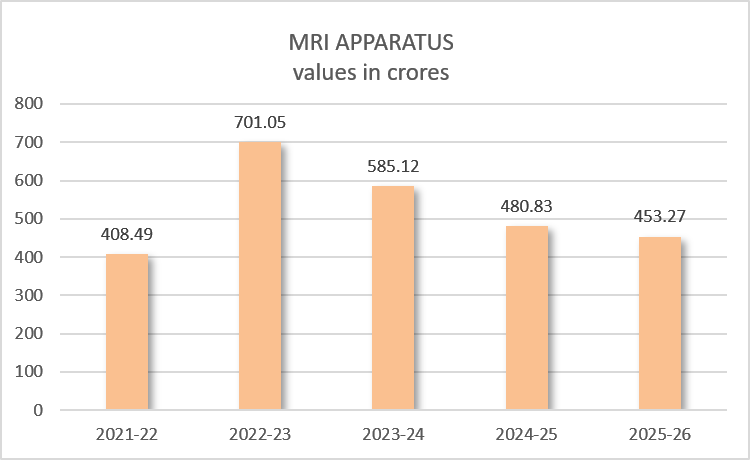
This dependency not only is limited to the initial cost of procuring an MRI machine but extends to procurement of replacement parts, specialized servicing and technical support. Limited domestic capabilities in manufacturing and maintaining these systems can increase lifecycle costs and make hospitals vulnerable to external supply disruptions, impacting access to necessary diagnostics.
Monolithic Integrated Circuits
These circuits, though not visible are very critical component. These digital chips are the “brain” inside a machine, controlling sensors, image acquisition, signal processing and communication between components. They quietly run CT scanners, MRI systems, and radiotherapy equipment.
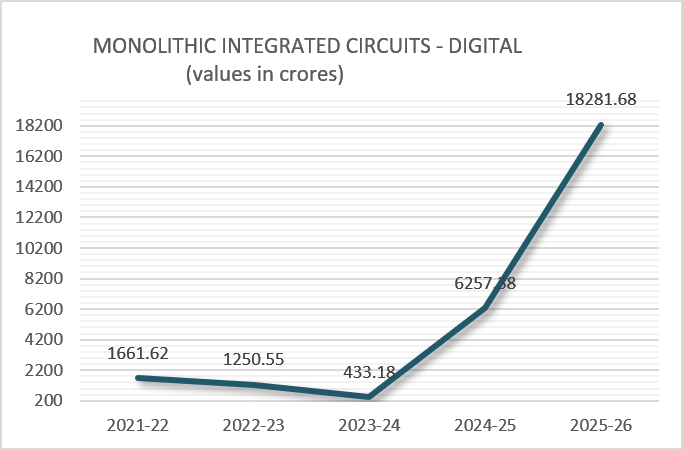
The scale of this dependency is striking, as imports from the USA exploded from Rs 6,257 crore in FY2024-25 to Rs 18,281 crore in FY2025-26. Healthcare itself likely accounts for Rs 500-600 crore of this total, since these chips serve many industries beyond the medical sector. However, their significance in healthcare extends beyond their role in powering medical devices. As these systems process and transmit sensitive patient information, vulnerabilities in hardware, firmware or software could expose citizens’ health data to unauthorised access, making data security a critical concern in this regard.
X-Ray Tubes
This device sits at the very core of imaging systems. Converting electrical energy into the X-ray radiation that produces diagnostic images. They power CT scanners used for cancer staging, PET-CT fusion imaging, and monitoring radiation treatment.
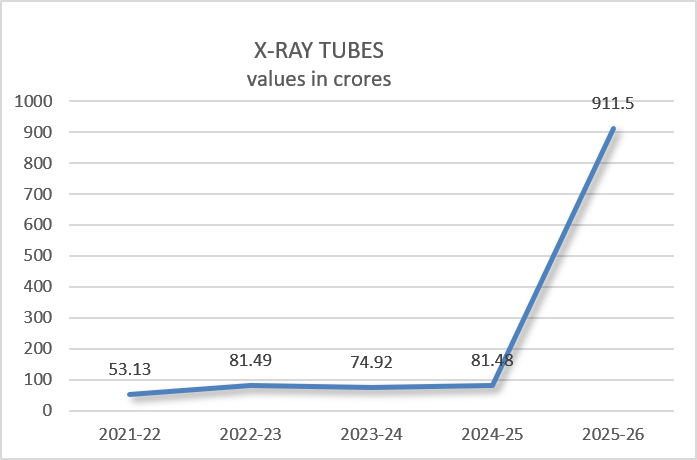
Here, the trend is even sharper, as imports from the USA exploded more than 10-fold, reaching Rs 911.51 crore in FY 2025-26. These tubes are high-precision components that undergo wear and tear and require replacement, thereby making access to reliable spares and specialised servicing essential. If domestic manufacturing and repair capabilities remain limited, even hospitals that have successfully procured CT scanners can face disruptions when these critical components fail to function efficiently.
Linear Ultrasound Scanners
The Ultrasound scanners by contrast, tell a story of gradual creep rather than explosion. These devices use high-frequency waves to create real-time images of tissues, organs and structures close to the body’s surface. These are crucial for non-invasive soft-tissue tumour screening (breast, liver, thyroid) and for real-time ultrasound-guided needle biopsies.
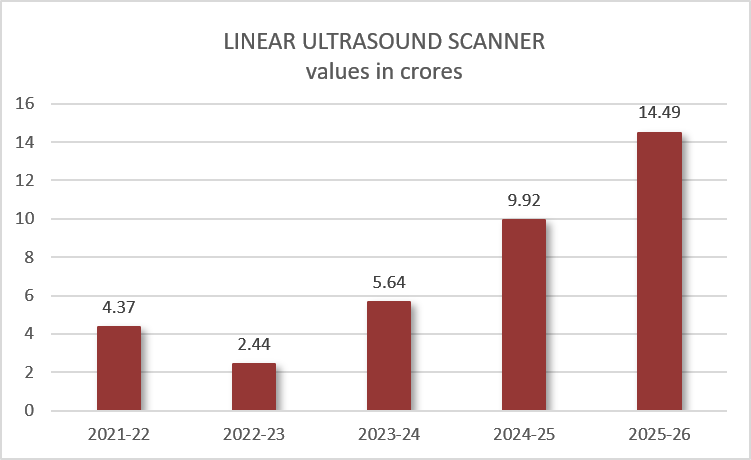
The US share of this import category remains small, but it is steadily climbing, reaching Rs.14.49 crores in 2025-26, a three-fold increase from the 2023-24 share. It signals a meaningful dependence, though it also shows that India draws from a much larger international supplier base for these particular devices.
Why can’t India build them yet?
It is easy to ask why a nation that lands rovers on the moon cannot manufacture a rotating X-ray tube or an MRI system. The honest answer lies in a combination of three separate problems: high-precision engineering requirements, tax policy anomalies, and Research and Development barriers.
Start with the engineering. An X-ray tube isn’t just glass and metal; it is an ultra-high vacuum environment containing a spinning (10,000 RPM) tungsten target that endures temperature spikes hot enough to melt most metals. A 1.5T MRI machine goes further still, requiring superconducting coils bathed in liquid helium at near absolute zero. India currently lacks the industrial equipment to process these specialised alloys and cryogenic systems at commercial scale.
Then there is the tax anomaly. Several reports have indicated that for years, Indian tax policy accidentally favoured companies for importing finished machines rather than building them locally. Since importing raw materials often incurred higher customs duties than a fully assembled, finished diagnostic device. Local entrepreneurs who wanted to build systems from scratch were put at a cost disadvantage despite attempting to manufacture locally.
Finally, there is the capital and patience problem. Designing an indigenous diagnostic scanner requires an upfront investment of Rs 200 to Rs 500 crore and a gestation period of 7-10 years for clinical trials, safety certifications and approvals from multiple bodies like the Central Drugs Standard Control Organisation (CDSCO) and the Atomic Energy Regulatory Board (AERB). For an Indian startup, finding investors willing to wait a decade for a return in a market dominated by multinational companies is an uphill battle.
The Self-Reliance Path of the Future
The picture, however, is beginning to shift slowly but visibly. Through strategic interventions like the National Medical Devices Policy 2023, the Production-Linked Incentive (PLI) schemes and specialised clusters like the Andhra Pradesh Medtech Zone (AMTZ) in Visakhapatnam, India is laying the groundwork for a genuine domestic MedTech ecosystem.
Moreover, companies such as Voxelgrids, with support from the Biotechnology Industry Research Assistance Council (BIRAC) under the National Biopharma Mission, has built a 1.5T MRI scanner. Its first clinical installation began patient diagnostics at the Chandrapur Cancer Care Foundation near Nagpur in December 2025. Skanray Technologies and Trivitron Healthcare have also demonstrated India’s growing medical-device manufacturing capabilities. In 2014, Skanray acquired Italy’s CEI, gaining ownership of specialized X-ray tube manufacturing technology.
By pairing the National Medical Devices Policy with targeted investments under the India Semiconductor Mission, correcting the inverted tariff structure, and supporting domestic startups, India can secure its oncology supply chains. Thus, India can protect its domestic healthcare ecosystem while emerging as a primary supplier of affordable, high-quality cancer diagnostics to the world.
India has already demonstrated its capabilities in generic pharmaceuticals, cost-effective space technology and digital public infrastructure. The next frontier is clear: India must move from assembling medical equipment to developing and manufacturing the critical healthcare technologies to realize the vision of Aatmanirbhar Bharat in true sense.
About the author

Arshik Anil Kumar is an aspiring policy professional with an M.A. in Public Policy, Law & Governance from Central University of Rajasthan. He is currently a TRIP intern.