In recent years, the UAE has also emerged as a favored higher education destination for Indian students; this could change after the current Middle East conflict. Several Indians in the Gulf have begun to move their assets to other countries.
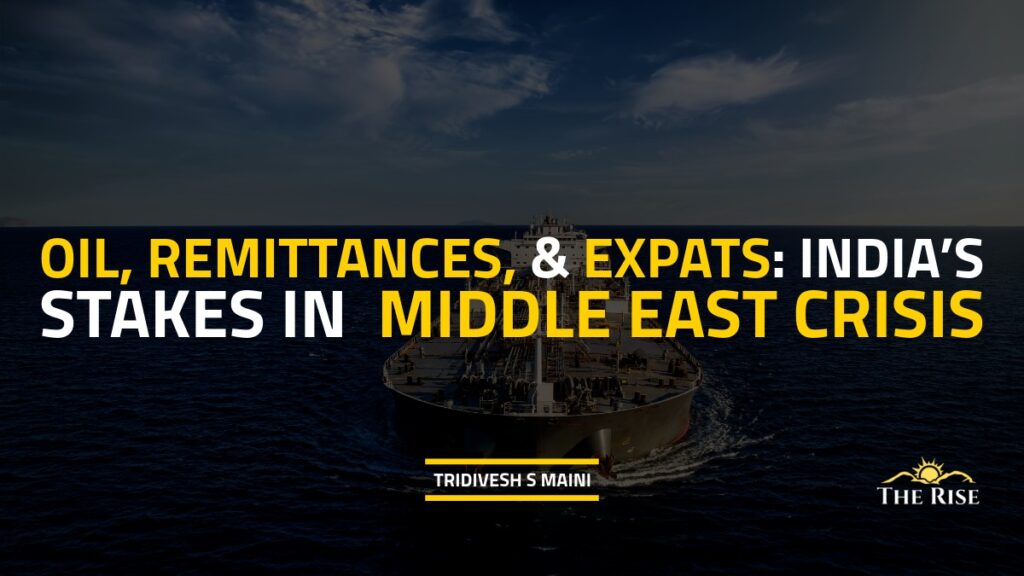
Two of the major concerns for India arising out of the current Middle East Conflict, which began on February 28, 2026, are: the safety of Indian expats in the Middle East and the Indian economy, especially the energy needs of the country.
Indian expats in the Gulf
Expats settled in the Middle East are estimated at 10 million. PM Modi has spoken to leaders of all GCC countries, Saudi Arabia, Bahrain, UAE, Qatar, Oman, and Kuwait. While condemning Iranian attacks on these countries, Modi also thanked the leaders of these countries for the support extended to the Indian community there.
India receives a significant percentage of remittances from the Gulf. In 2025, Gulf countries contributed over $ 50 billion of the total $135 billion remittances that India receives. Remittances account for over 3% (around 3-3.5%) of India’s GDP. In the long run, Indian expats in the Gulf will not be insulated from the economic impact of the conflict, and this could have ramifications for India, especially states like Kerala, which are heavily dependent upon remittances (according to estimates, there are well over 2 million Malayalis in the Gulf). It has also been argued that in the short-run there could be a rise in remittances – since expats may be looking at secure options- while a major impact on remittances is only likely if the conflict continues to intensify and expats are forced either to return to India or leave their jobs.
In recent years, the UAE has also emerged as a favored higher education destination for Indian students; this could change after the current Middle East conflict. Several Indians in the Gulf have begun to move their assets to other countries – especially Singapore.
Rise in oil prices
The current turmoil has also led to an effective disruption of shipping through the Strait of Hormuz, an important oil choke point, though it has not been formally declared closed.
Roughly 20% of global seaborne oil trade passes through this strait, while about 50–60% of India’s crude oil imports and a large share of its LNG imports are shipped through the Strait.
The conflict and the rising crude oil prices have resulted in a situation where the Indian market has witnessed its sharpest weekly decline in over a year.
According to Indian government sources, the country has enough stocks of crude oil and energy products (petrol and diesel) for the next 25 days each, accounting for a total of 50 days of stock.
It is not only oil; more than 13% of India’s non-oil exports pass through the Strait. India’s Rice Exporters are already beginning to feel the impact of this disruption, since Iran, Iraq, and Saudi Arabia are major markets for Basmati Rice (Middle Eastern and West Asian nations accounted for over two-thirds of India’s Basmati exports).
Currently, 37 Indian flagged ships are stranded in the Persian Gulf along with 1,100 crew members due to disruption in maritime traffic.
China is in talks with Iran to allow crude oil and Qatari liquefied natural gas (LNG) vessels safe passage through the Strait of Hormuz. When Iran’s Islamic Revolutionary Guard Corps IRGC said that Hormuz was closed to vessels from the United States, Israel, Europe, and their Western allies, there was a ray of hope for countries such as India.
Also Read: India-EU Ties Signal a Shift in the Global Power Order
Iran’s Deputy Minister of Foreign Affairs Dr. Saeed Khatibzadeh, on March 6, 2026, said: ‘We have not yet closed the Strait of Hormuz. If we are going to close it, we are going to announce it…It has not been closed by us. We have no intention to do it until further notice.’
A representative of the Naval Forces of the IRGC said that the vessels of some countries were allowed via the Strait, while as of March 5, 2026, more than 10 tankers had been hit.
Countries, including India, are thus likely to look at alternatives to oil trade through the Strait of Hormuz – unless Iran provides categorical assurances regarding safe passage of oil tankers and other vessels via the Strait.
US waiver to India for buying Russian oil
In the context of India’s energy needs, the US waiver to India for buying oil for 30 days is an important development. While announcing the same, US Treasury Secretary Scott Bessent said: ‘To enable oil to keep flowing into the global market, the Treasury Department is issuing a temporary 30-day waiver to allow Indian refiners to purchase Russian oil’.
Opposition leaders have questioned why India needs a go-ahead from the US for purchasing Russian oil. Amidst the geopolitical turbulence and significant economic challenges, this waiver will come as a temporary reprieve.
In conclusion, the current conflict in the Middle East is likely to have short-term effects as well as significant long-term implications for the Indian economy. All stakeholders need to work together to find solutions to deal with the economic challenges emerging from the conflict.
Disclaimer: The views expressed in this article are those of the author solely. TheRise.co.in neither endorses nor is responsible for them. Reproducing this content without permission is prohibited.
About the author

Tridivesh Singh Maini is a New Delhi-based Policy Analyst. He is faculty member of OP Jindal Global University, Sonepat, Haryana.