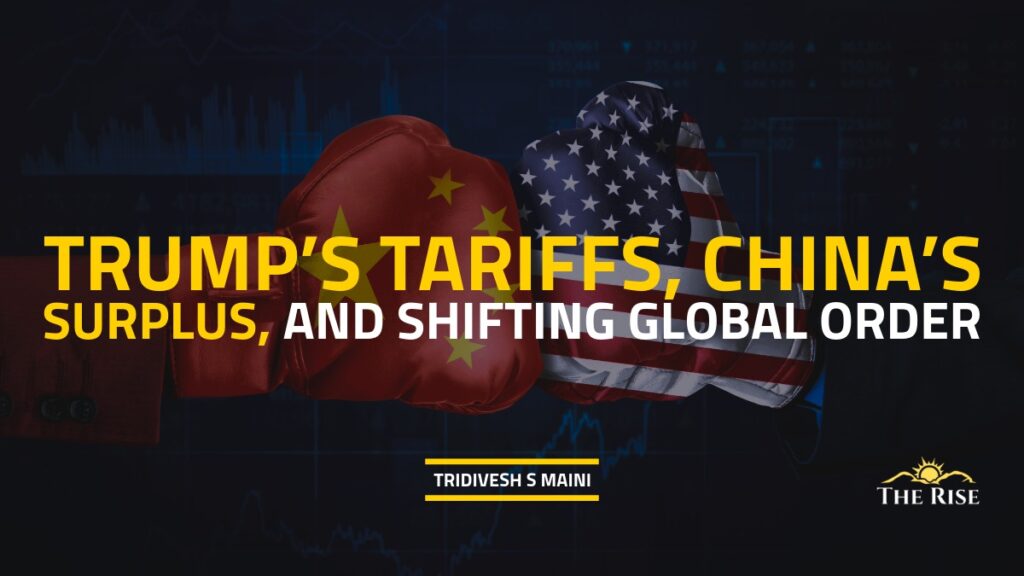
While it is true that, for now, Beijing has managed to navigate the turmoil and unpredictability arising from Trump’s tariffs, persistently large trade surpluses could strain China’s bilateral economic relations with multiple partners.
While the global attention is focused on developments in Venezuela, turmoil in Iran and the growing rift between Saudi Arabia and the UAE, these crises will have ramifications well beyond their respective regions, generating important geopolitical realignments and foreign policy recalibrations.
Beijing’s trade surplus
Amidst all the turmoil and uncertainty, Beijing has managed to close the year 2025 with a record trade surplus of over $ 1 trillion, marking nearly 20% increase over 2024. During Trump 2.0, ties between China and the US have witnessed a downturn, with the US President accelerating trade wars with China. As has been the case with ties with several other countries, Trump has given mixed and often contradictory signals.
Turmoil in Iran and announcement regarding sanctions on countries trading with Iran
On January 13 2026, the US President announced 25% tariffs on countries trading with Iran. This move was aimed at building pressure on the Iranian government, which has sought to brutally suppress the anti-government protests, which are now in their third week. As of Wednesday, over 2,000 casualties have been reported in the protests, which initially began due to the growing resentment over the economic challenges plaguing the country. Washington has given mixed signals regarding any direct intervention in Iran, even as reports suggest that the US has begun evacuating its troops from the Al Udeid Air Base, the largest US airbase in the region
“Effective immediately, any country doing business with the Islamic Republic of Iran will pay a Tariff of 25 per cent on any business being done with the United States of America. This Order is final and conclusive,” said Trump in a post on Truth Social.
China’s reaction to Trump tariffs
A spokesperson for the Chinese Embassy in the United States said in a post on X that China “firmly opposes any illicit unilateral sanctions and long-arm jurisdiction.”
China is the largest exporter of Iranian oil, though in 2025, it has significantly reduced its imports from Iran. Donald Trump has also given a go-ahead to a bill titled the ‘Sanctioning Russia Act of 2025‘, which seeks to impose 500% tariffs on countries purchasing oil from Russia.
China’s exports in 2025 and global geopolitics
In 2025, China’s exports to the U.S. fell sharply by 20%, while those to Africa jumped over 25% (26%). Exports to Southeast Asian countries rose by 13%, while to the European Union and Latin America also witnessed a rise of 8% and 7%, respectively. One of the key factors which has given a fillip to China’s exports is the weakening Yuan.
Also Read: Venezuela Exposes the Crisis of Global Humanitarian Governance
Several countries in Africa and South-East Asia that had earlier expressed scepticism over their overdependence on China have since then course-corrected. This recalibration has not been limited to trade alone. Beijing has also sought to address the concerns of certain countries regarding the Belt and Road Initiative (BRI) and has re-negotiated earlier agreements, though differences persist.
The year 2025 also witnessed a reduction of tensions between China and India, with Prime Minister Narendra Modi visiting Tianjin for the Shanghai Cooperation Organisation (SCO) meet. How ties between the two countries evolve in 2026, at a time of global churn and with India assuming the BRICS presidency, remains to be seen.
Need for nuance vis-à-vis China’s trade surplus
Here, it would be pertinent to point out that several domestic challenges, particularly the ongoing property crisis, have made domestic consumers more tentative vis-à-vis spending. Reaction to these figures, therefore, needs to be nuanced. While it is true that, for now, Beijing has managed to navigate the turmoil and unpredictability arising from Trump’s tariffs, persistently large trade surpluses could strain China’s bilateral economic relations with multiple partners.
Conclusion
In conclusion, while Donald Trump’s tariff measures appear aimed at consolidating support among his domestic political base, several important X factors remain. Rising inflation in the US, the possibility of adverse judicial rulings on tariffs, domestic political churn ahead of the 2026 mid-term elections, and pressure from within the Republican Party could all pose challenges to Trump’s increasingly insular economic policies.
If the US wants to ensure a modicum of stability in the world order and not further undermine its global standing, it needs to strengthen ties with allies and partners rather than sending mixed signals while following a more well-thought-out policy vis-à-vis China. Mere posturing and reactionary measures will not work, as evidenced by China’s growing trade surplus and the overall global chaos and uncertainty.
Disclaimer: The views expressed in this article are those of the author solely. TheRise.co.in neither endorses nor is responsible for them. Reproducing this content without permission is prohibited.
About the author

Tridivesh Singh Maini is a New Delhi-based Policy Analyst. He is faculty member of OP Jindal Global University, Sonepat, Haryana.