
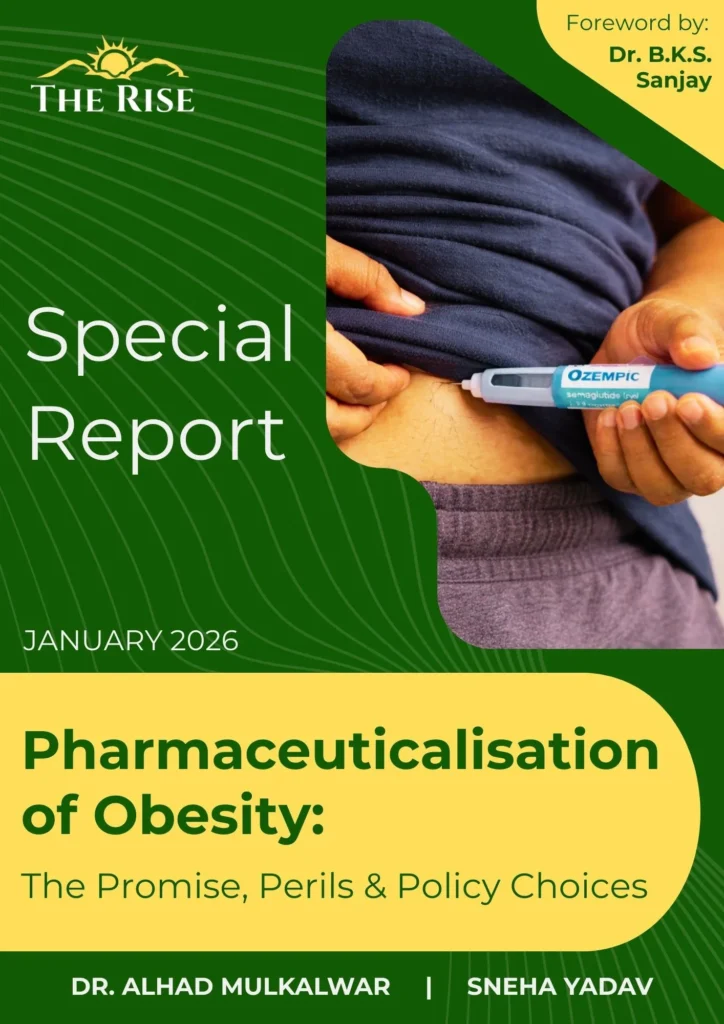
Obesity has emerged as a defining public health challenge of the twenty-first century, with rising prevalence across the globe. Advances in endocrinology, metabolism, and neurobiology have shifted obesity from a behaviourally framed condition to a chronic, relapsing disease, a reconceptualisation endorsed by global health authorities. This shift has not only reduced moral blame, but it has also accelerated pharmaceutical approaches, particularly with the advent of highly effective anti-obesity drugs such as GLP-1 receptor agonists and dual incretin therapies. Ozempic, Wegovy, Mounjaro and many others are the buzzwords today. People are increasingly ingesting semaglutide and tirzepatide as if these were sugar pills.
This report critically examines the global and regional forces driving the pharmaceutical pathologisation of obesity and its clinical, ethical, economic, and policy implications, with particular focus on low- and middle-income countries (LMIC), especially India. While obesity pharmacotherapy represents a major scientific advancement for individuals with severe obesity and metabolic disease, its rapid mainstreaming raises concerns about equity, long-term safety, stigma, and the narrowing of public health priorities.
Globally, obesity’s disease classification reflects evidence that body weight is regulated by complex hormonal, neural, and genetic systems that actively resist sustained weight loss. Formal recognition has catalysed innovation, positioning obesity drugs as a highly lucrative pharmaceutical market. New agents, such as semaglutide and tirzepatide, achieve weight loss comparable to that of bariatric surgery, and improve key cardiometabolic risk markers. However, discontinuation commonly leads to weight regain, implying the need for long-term or lifelong use, even while evidence on the safety of such use over decades remains limited.
These issues are amplified in India, where obesity coexists with undernutrition, micronutrient deficiencies, and profound socio-economic inequalities. Earlier metabolic risk at lower BMI thresholds creates a greater imperative for anti-obesity intervention, while simultaneously increasing the risk of over-medicalisation.
Get a hard copy delivered at your doorstep:
Terms & Conditions:
- Order cancellation procedure: Mail at support@therise.co.in requesting order cancellation with a valid reason within the first 24 hours of order placement. The payment receipt must be mandatorily attached, without which no order cancellation request will be entertained.
- Returns/Replacement: No return/replacement is possible
- Refunds: The complete amount is refundable if the order cancellation request is received at support@therise.co.in within the first 24 hours of the order placement. Refund will be issued in 5-7 working days.
About the author

Dr. Alhad Mulkalwar is an MBBS graduate from Seth GS Medical College and King Edward Memorial Hospital, Mumbai. Alongside a profile of 80+ publications, multiple awards and keynote addresses, he also serves as the Trustee of the QMed Knowledge Foundation which trains students and professionals in structured literature searching and referencing.

Sneha Yadav is an electronics engineer with a postgraduate degree in political science. Her interests span contemporary social, economic, administrative, and political issues in India. She has worked with CSDS-Lokniti and has been previously associated with The Pioneer and ThePrint.
-
Sneha Yadav

-
Sneha Yadav
-
Sneha Yadav
-
Sneha Yadav
-
Sneha Yadav
-
Sneha Yadav
-
Sneha Yadav
-
Sneha Yadav
-
Sneha Yadav
-
Sneha Yadav
-
Sneha Yadav
-
Sneha Yadav
-
Sneha Yadav
-
Sneha Yadav
-
Sneha Yadav
-
Sneha Yadav
-
Sneha Yadav
-
Sneha Yadav
-
Sneha Yadav
-
Sneha Yadav
-
Sneha Yadav
-
Sneha Yadav
-
Sneha Yadav
-
Sneha Yadav
-
Sneha Yadav
-
Sneha Yadav
-
Sneha Yadav
-
Sneha Yadav
-
Sneha Yadav
-
Sneha Yadav
-
Sneha Yadav
-
Sneha Yadav
-
Sneha Yadav















































































Very well written ब्द presented article. Obesity is indeed alarming . Lack of physical activities , addiction to junk food and sedentary life style must be checked at home and by parents .
Much-needed report. No one was writing in-depth about this rising issue. Few of my elite friends are also taking Ozempic and Wegovy. This is sheer laziness-driven consumerism amplified by glamourisation of these drugs and normalised by reel culture. These are the new “Narcotics” engulfing India’s Gen Z. Government must not just regulate them, but also initiate massive drive to aware citizens of its ill-effect. Kudos to the author. Very well placed to address this issue right before it become a Frankenstein monster.