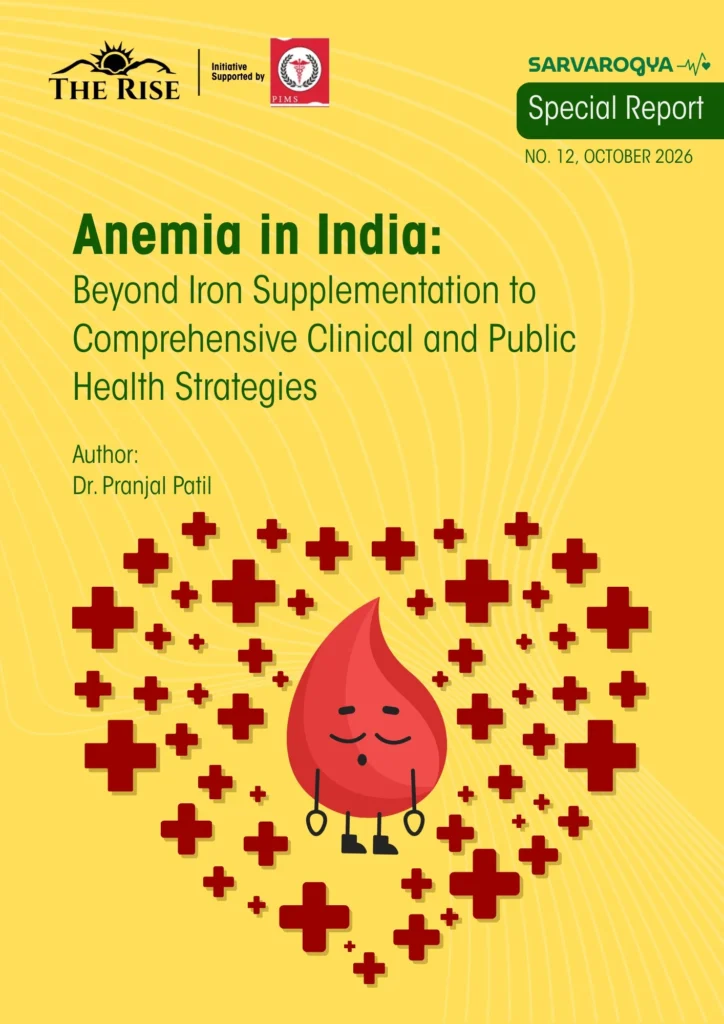
In India, anemia is one of the biggest public health challenges, with 57% of women and nearly two-thirds of children affected by it. Its effects go far beyond low hemoglobin levels, leading to poor maternal and newborn outcomes, and reduced productivity. Despite decades of implementing national policies, anemia continues to remain widespread because it has been treated as a single condition, while in reality it has multiple causes that are at times overlooked by policymakers.
Anemia in India comprises different disorders with distinct causes, including nutritional deficiencies (Iron & vitamin deficiencies), hereditary disorders (thalassemia and sickle cell disease), anemia due to chronic disease, inflammation and infection. Most screening programs rely on hemoglobin testing, which confirms a person is anemic but dies not establish the cause. Tests such as serum ferritin, C-reactive protein (CRP) and hemoglobin electrophoresis are important confirmatory tests that help identify specific causes, but are rarely available at the primary health care setting, making cause specific treatment difficult. Poor water, sanitation and hygiene (WASH) further contribute to recurrent infections which increases the anemia burden.
India’s Anemia Mukt Bharat (AMB) program has established a nationwide, multisectoral response through nutrition, iron supplementation, deworming, screening, and behavior change. However, evidences show that an iron-folic acid centred approach alone cannot address anemia arising from non-nutritional or mixed causes.
A more comprehensive response requires stronger diagnostic capacity alongside existing interventions. Potential steps to manage anemia like non-invasive screening techniques, digital integration through ABDM and e-Aushadhi, and the utilization of ferric carboxymaltose (FCM) as a diagnosis-confirmed intervention for patients who have been diagnosed with severe iron deficiency anemia, are rarely available at the primary health centre .
To address these gaps, the report proposes a three-tier policy framework to combat anemia. The first tier focuses on Diagnostic and Data Infrastructure, using the proposed “National Anemia Etiology Dashboard” to track cause-specific surveillance of anemia. The second tier improves service delivery by improving diagnostic skills among frontline healthcare workers and encouraging timely referrals. The third tier promotes community ownerships and behavioural interventions by promoting the role of ASHA workers. Collectively, these tiers aim to ensure that resources are directed at appropriate areas to eliminate the underlying causes of anemia.
A realistic transition towards this approach is feasible, and most importantly, the need of the hour. By shifting gears from a predominantly iron-centred programme to one that is precise, data-driven, and community-owned, India can climb the ladder of improving maternal health, promoting healthier child development, increasing productivity, and building a healthier future generations.
Get a hard copy delivered at your doorstep:
Terms & Conditions:
- Order cancellation procedure: Mail at support@therise.co.in requesting order cancellation with a valid reason within the first 24 hours of order placement. The payment receipt must be mandatorily attached, without which no order cancellation request will be entertained.
- Returns/Replacement: No return/replacement is possible
- Refunds: The complete amount is refundable if the order cancellation request is received at support@therise.co.in within the first 24 hours of the order placement. Refund will be issued in 5-7 working days.
About the author

Dr. Pranjal Patil is a MBBS graduate from Dr. Vaishampayan Memorial Government Medical College, Solapur. Her interests span clinical medicine, medical research & writing, and the evolving integration of healthcare into artificial intelligence. She is currently a SarvArogya intern.
-
This author does not have any more posts.

Sneha Yadav is an electronics engineer with a postgraduate degree in political science. Her interests span contemporary social, economic, administrative, and political issues in India. She has worked with CSDS-Lokniti and has been previously associated with The Pioneer and ThePrint.
-
Sneha Yadav

-
Sneha Yadav
-
Sneha Yadav
-
Sneha Yadav
-
Sneha Yadav
-
Sneha Yadav
-
Sneha Yadav
-
Sneha Yadav
-
Sneha Yadav
-
Sneha Yadav
-
Sneha Yadav
-
Sneha Yadav
-
Sneha Yadav
-
Sneha Yadav
-
Sneha Yadav
-
Sneha Yadav
-
Sneha Yadav
-
Sneha Yadav
-
Sneha Yadav
-
Sneha Yadav
-
Sneha Yadav
-
Sneha Yadav
-
Sneha Yadav
-
Sneha Yadav
-
Sneha Yadav
-
Sneha Yadav
-
Sneha Yadav
-
Sneha Yadav
-
Sneha Yadav
-
Sneha Yadav
-
Sneha Yadav
-
Sneha Yadav
-
Sneha Yadav
-
Sneha Yadav