Maritime Defence today, more than any operations in the world, is focused majorly on anti-submarine warfare (ASW) operations, because submarines pose a serious threat to navies that face them and are a boon to those who possess them. They are now the most sophisticated of technologies, held by only a few countries.
Two and a half centuries have passed since human exploration of the depths of the oceans evolved from exploration and trade to warfare. Seas were used by men for the discovery of civilization, for trade, for spices and the list goes on. The tale of a submarine is fascinating like the vessel itself. Like any new invention to mankind, submarines were deemed impractical.
The vessels once seen as the “death coffins” that only the daring or the foolish would voluntarily embark on, are today deemed among the most sophisticated war weapon of the 21st century. Only the brave can operate them. There is no room for cowardice (literally, submarines are tight).
Also Read: Breaking the Dam: How India Can Abrogate the Indus Waters Treaty
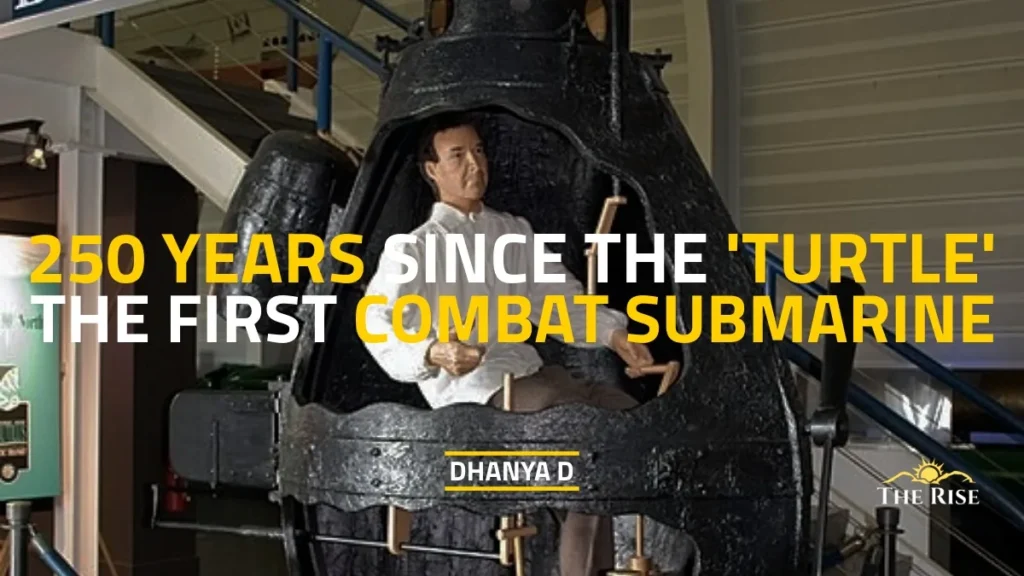
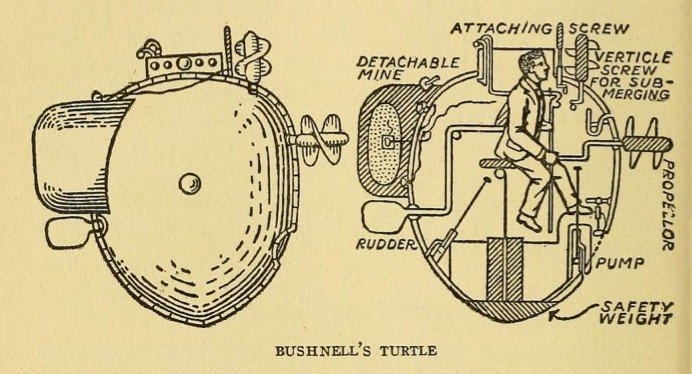
This article pays homage to the lineage of submarines by paying tribute to David Bushnell’s submarine the “Turtle”, which had the first ever propelling device and paved the way for its successors. Bushnell, who invented the underwater craft, built an oar that could be operated with a turn of a screw, by hand or by foot.
The submarine was shaped like an egg and was built to hold a single person. The vessel operated by the person seated inside, looked like a bicycle in its prototype design. Once submerged, the operator propelled the vessel using a rudder turned by foot, with two levers that turned the screws. The submarine had a ballast system which pumped the water out, controlling its buoyancy. The vessel carried instruments like a depth gauge and a compass with a luminous dial to navigate underwater.
Sergeant Ezra Lee was the soldier chosen to operate the Turtle. As the American colonies grew restless under King George III and the British declared a blockade of American ports, Bushnell thought the submarine could be used as a combat device against them. George Washington also believed the underwater craft would help break the blockade.
In September 1776, when Britain’s flagship HMS Eagle was harboured in New York, the Turtle took off with Sergeant Lee. The sub carried over a hundred pounds of gun powder in a magazine in its hull, which would blow up the warship when detonated through a device. The Turtle came close to doing exactly that, but HMS Eagle could not be penetrated to lodge the gun powder, as the hull had iron straps. After a while of trying a strong tide pushed the Turtle away along with Sergeant Lee, who narrowly escaped.
Although the Turtle did not impact the American Revolutionary War, it was a testament to the fact that underwater warfare was the deal for the years to come. Bushnell later went on to invent torpedoes, that could be launched by both land and sea.
The Turtle was also a testament to human intelligence and to pushing boundaries of warfare. The offshoots of inventions that came out of the expertise of the building the Turtle are the torpedoes, conning tower and the propeller.
Submarines are used by smaller navies today to gain sea control, it gives them an advantage over larger navies with huge aircraft carriers. Like the Turtle that went up against a formidable Great Britain, the concealment of the submarine gives the disadvantaged an advantage to the countries to sustain their sovereignty. Maritime Defence today, more than any operations in the world, is focused majorly on anti-submarine warfare (ASW) operations, because submarines pose a serious threat to navies that face them and are a boon to those who possess them. They are now among the most sophisticated of technologies, held by only a few countries, and no navy is deemed complete without a submarine arm.
David Bushnell’s Turtle was a vision that was beyond its time, and the humble vessel has led the way to what is now considered as the premier maritime force.
Disclaimer: The views expressed in this article are those of the author solely. TheRise.co.in neither endorses nor is responsible for them. Reproducing this content without permission is prohibited.
About the author

Dhanya D is a Research Scholar at the Department of Defence and Strategic Studies, University of Madras. Her research focuses on contemporary Maritime Security.