IISCO’s blast furnaces, open-hearth furnaces and rolling mills had become technologically outdated. Even as the global steel industry shifted toward basic oxygen furnaces — a far more efficient method of steelmaking — IISCO continued relying on traditional open-hearth furnaces, where steelmaking cycles were significantly slower and more energy intensive. Frequent mechanical failures led to repeated shutdowns for repairs, disrupting production cycles and increasing costs.
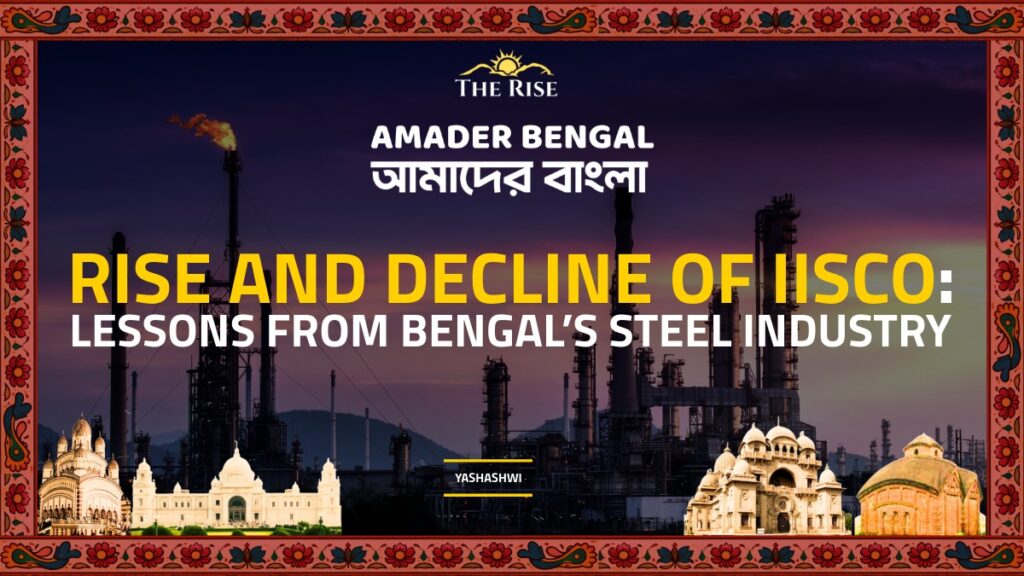
The year was 1918. The First World War was still raging, and India remained under British colonial rule. Steel had become a strategic commodity for the empire — required for railways, military logistics and expanding infrastructure. Maritime disruptions across the Indo-Pacific had severely limited access to imported steel, forcing the colonial administration to accelerate domestic production.
It was in this context that the Indian Iron and Steel Company (IISCO) emerged in the Burnpur industrial belt of present-day West Bengal. Located near the coal-rich Raniganj coalfields, the plant quickly developed into one of the earliest pillars of India’s industrial economy.
For decades, IISCO played a crucial role in supplying materials that underpinned the country’s infrastructure. Nearly two-thirds of the spun pipes required for water supply systems, sewage networks and pipeline infrastructure across India were manufactured at the plant. Its steel also fed railway expansion, bridge construction, power projects and engineering works across eastern India.
At its peak, IISCO was among the most prominent industrial companies in India. In the early 1960s, it was a leading listing on the Calcutta Stock Exchange and its shares were also quoted on the London Stock Exchange.
Yet the trajectory of IISCO gradually shifted from expansion to stagnation. By the late 1960s and early 1970s, structural weaknesses had begun to surface.
“IISCO has continued to make losses over the years due to technological obsolescence, ageing of plant and equipment, outmoded technology, lack of necessary capital inputs, etc.,” said Braja Kishore Tripathy, then Minister of Steel in the Parliament in 2002.
A major backdrop to this shift was the Industrial Policy Resolution (IPR) of 1956, often described as the “Bible of State Capitalism” in India. Under Schedule A of the resolution, industries considered strategically vital, such as iron and steel, were reserved exclusively for the public sector. Government investment began flowing primarily toward newly built public sector steel plants such as Bhilai, Rourkela and Bokaro. As capital and policy attention shifted to these new facilities, older plants like IISCO found themselves increasingly sidelined when it came to modernisation and expansion.
Also Read: The Makhana Paradox: Bihar Grows It, Others Gain
At the same time, operational challenges within IISCO began to intensify. Production fell from about 970,000 tonnes in 1965–66 to roughly 617,000 tonnes by 1971–72.
Much of this decline stemmed from the plant’s ageing metallurgical infrastructure. IISCO’s blast furnaces, open-hearth furnaces and rolling mills had become technologically outdated. Even as the global steel industry shifted toward basic oxygen furnaces — a far more efficient method of steelmaking — IISCO continued relying on traditional open-hearth furnaces, where steelmaking cycles were significantly slower and more energy intensive. Frequent mechanical failures led to repeated shutdowns for repairs, disrupting production cycles and increasing costs.
Eventually, the government decided to intervene more directly. In 1972, IISCO was nationalised. Later, in 1979, the company was integrated into the Steel Authority of India Limited (SAIL), bringing it formally under the umbrella of India’s public sector steel industry.
However, several problems persisted despite this takeover. By the late 1980s, sections of trade unions opposed modernisation initiatives, fearing that automation and technological upgrades could lead to large-scale job losses. In an industrial region where employment was closely tied to the survival of the steel plant, such concerns carried significant political weight.
These tensions were further complicated by differences between the central government, which controlled steel policy and public-sector investment, and the then-left-ruled West Bengal state government, which prioritised trade union rights in the region.
What had once been one of India’s proudest industrial enterprises was now fighting a prolonged battle for survival. Recognising the severity of the crisis, the government referred the company to the Board for Industrial and Financial Reconstruction (BIFR), which in 1987 classified IISCO as a “sick unit” requiring rehabilitation.
The broader economic transformation of India in the early 1990s further intensified these challenges as India moved toward liberalisation, privatisation and global integration. While domestic steel demand continued to grow, much of this demand was increasingly met by newer plants and technologically advanced private producers. IISCO found itself competing in a market where efficiency, technology and scale had become decisive factors.
Today, IISCO continues to operate under Steel Authority of India Limited, while facing new challenges such as inland logistical disadvantage, the pressures of the global carbon transition, and competition with private producers.
The story of IISCO is therefore not merely the story of a single steel plant; it is a cautionary tale about the costs of delayed industrial adaptation. When technological modernisation is repeatedly postponed, manageable operational stress gradually hardens into structural decline. In IISCO’s case, years of treating the plant as a “white elephant” delayed decisive intervention, allowing inefficiencies to accumulate and dramatically raising the eventual cost of revival.
As India seeks to revitalise its eastern industrial belt, the lessons of IISCO remain relevant. Sustaining West Bengal’s iron and steel industry will require a forward-looking industrial strategy built on technological upgrades, improved freight and industrial corridor connectivity, a skilled workforce, and investment in low-carbon steelmaking technologies. Without such reforms, the region risks repeating the very cycle of neglect and delayed reform that once pushed one of India’s most iconic steel enterprises into crisis.
Yashashwi Chandra is an intern under Amader Bengal
Mentored and Edited by Sneha Yadav
References
- Frontline. (2019). On Its Last Leg. https://frontline.thehindu.com/economy/article30252435.ece
- The Reason Why. (1972). Economic and Political Weekly, 7(30), 1390–1391. http://www.jstor.org/stable/4361611
- Ghosh, A. (1994). Indian Steel Industry: Problems and Prospects. Economic and Political Weekly, 29(33), 2121–2124. http://www.jstor.org/stable/4401615
- Merger In The Offing. (2004). Economic and Political Weekly, 39(37), 4120–4120. http://www.jstor.org/stable/4415520
- Firth, John & Liu, Ernest. (2018). Manufacturing Underdevelopment: India’s Freight Equalization Scheme, and the Long-run Effects of Distortions on the Geography of Production. https://share.google/oNCslueD8LdaVLF4x
- Modernisation Plans on Paper. (1987). Economic and Political Weekly, 22(1/2), 1–1. http://www.jstor.org/stable/4376509
- Ministry of Steel. (2002). Next Release. https://archive.pib.gov.in/archive/releases98/lyr2003/rjan2003/21012003/r210120035.html
- Rajya Sabha. (2002). Closure of Kulti Works of IISCO. https://rsdebate.nic.in/bitstream/123456789/102574/1/PQ_196_19072002_S83_p11_p21.pdf
About the author

Yashashwi is an undergraduate student of English literature at Lady Shri Ram College for Women, University of Delhi with academic interests in polity, law, psychology. She is currently an intern under Amader Bengal.

Sneha Yadav is an electronics engineer with a postgraduate degree in political science. Her interests span contemporary social, economic, administrative, and political issues in India. She has worked with CSDS-Lokniti and has been previously associated with The Pioneer and ThePrint.