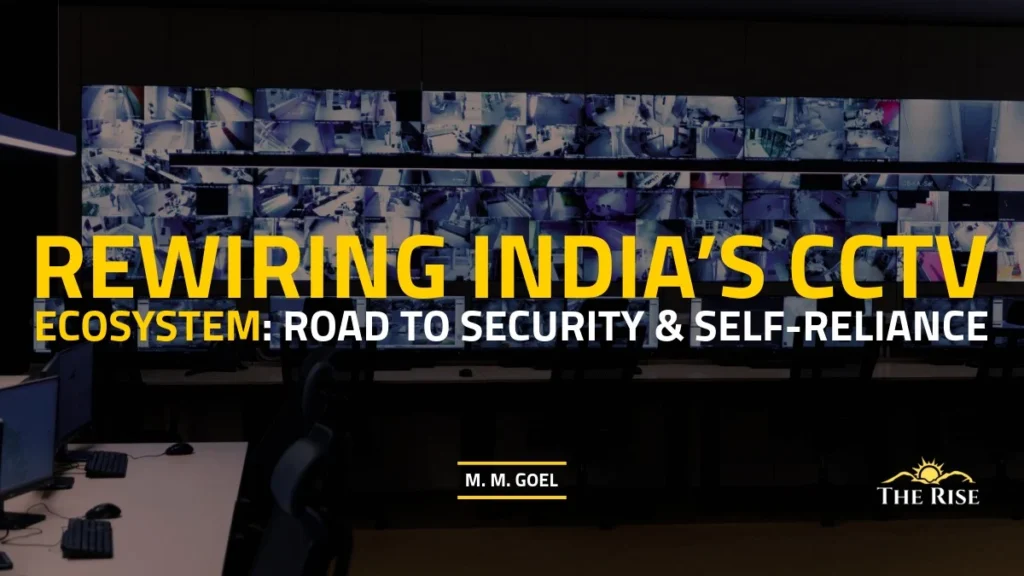
Surveillance systems, by their very nature, are custodians of sensitive information. When their integrity is in question, the risks extend beyond isolated breaches to systemic threats that affect governance, defense preparedness, and citizen privacy.
The Needonomics school of thought interprets the recent developments in India’s CCTV and surveillance ecosystem as a defining moment of structural transformation. What appears at first glance to be a security-driven regulatory intervention, in reality, is a deeper and more deliberate shift toward ethical governance, technological sovereignty, and economic self-reliance. This transition reflects not only a response to emerging threats but also a conscious reorientation of national priorities in line with need-based and value-driven decision-making.
The trigger for this shift can be traced to alarming developments reported in March, when solar-powered, China-manufactured CCTV systems—affordable, easily accessible through e-commerce platforms, and capable of operating independently via 4G connectivity—were allegedly used by Pakistan’s Inter-Services Intelligence (ISI) for espionage in North India. These incidents exposed critical vulnerabilities in India’s surveillance infrastructure, particularly the risks associated with unregulated imports of smart devices embedded with opaque technologies and external data dependencies.
Such revelations forced policymakers to confront an uncomfortable reality: that convenience and cost-efficiency, when pursued without adequate scrutiny, can compromise national security. Surveillance systems, by their very nature, are custodians of sensitive information. When their integrity is in question, the risks extend beyond isolated breaches to systemic threats that affect governance, defense preparedness, and citizen privacy.
In response, India undertook a decisive overhaul of its surveillance equipment regulations effective from April 1, 2026, introducing stricter certification norms and effectively barring Chinese companies from participating in the domestic CCTV market. While widely perceived as a security-centric move, NST emphasizes that limiting its interpretation to national security alone presents an incomplete picture.
From a Needonomics perspective, this regulatory shift represents a broader and more meaningful transformation—one that integrates security concerns with the principles of Atmanirbharta (self-reliance), ethical consumption, and sustainable economic development. It is not merely about restricting foreign participation but about fostering a resilient and trustworthy domestic ecosystem capable of meeting the nation’s surveillance needs without external vulnerabilities.
A key element of this transition is the Ministry of Home Affairs’ directive prioritizing Indian suppliers in government procurement processes. This marks a significant departure from earlier practices that often favored low-cost imports over long-term value creation. The new approach signals a strategic shift from price sensitivity to trust sensitivity—from short-term savings to long-term security and sustainability.
Also Read: Needonomics: Bringing Morality Back to Economics
Encouragingly, this policy direction is already yielding tangible outcomes. Indian companies such as CP Plus, Quba, Matrix, and Sparsh have emerged as credible players in the CCTV manufacturing space, demonstrating that domestic enterprises can compete not only on cost but also on quality, reliability, and innovation. By 2025, Indian firms are estimated to command nearly 80 percent of the domestic CCTV market-a milestone that underscores the success of this calibrated policy intervention.
This evolution of the CCTV ecosystem illustrates the “rewiring” of decision-making frameworks. For years, India’s surveillance infrastructure remained dependent on imported technologies, particularly from China, raising persistent concerns about data security and potential external control. However, the response was often reactive and fragmented, lacking a coherent long-term vision.
Also Read: Bharat Maritime Insurance Pool: India’s Shield Against Global Shipping Risks
The current shift, in contrast, reflects a more holistic and proactive approach. It recognizes that true security cannot be achieved through restrictions alone but requires the creation of robust domestic capabilities supported by strong regulatory frameworks and ethical governance practices.
Needonomics provides a valuable lens to understand this transformation. At its core, the philosophy advocates disciplined and mindful consumption—choosing what is necessary, appropriate, and aligned with collective well-being rather than being driven by excess, impulse, or superficial cost advantages. Applied to surveillance technologies, this translates into prioritizing systems that are secure, transparent, and accountable within the national ecosystem.
From this standpoint, the issue is not simply about banning certain products or countries. It is about redefining the criteria for technological adoption. Affordability, while important, must not come at the cost of sovereignty. Accessibility should not undermine accountability. And convenience must not override consciousness.
The rewiring of India’s CCTV ecosystem also highlights the importance of value addition within the domestic economy. By encouraging indigenous manufacturing, the policy not only enhances security but also generates employment, fosters innovation, and strengthens supply chain resilience. It aligns economic objectives with strategic imperatives, creating a virtuous cycle of growth and self-reliance.
At the same time, the transition underscores the need for continuous capacity building. Developing a robust surveillance ecosystem requires sustained investment in research and development, skill enhancement, and technological upgradation. It also calls for stringent quality standards and certification mechanisms to ensure that domestic products meet global benchmarks of performance and security.
Furthermore, regulatory vigilance must remain dynamic and forward-looking. As surveillance technologies evolve, integrating artificial intelligence, cloud computing, and Internet of Things (IoT) capabilities, the associated risks will also become more complex. Addressing these challenges will require not only technical expertise but also ethical clarity and institutional coordination.
In this context, Needonomics emphasizes the role of governance as a facilitator of balanced and informed choices. Policies must be designed not merely to respond to crises but to anticipate future challenges and guide the ecosystem toward sustainable outcomes. This involves engaging multiple stakeholders, including industry, academia, and civil society, in a collaborative framework.
India’s evolving approach to CCTV regulation thus represents more than a policy adjustment; it signifies a paradigm shift. It marks the transition from reactive security measures to proactive ecosystem building, from dependence to self-reliance, and from cost-centric thinking to value-centric governance.
As the country navigates the complexities of an increasingly digital and interconnected world, such shifts will become essential across multiple sectors. The challenge is not limited to protecting physical borders but extends to securing digital infrastructures that underpin modern life.
In this journey, the principles of Needonomics offer a guiding compass. They remind us that sustainable progress lies in aligning choices with genuine needs, ethical considerations, and long-term well-being. By embracing this approach, India can not only strengthen its surveillance ecosystem but also set a precedent for responsible and resilient technological development.
Ultimately, the rewiring of India’s CCTV ecosystem is not just about surveillance-it is about vision that integrates security with self-reliance, technology with trust, and policy with purpose. It is a step toward building a nation that is not only protected but also prepared, not only efficient but also enlightened.
Disclaimer: The views expressed in this article are those of the author solely. TheRise.co.in neither endorses nor is responsible for them. Reproducing this content without permission is prohibited.
About the author

Prof. Madan Mohan Goel, Former Vice Chancellor and Propounder of Needonomics School of Thought.