During her visits to the coal mines of the Jharia region, Renuka Ray personally observed the harsh and often dangerous conditions in which women labourers worked, many of them spending long hours in unhealthy surroundings with little protection or security. The experience left a lasting impression on her.
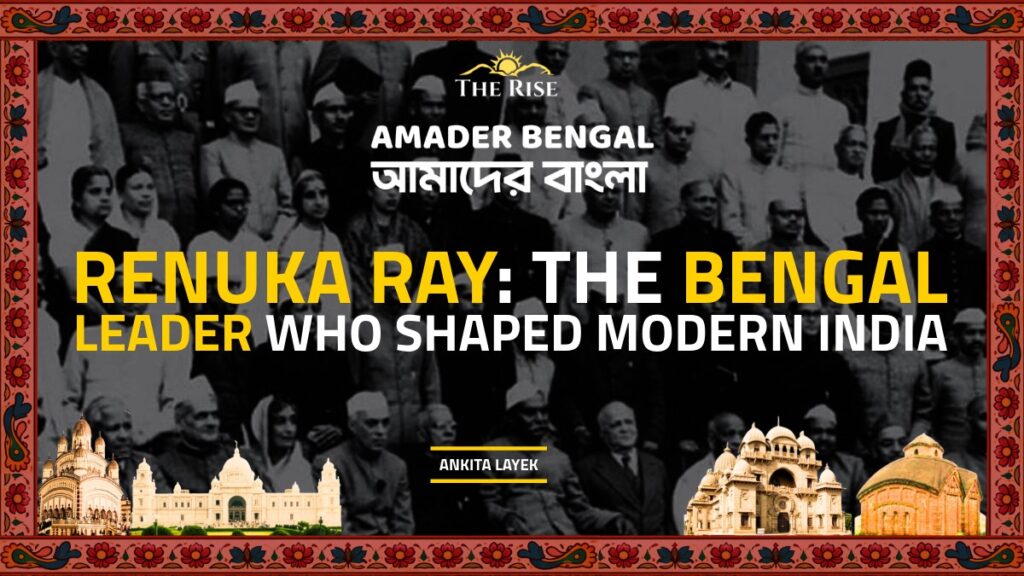
When the Constitution of India was being drafted between 1946 and 1949, the Constituent Assembly was dominated by towering political figures. Among them stood a small group of just 15 women. In this group was Renuka Ray, a representative from West Bengal, who emerged as a forceful voice on questions of equality, secularism, education, and social justice. Her ideas reflected a belief that freedom must bring real social change, especially for the disadvantaged, making her one of the early pioneers who worked to expand the idea of social justice and secularism in India.
“We have never stood nor do we stand today for Hindu domination; we do not want that Hindus as such as a religious community shall override any other interests. But we do want that India’s interests shall be paramount, that the interests of no special community shall stand in the way, whether it is a majority or a minority religious community,” said Renuka Ray in the Constituent Assembly on the question of religious minorities.
Also Read: Zheng Yi Sao: The Pirate Queen Who Brought British and Portuguese to Knees
Born in 1904 in the Bengal Presidency of British India, Renuka Ray grew up in a politically and socially active family. Though born into a family with colonial loyalties, she gradually embraced Gandhian ideals and developed a strong commitment to India’s national movement. She went abroad to complete her education at Kensington School in London and later at the London School of Economics, where she encountered new ideas on social reform and public policy.
After returning to India, Renuka Ray became deeply involved in public life and social reform. As a member of the All India Women’s Conference, she campaigned for women’s inheritance rights and legal equality. As the organisation’s Legal Secretary, she prepared a report on the legal disabilities faced by Indian women, highlighting inequalities within personal laws and arguing that legal reform was necessary to improve women’s social status. She consistently supported the idea of a uniform personal law framework and believed that legal equality was essential for meaningful freedom.
Also Read: Ancient Indian Laws on Women’s Rights: From Rig Vedic Equality to Modern Patriarchy
During her visits to the coal mines of the Jharia region, Renuka Ray personally observed the harsh and often dangerous conditions in which women labourers worked, many of them spending long hours in unhealthy surroundings with little protection or security. The experience left a lasting impression on her, and she later argued that women should be removed from hazardous forms of labour and provided with safer and more dignified employment opportunities. She also spoke strongly against the trafficking of women and the systems of exploitation that kept many trapped in poverty and insecurity, emphasising that legal reform alone would not be sufficient without education and broader social awareness.
Renuka Ray’s public career expanded through her service in several important institutions. She served as a member of the Central Legislative Assembly and later became a member of the Constituent Assembly and the Provisional Parliament. In independent India, she served as Minister of Relief and Rehabilitation in West Bengal and later represented the Malda constituency in the Lok Sabha. She also helped establish the Bengal Women’s Union and the Women’s Coordinating Council, organisations that worked for the welfare and protection of women.
Also Read: Rani Abbakka of Ullal: The Admiral Queen Who Fought Portuguese
In her memoir My Reminiscences: Social Development During the Gandhian Era and After, Renuka Ray reflects on the changing status of women and the course of social reform in modern India. She opposed special privileges for women, in the form of reservation of seats in the legislature, believing that Indian women had long struggled not for concessions but for equal partnership in national life.
Renuka Ray’s influence extended well beyond the Constituent Assembly. In 1960, she chaired the Committee on School Health in 1960, whose recommendations helped establish health education as a part of the general school curriculum in India, reflecting her continued commitment to social welfare long after independence.
Also Read: Queen Tomyris: The Myth, The Legend of Massagetae
Further, her efforts in refugee rehabilitation during the difficult years after Partition remain unforgettable. She helped lay the foundations for organised social welfare in Bengal, while her never-ending advocacy and her zeal for women’s legal rights anticipated later reforms that expanded women’s access to property and inheritance. Her emphasis on education and health reflected a vision that remains relevant in a state like West Bengal, where questions of public education and social welfare remain central to development.
Remembering her today is not merely an act of historical recognition but a reminder that the institutions we rely on were also shaped by women whose enduring contributions continue to influence society in quiet but lasting ways.
Ankita Layek is an intern under Amader Bengal
Mentored and Edited by Sneha Yadav
About the author

Ankita is a second year International Relations student at Jadavpur University with a strong interest in gender justice, constitutional history and public policy. She is currently an intern under AMADER BENGAL.
-
This author does not have any more posts.

Sneha Yadav is an electronics engineer with a postgraduate degree in political science. Her interests span contemporary social, economic, administrative, and political issues in India. She has worked with CSDS-Lokniti and has been previously associated with The Pioneer and ThePrint.
-
Sneha Yadav

-
Sneha Yadav
-
Sneha Yadav
-
Sneha Yadav
-
Sneha Yadav
-
Sneha Yadav
-
Sneha Yadav
-
Sneha Yadav
-
Sneha Yadav
-
Sneha Yadav
-
Sneha Yadav
-
Sneha Yadav
-
Sneha Yadav
-
Sneha Yadav
-
Sneha Yadav
-
Sneha Yadav
-
Sneha Yadav
-
Sneha Yadav
-
Sneha Yadav
-
Sneha Yadav
-
Sneha Yadav
-
Sneha Yadav
-
Sneha Yadav
-
Sneha Yadav
-
Sneha Yadav
-
Sneha Yadav
-
Sneha Yadav
-
Sneha Yadav
-
Sneha Yadav
-
Sneha Yadav
-
Sneha Yadav
-
Sneha Yadav