In a changing and increasingly fragile world order, middle powers have begun to re-orient their foreign policy- France, India, and Brazil are no exceptions. All three countries are important players on multilateral platforms and have taken an independent stance on key geopolitical issues.
During the state visits of French President Emmanuel Macron and Brazilian President Luiz Inacio Lula De Silva to India, important agreements, aiming to strengthen India-France and India-Brazil relations, respectively, were signed. Both Macron and Lula highlighted the importance of greater cooperation between India and France and India and Brazil, respectively, on multilateral platforms. During both visits, the need for reform of the United Nations Security Council (UNSC) was also discussed.
The Brazilian President, during his Delhi visit, said: “We emphasised our commitment to the UN reform, particularly of the UN Security Council, so that it represents the interests of the Global South. Brazil and India are natural candidates to become permanent members of the Security Council.”
Middle Powers
In a changing and increasingly fragile world order, middle powers have begun to re-orient their foreign policy- France, India, and Brazil are no exceptions. All three countries are important players on multilateral platforms and have taken an independent stance on key geopolitical issues. President Macron reiterated the importance of countries like India and France to take an independent stance in the sphere of Artificial Intelligence. Macron said, “There is a path for innovation, independence, and strategic autonomy. And this path, I’m convinced, is one that countries like France and India must take together.”
Cooperation between G7 and BRICS
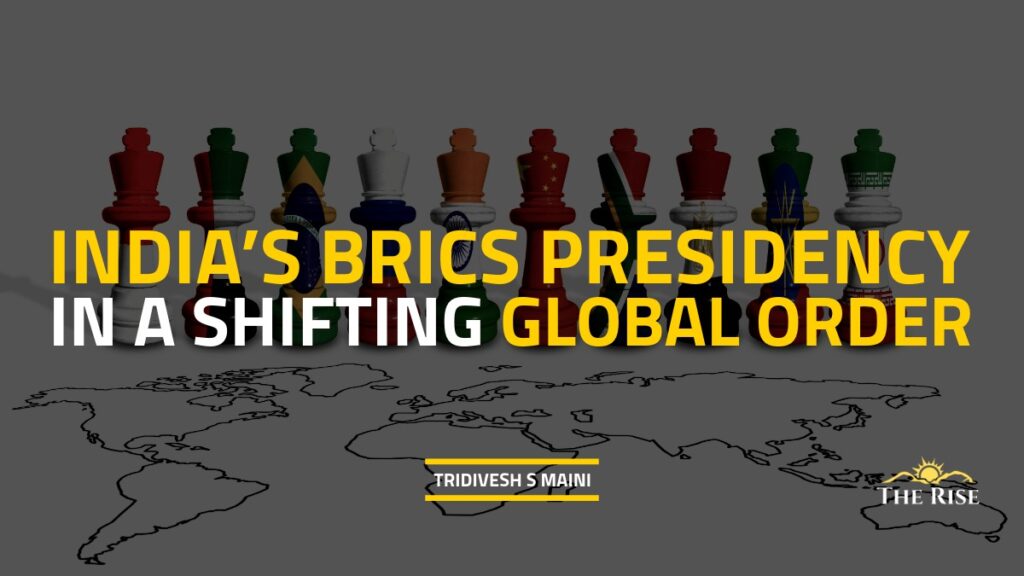
India holds the Presidency of BRICS in 2026, while France holds the rotating presidency of G7. During his visit to India, the French President mentioned the need for greater cooperation between India and France on multilateral platforms and between the G7 and BRICS. Macron also reiterated that India is chairing the BRICS group in 2026, while France is chairing the G7. In January 2026, Macron said that India could “create bridges to build cooperation.”
India and France are also part of two plurilateral groups. The first is the India-France-UAE trilateral, which was formalised in February 2023. India and France, along with Australia, are also part of another trilateral grouping announced in 2020.
Brazil-India cooperation in BRICS
Brazil is an important country in the Global South and a founding member of BRICS. In 2025, Brazil held the Presidency of BRICS. Prime Minister Modi attended the BRICS Summit held in Rio De Janeiro in July 2025. Lula, during his visit to India, highlighted the point that both Brazil and India, as two democracies of the Global South, have an important responsibility and extended Brazil’s support for India’s BRICS presidency.
Lula, in a media interview, clarified that while there was a need to promote trade in local currencies, no proposal for a common BRICS currency had been discussed. The Brazilian President said, “No one proposed to create the BRICS currency. There is no debate within BRICS to create a new currency.” India has taken a similar position on the issue, pitching for trade in local currencies.
BRICS member states are working towards setting up BRICS pay, which will enable cross-border trade links via local currencies and CBDCs (central bank digital currencies). India is also likely to push other countries to adopt India’s digital system – United Payments Interface (UPI) – to give a push to BRICS pay.
Also Read: India-EU Ties Signal a Shift in the Global Power Order
It would be pertinent to point out that France was the first EU member state and developed country to adopt UPI in 2024. Intra-BRICS trade in local currencies has risen, and 90% of India’s trade with Russia is conducted in local currencies, while it has also signed an agreement with the UAE for trade in local currencies. During his visit, the Brazilian President also pitched for trade in local currencies between Brazil and India. Lula said, “It is not necessary that a trade agreement between India and Brazil has to be done with US dollars. We can use our own currencies. It is difficult, but we can try.”
There is no doubt that trade in local currencies does pose logistical challenges, but it is likely to grow in a changing geo-economic landscape.
Conclusion
In conclusion, India’s Presidency of BRICS is important for more than one reason. First, it comes amid global geopolitical uncertainty. Donald Trump has been critical of BRICS and attempt of members towards de-dollarisation and has even threatened sanctions. Second, India, as Chair of BRICS, can play the role of a bridge between BRICS and G7, as mentioned earlier. India has been invited to G7 Summits since 2019, and, along with other developing countries like Indonesia, has also been articulating the demands of the Global South. Third, the India-Brazil relationship is important not just in the bilateral context, but on multilateral platforms – especially BRICS. In this context, the timing of the Brazilian President’s visit to India is particularly significant.
Disclaimer: The views expressed in this article are those of the author solely. TheRise.co.in neither endorses nor is responsible for them. Reproducing this content without permission is prohibited.
About the author

Tridivesh Singh Maini is a New Delhi-based Policy Analyst. He is faculty member of OP Jindal Global University, Sonepat, Haryana.