Indian courts had touched on related issues before, but never as directly as this. While judgments such as Devika Biswas v. Union of India dealt with reproductive health and sterilisation camps, none of these decisions fully located menstrual health within the broader constitutional framework that links the right to health, dignity, equality, and education. Jaya Thakur does exactly that, focusing on substantive equality rather than formal equality.
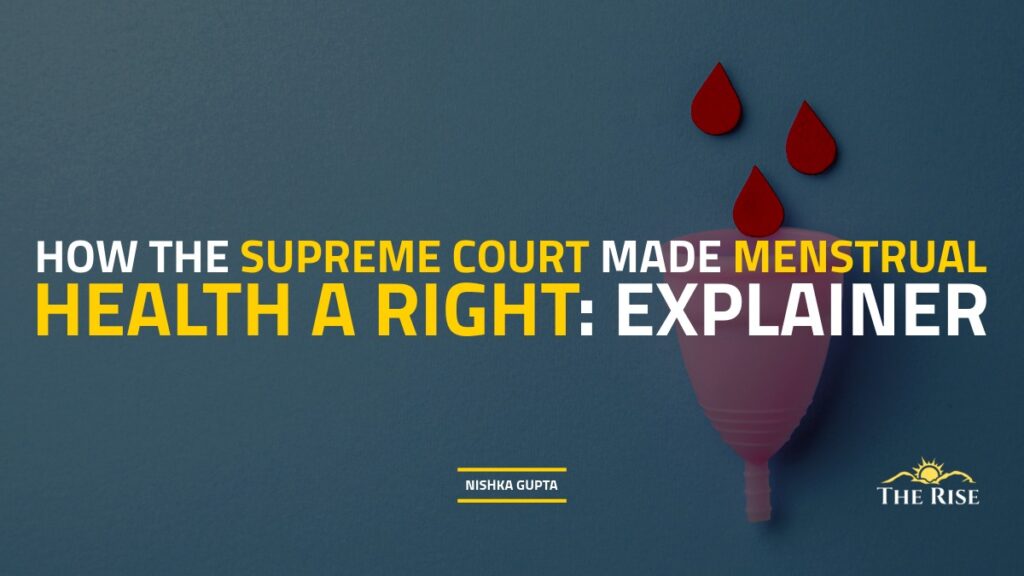
A petition asking the state to provide toilets and sanitary pads in schools had to travel all the way to the Supreme Court of India, and then wait over two years for a final answer. That journey says a lot about how long this country has treated menstrual hygiene as someone else’s problem. The Supreme Court’s judgment in Dr. Jaya Thakur v. Government of India, delivered on 30 January 2026, directly challenges that neglect. A bench of Justices J.B. Pardiwala and R. Mahadevan held that menstrual health falls within the right to life under Article 21 and linked the issue to the effective realisation of the right to free and compulsory education under Article 21A, making it a constitutional guarantee, not a matter of government favour.
Dr Jaya Thakur, a social worker, filed this PIL under Article 32 in 2022. The ask was concrete: free sanitary pads for girls in Classes 6 to 12, separate female toilets in all government-aided and residential schools, sanitation workers to maintain them, and awareness programmes to address menstrual stigma.
The Court examined how poor infrastructure and the absence of menstrual hygiene products force girls to miss school or drop out altogether, turning a biological process into an educational barrier. ASER data has consistently shown that even where toilets exist in government schools, a significant proportion remain non-functional or lack water supply. The gap between a policy document and a functional toilet in a rural school is where girls actually drop out, and that gap has gone largely unaddressed for years.
Indian courts had touched on related issues before, but never as directly as this. While judgments such as Devika Biswas v. Union of India dealt with reproductive health and sterilisation camps, none of them fully located menstrual health within the broader constitutional framework linking the right to health, dignity, equality, and education.
Jaya Thakur does exactly that, focusing on substantive equality rather than formal equality. It recognises that menstrual hygiene management is not merely a matter of personal care or public health, but a constitutional precondition for meaningful access to schooling.
The court directed all states and UTs to ensure free sanitary pads and functional, gender-segregated toilets under a continuing mandamus. By locating menstrual health inside Article 21, the judgment makes this a justiciable right. Over time, this feeds into a growing line of jurisprudence that reads the right to education as something more than enrolment, pushing courts and governments to ask whether children can meaningfully participate in school, not just whether they technically attend it.
The judgment is, however, not without its limits. The directions cover government-aided and residential schools, leaving private unaided institutions largely untouched. Even so, it creates an accountability framework where one barely existed before. A girl who is forced to miss school or drop out because her school lacks basic menstrual hygiene infrastructure can now be understood, in constitutional terms, as a victim of a rights violation. Whether courts, governments, and advocates use that framework to push for meaningful implementation is the question that outlives this judgment.
Nishka Gupta is a TRIP intern
Mentored and Edited by Sneha Yadav
About the author

Nishka is a first-year BBA LLB student at IIM Rohtak who writes at the intersection of law, policy, and social justice.
-
This author does not have any more posts.

Sneha Yadav is an electronics engineer with a postgraduate degree in political science. Her interests span contemporary social, economic, administrative, and political issues in India. She has worked with CSDS-Lokniti and has been previously associated with The Pioneer and ThePrint.
-
Sneha Yadav

-
Sneha Yadav
-
Sneha Yadav
-
Sneha Yadav
-
Sneha Yadav
-
Sneha Yadav
-
Sneha Yadav
-
Sneha Yadav
-
Sneha Yadav
-
Sneha Yadav
-
Sneha Yadav
-
Sneha Yadav
-
Sneha Yadav
-
Sneha Yadav
-
Sneha Yadav
-
Sneha Yadav
-
Sneha Yadav
-
Sneha Yadav
-
Sneha Yadav
-
Sneha Yadav
-
Sneha Yadav
-
Sneha Yadav
-
Sneha Yadav
-
Sneha Yadav
-
Sneha Yadav
-
Sneha Yadav
-
Sneha Yadav
-
Sneha Yadav
-
Sneha Yadav
-
Sneha Yadav
-
Sneha Yadav
-
Sneha Yadav