Declining capabilities of graduates from core engineering domains may eventually pose competency challenges in conventional sectors of manufacturing, construction, infrastructure, etc. and slow down the overall growth, research, and development. Reorienting the core engineering curriculum solely towards employment outcomes could show short-term gains, but their abundance is likely to create an imbalance between demand and supply in the digital fields as well
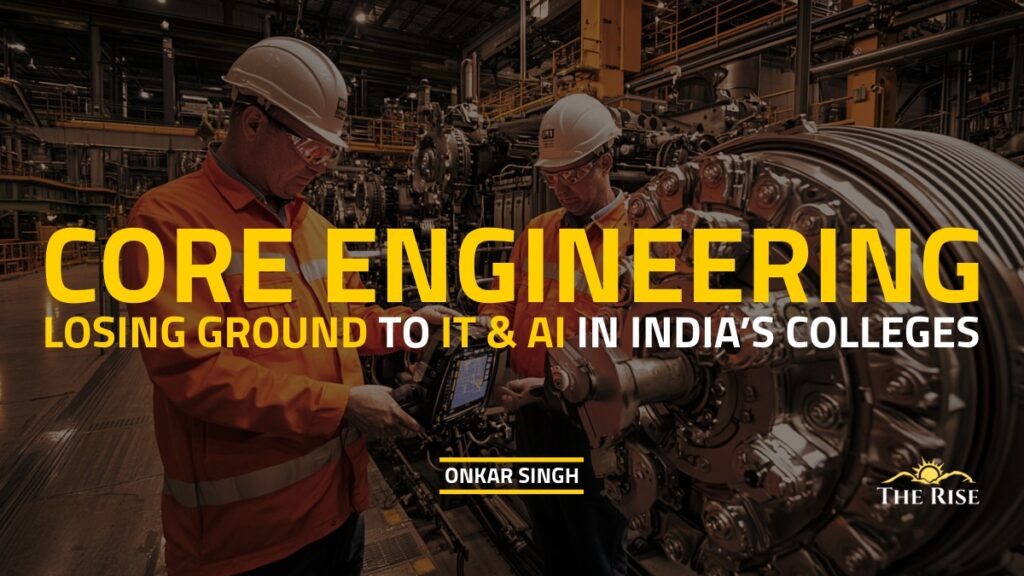
A silent shift is underway in the higher engineering educational institutions. Students pursuing core engineering programmes in domains such as civil, chemical, electrical, and mechanical are no longer keen on studying the core engineering subjects prescribed for their broader domain. A clear temptation to pursue coding, data analysis, AI, and machine learning, etc., is visible among such engineering students.
Reasoning choices
Generally, this shift is attributed to the waning interest of students in the engineering curriculum because of its rigour and perceived absence of lucrative career opportunities in the core domain, while the IT domain offers attractive career options. But a deep dive shows that the problem is rooted elsewhere in the economy and the ecosystem, which rewards digital skills more than hardcore engineering expertise needed to meet the technological ambitions of the country, in particular, and society in general.
Also Read: Time to Fix Admission Cycles in Higher Education in India
Furthermore, the shrinking career opportunities due to a mismatch between the expansion of capacity in engineering institutions and the actual demand for respective engineering professionals, accompanied by low starting salaries, slow career growth, a demanding work lifestyle, insufficient nurturing of students to make them passionate about core engineering domains, etc. This is eventually prompting the students to explore the career opportunities in other sectors, and the IT sector becomes the default choice. The attitude of the majority of engineering students is at present seen to focus on securing employment through an engineering degree rather than equipping themselves professionally to contribute to and advance technological developments. The growing hype around placements to attract new admissions, instead of engineering breakthroughs, is also impacting the academic ambience, and engineering education is seen as a direct pathway to employment.
Also Read: How External Politics Is Undermining India’s Universities
The declining interest in core engineering also stems from the continuously reducing focus on the domain-specific laboratories and theoretical subjects. As a result, in core engineering, the translation of domain-specific theory to practice in the laboratory appears relatively static and lags behind the fast-evolving IT & digital domains, where skill acquisition is tangible and fast-rewarding. These choices are cultivating a culture in which engineering institutions confine themselves to producing job-ready graduates for specific roles, rather than nurturing holistic domain-specific capabilities in engineers and technologists, which is deeply concerning.
Deeper Questions
The precarious decline in the rigour level of the engineering institutions towards core engineering domains raises pertinent questions. Firstly, are the core domains of engineering and technology losing their relevance? Secondly, with an increasing share of interdisciplinary content in the curriculum at the cost of core domain-specific content, is it worthwhile to roll out engineers adaptable to any industry? Thirdly, will such engineering graduates be capable of undertaking foundational transformations, upgradations, research and development in their core domains?
Also Read: UGC’s Equity Push and the Unfinished Battle Against Caste Bias
There could be differing interpretations and justifications of the prevailing situation, but the declining capabilities of graduates from core engineering domains may eventually pose competency challenges in conventional sectors of manufacturing, construction, infrastructure, etc. and slow down the overall growth, research, and development. Reorienting the core engineering curriculum solely towards employment outcomes could show short-term gains, but their abundance is likely to create an imbalance between demand and supply in the digital, cyber, software, and IT fields as well in the future. Moreover, the neglect of core engineering capabilities in human resources will endanger fields like manufacturing, infrastructure, defence, food processing, agriculture, innovation, technological self-reliance, etc.
A cue can be had from the past, where countries have focused on certain domains and made remarkable contributions to technological advancements in those areas. Without any prejudice to any nation, public perception is that the countries like Germany, Japan, China are known as major contributors in Mechanical Engineering; USA, France, UK for the Aerospace industry; USA, China, India, Israel for Software / Artificial Intelligence; Taiwan, South Korea, USA, Japan for the Electronics industry; China, Netherlands for Civil engineering; Japan, Germany, China in Robotics; Germany, Denmark, China for Renewable Energy, etc. Thus, a balance in the industrial ecosystem can be accomplished only by a fairly competent engineering workforce in all fields of engineering & technology.
Way Forward
Apparently, the students are not wilfully escaping core engineering; rather, they are moving away because they are unable to see the connection between their learning and the real-world opportunities, where the role of engineering & technology is in abundance. Thus, it is an opportune time for academics, regulators, and government stakeholders to realistically contemplate the declining interest of engineering students in core engineering disciplines and make course corrections for strengthening these disciplines.
While restoring the old rigour of the engineering education, it will be prudent to remodel it holistically to capitalise on the creativity, interests, and innovative potential of the present generation of core engineering students. Integrating digital tools for problem-solving into the curriculum of traditional disciplines and increasing the weightage of laboratory sessions, and hands-on training on real-world engineering applications may help channelise students’ interest in IT domains without diverting them from core engineering fields.
Also Read: PhD Thesis Ghostwriting in India: A Crisis of Academic Ethics
Policy-level interventions in industrial policy for mandatory engagement of industry with engineering institutions could help enhance student proficiency through live engineering learning, along with a regular academic curriculum, just like in medical education, where hospitals are inevitable for medical colleges. The compulsory industry partnership with educational institutions will not only help in curriculum development and student exposure to real processes of engineering & technology, but these learnings will also boost entrepreneurship to catalyse manufacturing growth and research ecosystem for core engineers. The success stories of the technological advances and the role of core engineers behind them must be demonstrated to invigorate the interest in students to utilise learnings from engineering and technology for negotiating contemporary challenges and sustainable development.
Simultaneously, a comprehensive engineering human resources planning framework could be envisioned to balance between demand and supply of the engineers and technologists from the respective domains. This will correct the current skewed spectrum with predominance of CS & IT capacity in the technical education. Otherwise, with the fast proliferation of AI, the continuance of the ongoing trend could pose significant future challenges.
Disclaimer: The views expressed in this article are those of the author solely. TheRise.co.in neither endorses nor is responsible for them. Reproducing this content without permission is prohibited.
Follow the TheRise channel on WhatsApp
About the author

Prof. Onkar Singh is the former Vice Chancellor of Veer Madho Singh Bhandari Uttarakhand Technical University, Dehradun, He has been the Founder Vice-Chancellor of the Madan Mohan Malaviya University of Technology, Gorakhpur (U.P.). He is a Professor of Mechanical Engineering at Harcourt Butler Technical University, Kanpur (U.P.).