By constitutionalising the right to food, the Supreme Court ensured that poverty alleviation is not left to shifting political priorities or administrative goodwill. The judgment asserts that a State which allows its people to go hungry, despite having the means to prevent it, fails in its most basic constitutional duty.
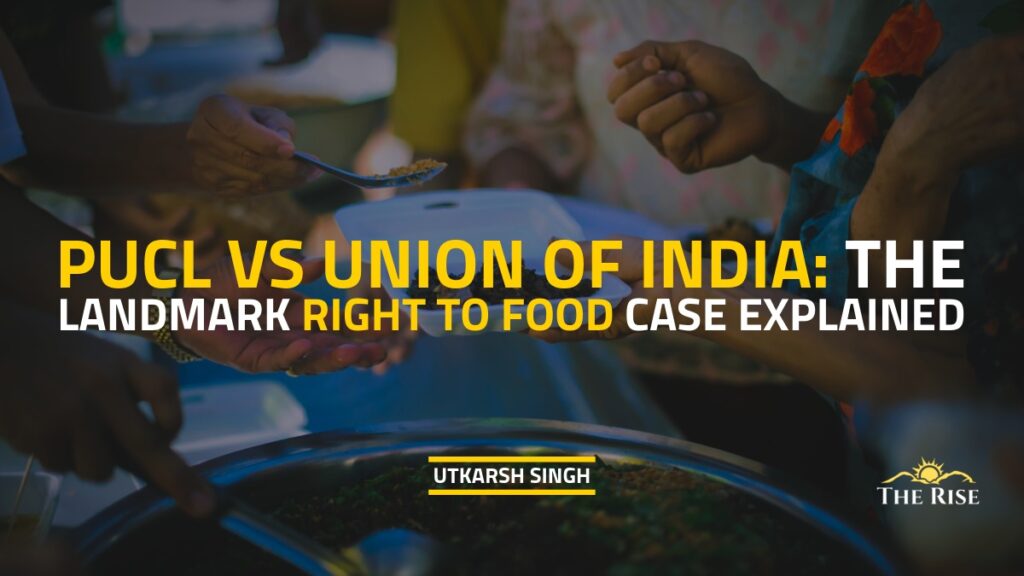
Emerging as one of the most consequential interventions in Indian socio-economic rights jurisprudence, the case of People’s Union for Civil Liberties v. Union of India, popularly known as the “Right to Food case,” has transformed access to food from a matter of governmental welfare into a constitutionally enforceable right flowing from Article 21 of the Constitution.
Although the case did not conclude with a single final verdict, the Supreme Court issued a series of binding and continuing directions that collectively recognised freedom from hunger and malnutrition as intrinsic to the right to life. In doing so, the Court shifted poverty alleviation, particularly food security, from the margins of policy discretion to the core of constitutional governance.
The case traces its origin to 2001, against the backdrop of a troubling national paradox. India possessed surplus food grains stored in government warehouses, yet starvation deaths and chronic malnutrition were being reported across several States. This contradiction exposed deep systemic failures in distribution and access, rather than scarcity of resources. The People’s Union for Civil Liberties approached the Supreme Court under Article 32, arguing that the State’s inability to deliver food to vulnerable populations amounted to a violation of the right to life.
Recognising that hunger is neither temporary nor isolated, the Supreme Court declined to treat the petition routinely. Instead, it adopted the mechanism of continuing mandamus, retaining jurisdiction over the case and issuing periodic orders to ensure sustained compliance. Over the years, the scope of the case expanded to include the Public Distribution System, the Integrated Child Development Services, and supplementary nutrition schemes for children, pregnant women, lactating mothers, and adolescent girls. Later proceedings, particularly those linked to the National Food Security framework, further reflected the Court’s concern that administrative transitions and policy delays should not disrupt food entitlements.
Relevance of the Judgement
The judgment’s relevance lies in its recognition that poverty is not merely economic but a lived reality marked by hunger, malnutrition, and erosion of dignity. For millions, poverty manifests first as an empty stomach rather than an empty wallet. By tackling hunger directly, the Court addressed poverty at its most fundamental level.
Equally important is its reframing of welfare as a matter of right rather than charity. The ruling emphasised that democratic governance loses moral legitimacy when basic nutrition is denied despite available resources. At a time when policy debates often focus on fiscal efficiency and targeting, this case is a reminder that human survival cannot be subordinated to administrative convenience.
Details of the Judgment
At the centre of the Court’s reasoning was an expansive interpretation of Article 21. The right to life, it reaffirmed, is not mere physical existence but life with dignity, for which adequate food is indispensable. A life lived in hunger is a life lived in violation of the Constitution.
The Court issued detailed implementation directives, emphasising that delays, procedural hurdles, or changes in procurement models cannot interrupt food supply to beneficiaries. It encouraged decentralisation of food distribution and supported the involvement of self-help groups and women’s collectives in the preparation and supply of supplementary nutrition. This approach not only ensured better delivery but also aims to minimise leakages and contractor-driven exploitation.
Significantly, the Court cautioned that prolonged inaction or superficial compliance may invite stronger orders. This judicial stance sent a clear message that hunger is not an unfortunate administrative lapse but a constitutional wrong demanding urgent correction.
Impact of the Judgment
Legally, PUCL v. Union of India reshaped constitutional law by strengthening the doctrine that fundamental rights impose positive obligations on the State, particularly in matters concerning survival and dignity. The case demonstrated how Directive Principles of State Policy can inform and expand the scope of enforceable rights under Article 21. The case also legitimised sustained judicial oversight in welfare matters, influencing subsequent cases on health, shelter, and social security.
Socially, the impact of the judgment is equally profound. For families living on the margins, the Court’s intervention translated into more reliable access to food and nutrition. The focus on children and women helped address intergenerational poverty by targeting malnutrition at its earliest stages. More importantly, the judgment reshaped public understanding of hunger. It affirmed that hunger is not the result of personal failure or lack of effort but a systemic issue that the Constitution obligates the State to address.
By recognising the poor as rights holders rather than passive recipients of charity, the Court restored a measure of dignity to those whose suffering often goes unnoticed.
The decision in People’s Union for Civil Liberties v. Union of India thus stands as a powerful reminder that constitutional law can and must respond to human suffering. By constitutionalising the right to food, the Supreme Court ensured that poverty alleviation is not left to shifting political priorities or administrative goodwill. The judgment asserts that a State which allows its people to go hungry, despite having the means to prevent it, fails in its most basic constitutional duty.
In giving legal voice to the hungry, the Supreme Court transformed the Constitution from a document of ideals into an instrument of compassion. The case remains a cornerstone of India’s poverty alleviation jurisprudence, reminding us that the true promise of the Constitution lies not in abstract freedoms alone, but in the assurance that every person can live and eat with dignity.
Utkarsh Singh is a TRIP intern
Mentored and Edited by Sneha Yadav
About the author

Utkarsh Singh , 3rd Year Student at Maharashtra National Law University, Nagpur. He is currently a TRIP intern.


Sneha Yadav is an electronics engineer with a postgraduate degree in political science. Her interests span contemporary social, economic, administrative, and political issues in India. She has worked with CSDS-Lokniti and has been previously associated with The Pioneer and ThePrint.
-
Sneha Yadav

-
Sneha Yadav
-
Sneha Yadav
-
Sneha Yadav
-
Sneha Yadav
-
Sneha Yadav
-
Sneha Yadav
-
Sneha Yadav
-
Sneha Yadav
-
Sneha Yadav
-
Sneha Yadav
-
Sneha Yadav
-
Sneha Yadav
-
Sneha Yadav
-
Sneha Yadav
-
Sneha Yadav
-
Sneha Yadav
-
Sneha Yadav
-
Sneha Yadav
-
Sneha Yadav
-
Sneha Yadav
-
Sneha Yadav
-
Sneha Yadav
-
Sneha Yadav
-
Sneha Yadav
-
Sneha Yadav
-
Sneha Yadav
-
Sneha Yadav
-
Sneha Yadav
-
Sneha Yadav
-
Sneha Yadav
-
Sneha Yadav