
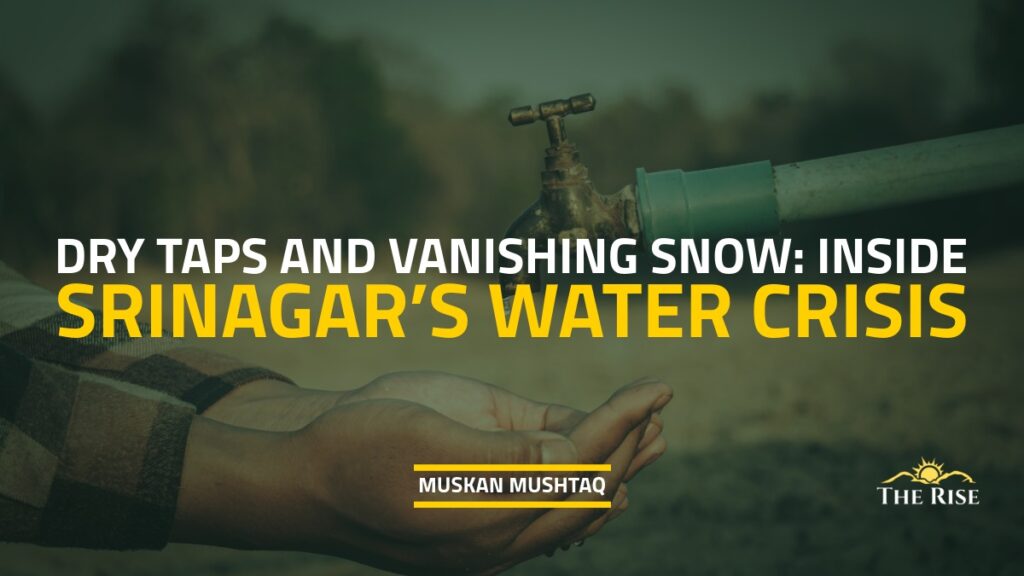
Most households in Srinagar receive water only once every two to three days, often for limited hours, forcing families to store water or rely on costly private tankers.
Srinagar is experiencing an acute and recurring drinking water shortage, marked by irregular supply, low pressure, and frequent dry taps across several residential areas. These water supply disruptions have become increasingly common, particularly during dry seasons and maintenance shutdowns of major water treatment plants.
“Earlier, snowfall itself was our storage. Now winters pass without snow, and by summer, water disappears,” stated a local shopkeeper from Hazratbal.
To move beyond official explanations, TheRise spoke to residents across Downtown Srinagar, Bemina, Batamaloo, and Hazratbal. A common pattern emerged: most households receive water only once every two to three days, often for limited hours, forcing families to store water or rely on costly private tankers.
Why Has the Water Shortage Occurred?
Residents have linked the water shortage to reduced rainfall and snowfall. Elderly residents noted that winters are now “dry and short,” unlike earlier decades when heavy snowfall ensured year-round water availability.
Scientific assessments reinforce these observations. Jammu and Kashmir has experienced severe precipitation deficits, with recent years recording the lowest rainfall in over five decades[2]. As a result, springs across the region have begun drying up, further worsening the water crisis.
While climate change forms the backdrop, locals identified infrastructure failure and administrative mismanagement as other dominant concerns. Residents complained about frequent pipe leakages, delayed repairs, and poor communication during supply shutdowns.
“Water flows on roads from broken pipes, but we have nothing in our taps,” a homemaker from Batamaloo noted.
These concerns are reflected in recurring supply disruptions, as maintenance shutdowns of canals supplying water treatment plants such as Alusteng and Rangil regularly disrupt supply to large parts of Srinagar[6]. Locals have complained of delayed repairs, frequent leakages, and poor communication during shutdowns.
Another recurring concern raised was rapid urban expansion. Locals pointed out that wetlands and open spaces, which were once critical water absorption zones, have been replaced by concrete structures, reducing groundwater recharge. Satellite-based studies confirm significant shrinkage of lakes and wetlands in the Kashmir Valley, including Dal Lake [5].
While drought-like conditions were recorded in the past, recent years have witnessed a sharp rise in both the frequency and severity of shortages, driven by compounding climatic and anthropogenic pressures.
The impact on daily life is stark. Families wake up at odd hours to collect water when the supply is available. Purchasing tanker water has become common, costing ₹800–₹1,500 per month for some households.
“We plan our entire day around water timing; studies become secondary,” stated Farhan, a college student from Bemina.
Residents emphasized that addressing the crisis requires fixing systemic failures before pursuing new water sources, particularly by repairing widespread leakages and penalizing illegal connections that drain the already limited supply. There was also a strong demand for advanced public communication during supply shutdowns and regulated, equitable tanker distribution to prevent exploitation during shortages.
Beyond immediate management, both community voices and experts underscored the urgency of protecting and restoring springs, wetlands, and groundwater recharge zones, which have been steadily eroded by unplanned urban expansion. In this context, rainwater harvesting at household and community levels was cited as a practical, low-cost intervention.
Together, these measures point to the need for infrastructure modernization and climate-resilient urban water planning, signalling that Srinagar must move beyond temporary crisis responses toward long-term, accountable water governance [1].
Conclusion
Srinagar’s water crisis is the result of intertwined natural changes and human-induced pressures. While climate change has reduced water availability, poor infrastructure, urban expansion, and environmental degradation have intensified the crisis. Local voices clearly indicate that sustainable solutions must integrate scientific planning with community participation to secure Srinagar’s water future.
(Muskan Mushtaq is an intern under TRIP.)
(Edited and Mentored by Sneha Yadav)
References
- Associated Press. (2025). Famed for Himalayan peaks and pristine lakes, Kashmir faces a water crisis amid dry weather.
- Deccan Herald. (2025). Lowest precipitation in 50 years raises alarm over water scarcity in Jammu and Kashmir.
- Kashmir Life. (2025). Water shortage sparks protest in Srinagar.
- Kashmir Observer. (2025). Residents face acute drinking water shortage in Srinagar.
- NASA Earth Observatory. (2023). Shrinking lakes of the Kashmir Valley.
- Rising Kashmir. (2025). Water supply disruption in Srinagar due to canal repair work.
About the author

Muskan Mushtaq is a passionate environmental researcher and a Zoology postgraduate from the Central University of Kashmir. She holds a strong passion for sustainability, wildlife and environmental conservation, and for combining scientific research with practical fieldwork. With this commitment, she aspires to build a purposeful career in field ecological and environmental sustainability. She is currently a TRIP Intern.
-
This author does not have any more posts.

Sneha Yadav is an electronics engineer with a postgraduate degree in political science. Her interests span contemporary social, economic, administrative, and political issues in India. She has worked with CSDS-Lokniti and has been previously associated with The Pioneer and ThePrint.
-
Sneha Yadav

-
Sneha Yadav
-
Sneha Yadav
-
Sneha Yadav
-
Sneha Yadav
-
Sneha Yadav
-
Sneha Yadav
-
Sneha Yadav
-
Sneha Yadav
-
Sneha Yadav
-
Sneha Yadav
-
Sneha Yadav
-
Sneha Yadav
-
Sneha Yadav
-
Sneha Yadav
-
Sneha Yadav
-
Sneha Yadav
-
Sneha Yadav
-
Sneha Yadav
-
Sneha Yadav
-
Sneha Yadav
-
Sneha Yadav
-
Sneha Yadav
-
Sneha Yadav
-
Sneha Yadav
-
Sneha Yadav
-
Sneha Yadav
-
Sneha Yadav
-
Sneha Yadav
-
Sneha Yadav
-
Sneha Yadav
-
Sneha Yadav













































































Nice job keep it up …..rise and shine dear muskaan