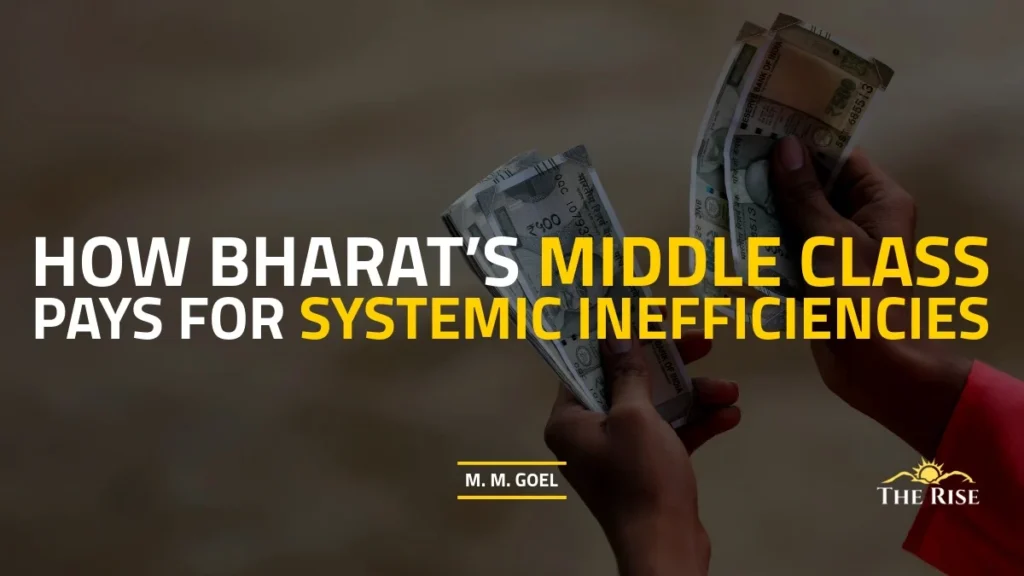
The inefficient economy imposes a hidden economic burden on households. Families spend additional income on water purification, electricity backup, transportation alternatives, pollution protection, healthcare support, and educational assistance. What should ideally be guaranteed as a public good often becomes a private responsibility.
The Needonomics School of Thought (NST) views the inefficient economy of Bharat as both a challenge and an opportunity. Inefficiencies in the delivery of essential public goods impose hidden costs on citizens, particularly the middle class, which silently pays the price to maintain a reasonable quality of life. At the same time, these gaps create opportunities for innovation, entrepreneurship, and need-based markets.
Needonomics does not ignore the realities of everyday economic life. Instead, it examines them through the principles of need, affordability, worth, sustainability, and human welfare. The focus is not on promoting consumption for its own sake but on understanding how genuine human needs emerge when existing systems fail to provide efficient solutions.
Middle Class: The Silent Payer and Manager of Inefficiencies
An efficient economy should ideally ensure reliable access to essential public goods such as safe drinking water, electricity, clean air, transportation, education, and security. However, the lived experience of many citizens reveals persistent gaps in the quality and accessibility of these services.
The middle class becomes the silent manager of these inefficiencies. It pays additional costs to overcome limitations in public systems while continuing to contribute significantly to economic growth. Through its purchasing decisions, the middle class creates demand for alternative solutions that make daily life manageable.
This reality explains why households invest in water purifiers, bottled water, power backup systems, private transportation, additional educational support, and health protection measures. Such expenditure is not always driven by luxury or excessive consumption; often, it represents a response to unavoidable circumstances.
From Consumption to Needo-Consumption
Needonomics introduces the concept of needo-consumption—consumption guided by genuine needs rather than greed. It recognizes that a large part of modern consumption emerges not from unlimited desires but from the necessity to compensate for deficiencies in existing systems.
For example, when citizens cannot fully trust the quality of tap water, they seek purification solutions. This creates opportunities for affordable innovations such as portable water filtration devices that can reach wider sections of society through the Need-Affordability-Worth (NAW) approach.
Similarly, unreliable electricity supply generates demand for inverters, generators, voltage stabilisers, and UPS systems. In many parts of Bharat, including regions of Haryana, households and businesses depend on such alternatives to ensure continuity of work, education, and daily activities.
Compensatory Consumption: The Cost of Systemic Gaps
Needonomics distinguishes between aspirational consumption and compensatory consumption.
Aspirational consumption reflects the human desire for improvement, comfort, and progress. It represents the positive pursuit of a better quality of life.
Compensatory consumption, however, occurs when individuals spend additional resources to overcome inefficiencies around them. Air purifiers due to severe pollution levels, mosquito repellents due to inadequate vector control, private vehicles due to weak public transportation, and private tuition or coaching due to limitations in institutional education are examples of such spending.
The middle class often bears this additional financial burden because it seeks solutions within available means. It pays not only for goods and services but also for the inefficiencies embedded in the surrounding systems.
Inefficient Economy: Opportunity Without Celebration of Failure
NST does not support the continuation of inefficiencies. The purpose is not to accept failures as permanent but to understand the economic behaviour they create and encourage better alternatives.
The substitutes developed by citizens are often better than having no solutions, but they also carry limitations. An inverter cannot operate every appliance during a power failure. A generator provides backup electricity but may create noise pollution. Private coaching supports learning but may increase financial and time pressures. Personal vehicles provide mobility but contribute to congestion and environmental concerns.
Therefore, the larger objective must remain the improvement of public systems while ensuring that alternative solutions are affordable, sustainable, and socially responsible.
Hidden Price Paid by Bharat’s Middle Class
The inefficient economy imposes a hidden economic burden on households. Families spend additional income on water purification, electricity backup, transportation alternatives, pollution protection, healthcare support, and educational assistance.
What should ideally be guaranteed as a public good often becomes a private responsibility. This transformation creates a new form of inequality between those who can afford alternatives and those who cannot.
A society that normalizes inefficiency risks deepening these inequalities. Citizens with financial capacity manage the shortcomings, while economically weaker sections remain more vulnerable to the consequences.
Needonomics: Transforming Inefficiency into Responsible Opportunities
The Needonomics School of Thought advocates a transition from greed-driven markets to need-driven markets. Entrepreneurs and businesses should identify real challenges faced by people and develop solutions based on affordability, accessibility, and social value.
The NAW principle—Need, Affordability, and Worth—provides guidance for responsible entrepreneurship. Markets should not artificially create unnecessary wants; they should respond to genuine human needs.
The inefficient economy offers opportunities for innovators, startups, and policymakers. However, the ultimate national goal should be an efficient Bharat where citizens spend more on progress, creativity, and well-being rather than on compensating for systemic failures.
Conclusion
The inefficient economy of Bharat represents a complex reality. It reflects shortcomings in public service delivery while simultaneously generating economic activities that contribute to growth. The middle class silently pays the price of these inefficiencies through compensatory consumption, while also becoming a major source of demand, innovation, and entrepreneurship. Needonomics reminds us that true development cannot be measured solely by increased consumption. It must be assessed through improvements in quality of life, dignity, and access to efficient systems. The journey towards Viksit Bharat requires transforming an economy of compensation into an economy of efficiency—where citizens are empowered to invest in aspirations rather than merely pay the price of inefficiencies.
Disclaimer: The views expressed in this article are those of the author solely. TheRise.co.in neither endorses nor is responsible for them. Reproducing this content without permission is prohibited.
About the author

Prof. Madan Mohan Goel, Former Vice Chancellor and Propounder of Needonomics School of Thought.