A deeper social problem underlies biodiversity loss: people are becoming disconnected from nature. Urban children may know international cartoon characters better than native birds such as the Indian Peafowl or the House Sparrow. When society stops noticing nature, it stops valuing it. This disconnect breeds apathy.
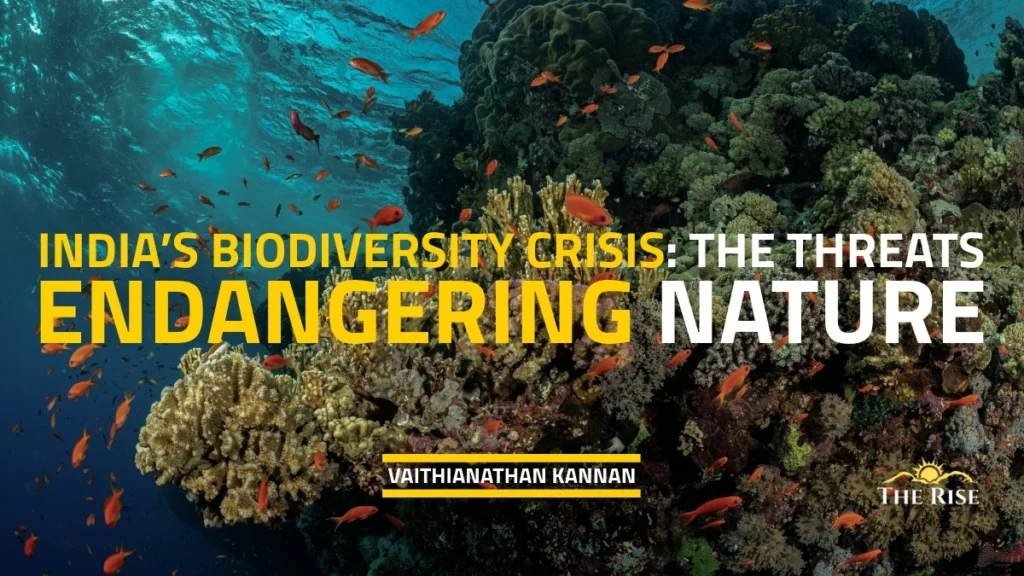
The loss of biodiversity is no longer a distant scientific concern discussed only in academic journals or at global climate summits. It is now a visible reality unfolding across India in shrinking forests, polluted rivers, disappearing wetlands, and the increasing silence of landscapes once alive with birds, insects, and wild animals. Biodiversity, the vast web of life that includes plants, animals, fungi, and microorganisms, is the foundation upon which human civilisation rests. Yet, ironically, humanity itself has become its greatest threat. India, celebrated as one of the world’s 17 megadiverse countries, is home to remarkable ecological wealth from the Western Ghats and Eastern Himalaya to the mangroves of Sundarbans and the coral reefs of the Gulf of Mannar. But this treasure is increasingly under siege. The question is not whether biodiversity is at risk; it is what is placing it in danger and why we continue to allow it.
Development Without Ecological Wisdom
The most visible threat to biodiversity in India is the relentless expansion of infrastructure under the banner of development. Highways cut through elephant corridors, railway lines fragment tiger habitats, ports invade coastal breeding grounds, and urban sprawl swallows agricultural and forest lands alike. Economic growth is essential, but when development proceeds without ecological wisdom, it becomes destructive. The tragedy lies not in building roads or cities, but in building them without respecting the natural systems that sustain life. The destruction of forests for mining in states like Odisha and Chhattisgarh has shown how short-term extraction often leads to long-term ecological collapse. Once a forest is fragmented, it loses not only trees but also pollinators, predators, seed dispersers, and the countless invisible interactions that keep ecosystems functioning.
Also Read: Invasive Plants: The Silent Threat to Biodiversity
Agriculture: Feeding People, Starving Nature
India’s agricultural success has helped feed millions, but intensive farming has often come at the expense of biodiversity. The Green Revolution transformed food security, yet it also introduced monocultures, chemical pesticides, synthetic fertilizers, and large-scale irrigation systems that altered landscapes permanently. Traditional farming systems in India once supported a mosaic of biodiversity, such as house sparrows nesting in thatched roofs, frogs in paddy fields, vultures scavenging carcasses, and native grasses supporting insects. Modern industrial agriculture, however, has simplified ecosystems. Vast stretches of single crops such as rice, wheat, or sugarcane offer little refuge for wildlife. Pesticides have decimated pollinators, including bees and butterflies. The decline of insect populations should alarm every citizen because insects are not merely pests; they are the engineers of ecosystems. Without them, crop pollination, decomposition, and food chains collapse.
Climate Change: The Invisible Accelerator
If habitat destruction is the visible enemy, climate change is the invisible accelerator. Rising temperatures, erratic monsoons, prolonged droughts, and extreme weather events are altering species distributions across India. In the Himalayas, alpine species are moving upward in search of cooler climates. In coastal India, rising sea levels threaten nesting beaches of marine turtles. Coral bleaching events in the Lakshadweep and the Gulf of Mannar indicate how fragile marine ecosystems have become. Climate change does not act alone; it compounds existing threats. A forest already weakened by logging is less resilient to drought. A river polluted by industry becomes even more hostile when water temperatures rise. The combined effect pushes species beyond their capacity to adapt.
The Silent Crisis of Invasive Species
Another underappreciated threat to Indian biodiversity is the spread of invasive alien species. Plants like Prosopis juliflora, Lantana camara, and water hyacinth have transformed ecosystems across the country. These species often outcompete native vegetation, alter soil chemistry, and make habitats unsuitable for indigenous fauna. Lantana, originally introduced as an ornamental plant, now dominates many forest understories in India, especially in protected areas. It prevents the regeneration of native plants and reduces grazing opportunities for herbivores. Invasive species are not just botanical curiosities; they are agents of ecological disruption.
Also Read: Chemical Ecology in the Anthropocene: The Silent Collapse of Nature’s Language
Pollution: Poisoning the Web of Life
Pollution is perhaps the most insidious threat because it operates quietly. Rivers such as the Ganges and Yamuna continue to receive untreated sewage, industrial effluents, and plastic waste. These pollutants affect not only fish but entire freshwater ecosystems. Air pollution, too, impacts biodiversity. Studies suggest that toxic air can interfere with plant growth, reduce pollinator activity, and alter bird migration patterns. Plastics, meanwhile, have entered the food chain. Sea turtles mistake plastic bags for jellyfish, birds ingest microplastics, and even remote mountain streams now carry plastic particles.
India’s biodiversity cannot survive in poisoned habitats.
Illegal Wildlife Trade and Overexploitation
Despite strong wildlife laws, poaching and illegal trade continue to threaten many species. Pangolins are trafficked for their scales, star tortoises are smuggled for the pet trade, and rare birds are captured for illegal markets. Overfishing depletes marine biodiversity, while unsustainable harvesting of medicinal plants threatens forest ecosystems. What makes this especially troubling is that many local extinctions occur unnoticed. Species disappear before they are even properly studied. India may be losing insects, amphibians, and lesser-known plants that science has barely documented.
The Urban Disconnect
A deeper social problem underlies biodiversity loss: people are becoming disconnected from nature. Urban children may know international cartoon characters better than native birds such as the Indian Peafowl or the House Sparrow. When society stops noticing nature, it stops valuing it. This disconnect breeds apathy. Wetlands are seen as vacant land waiting to be converted into apartments. Scrublands are dismissed as wastelands, even though they may support foxes, owls, reptiles, and endemic plants. Biodiversity suffers not only because of bulldozers but because of ignorance.
Conservation Cannot Remain an Island
India has made significant strides in conservation through initiatives such as Project Tiger and protected area networks. Tigers have recovered in several landscapes, and some flagship species have benefited. But conservation cannot remain confined to national parks and sanctuaries. Most biodiversity exists outside protected areas in farmlands, village tanks, sacred groves, urban lakes, and community forests. Protecting only charismatic megafauna while neglecting common species and everyday habitats is a flawed strategy. The future of biodiversity lies in integrating conservation into all sectors: agriculture, education, infrastructure, urban planning, and public health.
A Moral and National Responsibility
Biodiversity is not merely about saving animals for tourism or aesthetics. It is about safeguarding ecological services, such as clean air, fertile soil, pollination, water security, climate regulation, and disease control. The collapse of biodiversity will directly affect food security, livelihoods, and public health. India’s ancient cultural traditions recognised this interdependence. Rivers were worshipped, trees were considered sacred, and many animals became symbols of divinity. Modern India, however, often treats nature as expendable. This contradiction must end. Protecting biodiversity is not anti-development; it is intelligent development. No nation can claim progress if its rivers are dead, forests fragmented, and species vanishing.
Conclusion
The biodiversity crisis in India is not a future threat; it is a present emergency. Every felled forest patch, every polluted wetland, every vanished butterfly is a warning. We are dismantling the living systems that support our own survival. The answer lies not only in stronger laws but in changing how we think about growth, consumption, and coexistence. Policymakers must stop viewing environmental safeguards as bureaucratic hurdles. Citizens must recognise that the disappearance of a frog, a bee, or a vulture is connected to the disappearance of human well-being. If India is to secure its future, biodiversity must be treated as national infrastructure as essential as roads, power, and digital connectivity. To destroy it is to undermine the very foundation of the country’s prosperity. The question is not whether we can afford to protect biodiversity. The real question is whether we can afford not to.
Disclaimer: The views expressed in this article are those of the author solely. TheRise.co.in neither endorses nor is responsible for them. Reproducing this content without permission is prohibited.
About the author

Dr Vaithianathan Kannan is a Wildlife Biologist who has worked with Sathyamangalam Tiger Conservation Foundation Tamil Nadu Trust, Erode, Tamil Nadu, Bombay Natural History Society, Mumbai & AVC College, PG Research Department of Zoology & Wildlife Biology, Mannampandal, Tamil Nadu, and various other NGOs. He is a member of the IUCN/WI/SSC Pelican Specialist Group (Old World) and has a voluntary position within the Old World Pelican Specialist Group. His research interests are diverse largely related to Ecology, Biodiversity, Limnology, Mammalogy, Ornithology and Wetlands