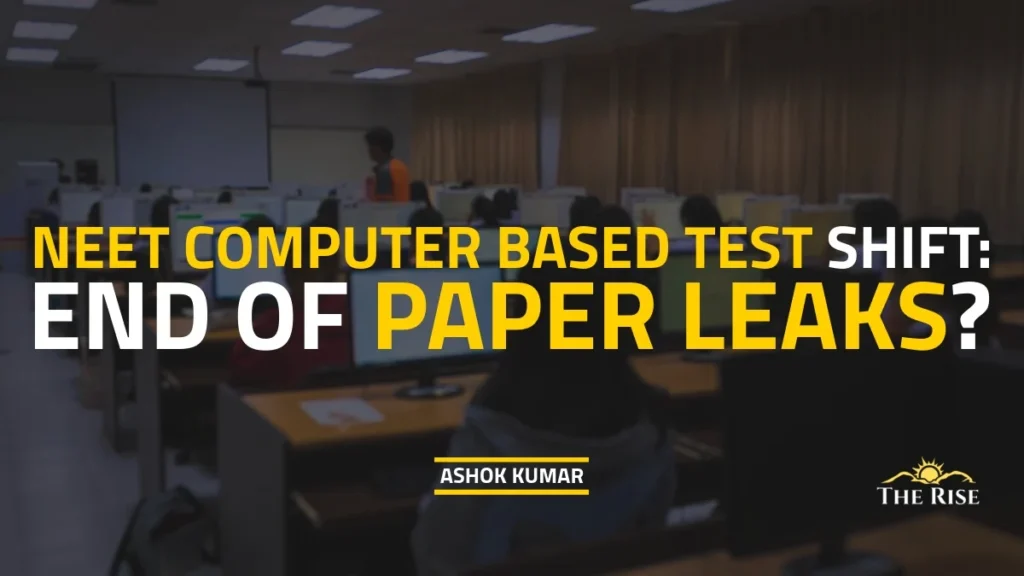
For examination authorities, a well-designed CBT system offers an almost “impenetrable fortress” where the scope for human error, logistical vulnerability, and corruption is drastically reduced.
Maintaining the credibility and fairness of competitive examinations in India is an extremely sensitive and critical matter for the country’s future. Recently, the Union Education Minister announced that from next year, the medical entrance examination will be shifted from the traditional ‘pen-and-paper’ mode to a ‘Computer-Based Test’ (CBT) system. The government argues that this step will enhance the sanctity of the examination, curb incidents like paper leaks, and speed up the evaluation process. From a technological standpoint, this appears to be a progressive step.
Approximately 2.5 million (25 lakh) students appear for the NEET examination. Currently, this exam is conducted offline through pen-and-paper and OMR sheet on a single day, and at the same time across the country. Printing physical question papers in such massive quantities, transporting them, and securing them across thousands of remote centers nationwide significantly increases the risk of ‘paper leaks’.
Also Read: India’s Higher Education Crisis: Degrees Growing, Quality Declining
If NEET transitions into a fully computer-based examination system, similar to the Joint Entrance Examination (JEE), conducting a transparent and secure examination for 2.5 million students is not only possible but may also be the most scientific solution to the current crisis. Below is a detailed analysis of how and in what phases this can be implemented securely:
1. Multi-Session and Multi-Day Examination Format
Conducting an online exam for 2.5 million students in a single day is technically and logistically impossible. For this, the examination will have to be divided into a cycle of 10 to 12 days.
- Two Shifts Per Day: If the examination runs for 10 days and is conducted in two shifts daily (morning and evening), there will be a total of 20 sessions.
- Student Volume Per Session: Dividing 2.5 million students into 20 sessions means approximately 1,25,000 students will take the exam per session.
India already has a readily available capacity of 200,000 to 300,000 computer nodes per shift, combining Tata Consultancy Services iON and other government and private centers.
2. Diversification of Question Papers and ‘Psychometric Normalization.’
When the examination is conducted across 20 different sessions, the biggest question arises: Will all students receive the same question paper? And if the papers are different, how will fairness be ensured?
- Comprehensive Question Bank and Use of AI: The National Testing Agency (NTA), with the help of subject experts, would need to create a massive, coded, and highly secure ‘Question Bank’. Using Artificial Intelligence (AI) algorithms, a fresh question paper could be generated automatically for each session just 30 minutes before the exam begins. The ratio of easy, medium, and difficult questions would remain identical across all papers to maintain parity.
- Percentile and Normalization Method: Since marginal variations in difficulty levels across shifts are unavoidable, percentile scores instead of raw marks should be used, as is currently done in the JEE system. This is called the ‘Unified Normalization Formula’, which ensures that if a particular shift’s paper was difficult, the students of that shift are not placed at a disadvantage.
3. How the CBT System Can Completely Eliminate ‘Paper Leaks’?
In traditional exams, paper leaks occur because physical question papers are printed several days before the exam and transported to centers via trucks, treasuries, and strong-rooms. A CBT system eliminates this entire supply chain.
- Zero Physical Transport: There will be no printing presses, sealed boxes, or transportation vehicles, thereby eliminating the primary source of leaks.
- Last-Minute Digital Delivery: The question paper would remain stored on an ‘end-to-end encrypted’ server and would only be accessible to the local server of an exam center 15–30 minutes before the exam starts.
- Screen Randomization: Even if an unauthorized attempt is made to view the paper at a center, the sequence of questions and answer options on the computer screen will be completely different for every student. Question number 1 for Student A could be question number 45 for Student B. This makes mass cheating entirely impossible.
4. Preventing Digital-Age Malpractices and Impersonation
While CBT reduces traditional paper leaks, it also introduces new challenges such as hacking, screen sharing, and dummy candidates. To counter these risks, the following modern technological shields are essential:
- Impenetrable Software and ‘Locked Browsers’: Computers used during the examination must operate on an ‘Isolated Local Area Network’ (LAN) that has no connection to the public internet. The computers should be configured with locked browsers that completely block any other background software, remote desktop sharing, or USB ports during the exam.
- Three-Tier Biometric and Face Recognition: At the entry point, a fingerprint scanner linked to Aadhaar cards and a facial recognition system must be mandatory at the main gate of the exam center. Further, during the exams, a pop-up should randomly appear on the computer screen mid-exam, asking the student to re-verify their thumbprint or face the webcam. This will ensure that the person who entered after biometric verification is the one taking the exam until the end. Later, at the time of medical college admission, the biometric data captured at the exam center must be cross-verified again.
- AI-Driven Live E-Surveillance: The live feeds from CCTV cameras in every exam hall should be connected to a central national command center (e.g., in New Delhi). AI software will track suspicious behavior of students (such as repeatedly looking away, whispering, or diverting attention from the screen) and immediately send a ‘Red Alert’ to the local invigilator.
5. Challenges and Solutions for Rural and Economically Weaker Students
A large segment of NEET aspirants comes from rural backgrounds, lacking prior experience operating computers or facing a lack of basic infrastructure in their regions. To address this sensitivity, the following steps must be taken:
National Exam Practice Centers: The government should set up free ‘CBT Mock Test Centers’ in government schools or Common Service Centers (CSCs) at every block and tehsil level across the country. Here, rural students can practice taking computer-based tests 3–4 months before the actual exam.
Simple User Interface: The CBT software interface should remain extremely simple, requiring students to only click ‘Next’, ‘Save’, and ‘Submit’. The option to change languages (Hindi, English, and regional languages) must remain available on the screen throughout the examination.
Conclusion
While a strength of 2.5 million students is certainly massive, it is not impossible, given modern India’s technological capability. When hundreds of millions of people in the country can make digital payments in a single day, and the NTA can successfully conduct exams like JEE and CUET in CBT mode, it can definitely be fully adopted for NEET as well.
For examination authorities, a well-designed CBT system offers an almost “impenetrable fortress” where the scope for human error, logistical vulnerability, and corruption is drastically reduced. Moving NEET to a computer-based mode will not only preserve the sanctity and dignity of medical education but will also secure and brighten the future of millions of honest and talented students in the country.
Disclaimer: The views expressed in this article are those of the author solely. TheRise.co.in neither endorses nor is responsible for them. Reproducing this content without permission is prohibited.
About the author
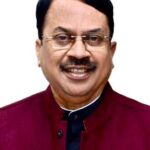
Prof. Ashok Kumar is former Vice-Chancellor of Deen Dayal Upadhyaya University, Gorakhpur (U.P.) & CSJM University, Kanpur, (U.P.), Nirwan University, Jaipur, Rajasthan, and Shri Kallaji Vedic University, Nimbahera, Rajasthan. He is President of the Social Research Foundation, International Society of Life Sciences.