It is important that the approach towards border states is not limited to a security perspective alone, but adopts a more holistic framework.
While speaking in the Rajya Sabha (Upper House of Parliament), a BJP MP, Dorjee Tshering Lepcha, pushed for the re-opening of India–China land trade via Nathu-la in Sikkim, stating, “The border trade through Nathu-la is a vital economic lifeline for the people of Sikkim and an important confidence-building measure between the two nations.”
Trade via Nathu-la had been suspended in the aftermath of the Galwan clashes in 2020. The Sikkim MP not only underscored the strategic significance of the route but also highlighted the everyday economic distress faced by border communities, which have suffered due to the prolonged closure of this land crossing. In this context, the BJP MPs’ demand holds immense significance.
Several commentators and analysts have argued that India’s approach towards border regions, despite each border state having its own distinct political, social, and economic characteristics, has remained largely unchanged since independence. These regions continue to be viewed primarily through a security-centric lens, unlike in several other countries where borderlands are increasingly seen as gateways of economic opportunity.
This structural balance between security concerns and economic development becomes clearer when one examines India’s western border state, Punjab.
The case of Punjab
If one were to take the case of an important border state – the state of Punjab – it has consistently borne the brunt of strained India-Pakistan relations. Unfortunately, the state often receives national media attention only during moments of crisis—terror incidents, border tensions, or military escalations, while other socio-economic issues of the state are conveniently glossed over.
India-Pakistan trade via the land route
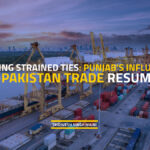
Trade via the Attari (India) – Wagah (Pakistan) land-crossing was suspended by Pakistan in August 2019. This decision had a direct and severe impact on the livelihoods of thousands of families employed in the tertiary sector, including transporters, labourers, small traders and others in Punjab’s border district.
In April 2021, the then Imran Khan-led Pakistan Tehreek-e-Insaf government had given the go-ahead for the resumption of trade in essential commodities via the Attari-Wagah land-crossing, but the proposal was ultimately rejected by his cabinet, reflecting the dominance of political considerations over economic rationality. While land trade via Attari–Wagah was modest in terms of overall volume, its localised impact was substantial, providing a critical boost to the tertiary sector of districts in Punjab’s border belt.
The vulnerability of border economies becomes even more apparent during periods of military escalation. Any escalation of tensions between India and Pakistan results in the displacement of individuals residing in border districts and creates an atmosphere of uncertainty, though the people are extremely resilient.
During the recent conflict with Pakistan, in May 2025, it was the livelihoods of those from the border belt of the state which were severely impacted. It would not be incorrect to say that, apart from the districts of Poonch and Rajouri (Jammu and Kashmir), where there were several civilian casualties and economic losses, it was the border districts of the state of Punjab which suffered from acute human and economic distress. Two individuals from the same family, hailing from Ferozepur district, lost their lives after being struck by a Pakistani drone in May 2025. Compounding this tragedy, barely three months later, the state was hit by devastating floods, leading to further loss of lives and massive economic damage.
While the reactivation of trade via the Attari-Wagah land-crossing will be determined not merely by geopolitics, but also by the domestic economic lobbies on both sides. It is therefore important to create alternative livelihood opportunities for those who have suffered due to the prolonged closure of trade via the Attari-Wagah land route.
One step which needs to be taken in this direction is a substantial and targeted relief package for Punjab’s border belt. This has been a longstanding demand of successive state governments, but has consistently failed to get a meaningful response. In fact, it is not just the border regions, but Punjab as a whole, which needs sustained support from the centre. Both the farm sector and industry are in distress, and a substantial economic package from New Delhi is essential to revive the sagging economy of the state.
In addition to fiscal support, there is a pressing need for policy imagination and coordination among all stakeholders to explore alternative trading routes. One such avenue lies in expanding trade via air, with Afghanistan, Iran and the Middle East. The reactivation of the Amritsar (Punjab) -Kabul (Afghanistan) air freight corridor is a welcome step and may provide some relief to the traders and farmers of the state. However, this initiative must be complemented by greater international air connectivity from Punjab, enabling the state to tap overseas markets more effectively.
Conclusion
In conclusion, the debate triggered by the demand to reopen trade via Nathu-la should serve as a broader policy wake-up call. It is important that the political and economic issues of all border states are viewed with greater sensitivity, and that the approach towards border states is not limited to a security perspective alone, but adopts a more holistic framework.
Disclaimer: The views expressed in this article are those of the author solely. TheRise.co.in neither endorses nor is responsible for them. Reproducing this content without permission is prohibited.
About the author

Tridivesh Singh Maini is a New Delhi-based Policy Analyst. He is faculty member of OP Jindal Global University, Sonepat, Haryana.