The US absence from the G20, even though it will be holding the presidency in 2026, clearly underlines the fact that Washington, under Trump, is likely to pay less attention to important multilateral forums. This may further push countries to re-examine their policies, seek alternative platforms, and even explore the possibility of new groupings.
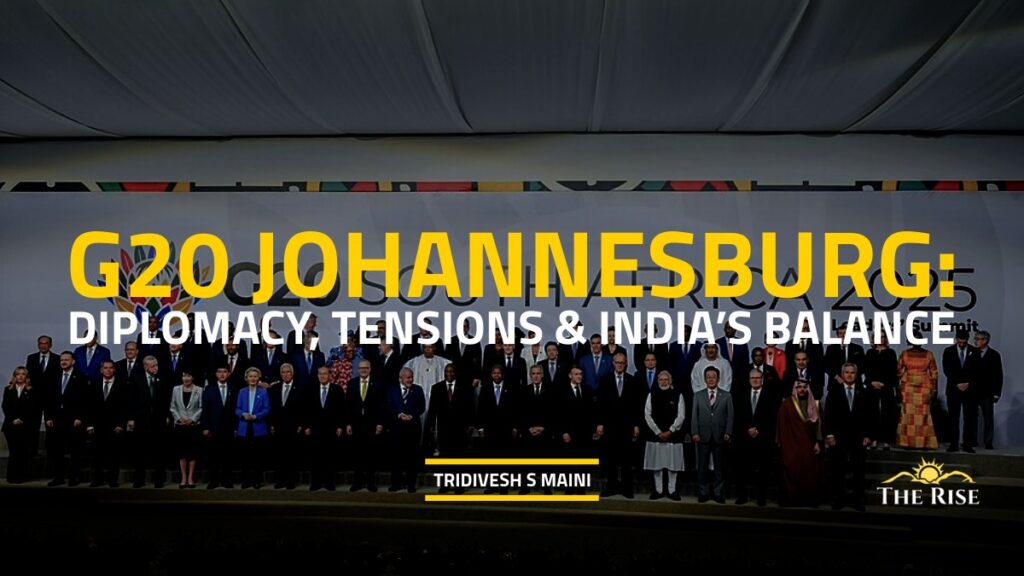
The G20 Summit held in Johannesburg from November 23 to November 25, 2025, drew attention for several reasons. Firstly, it was the first time that a G20 Summit was held in an African country. The second was the absence of US President Donald Trump from the Summit. The US’s absence from the G20 Summit was even more surprising, since the US will be holding the Presidency of the G20 in 2026. The US President attributed his absence from the G20 Summit to what he believed was the ‘ill treatment’ of the country’s white minority. The US President reiterated this claim on November 25, 2025.
US-South Africa tensions
Trump has also been critical of South Africa’s stance on issues related to climate change. The South African President, Cyril Ramaphosa, pointed to an empty chair, saying that the African nation would hand over the G20 presidency to an empty chair. He also said that the ‘stature’ of South Africa’s presidency should not be overshadowed by the absence of Donald Trump.
The South African Foreign Minister, Ronald Lamola, said that the G20 was not only about the US and added: ‘We are all equal members of the G20. What it means is that we need to make a decision. Those of us who are here have decided this is where the world must go.’
South Africa also criticised the US for sending only a US embassy official. The African nation has not yet officially handed over the presidency to the US. Trump criticised this decision, and on November 26, 2025, said that South Africa would not be invited to the G20 summit of 2026 to be held in Miami (Florida).
The G20 adopted a declaration that addressed issues about climate change as well as the debt distress of developing countries. The US was critical of the statement, saying that its inputs were not taken.
India’s meeting on the sidelines of the G20 Summit: Successful balancing act?
On another note, some important meetings happened on the sidelines of the summit. The first was the IBSA (India, Brazil, Russia, South Africa) Summit. Apart from reform of the United Nations Security Council (UNSC), PM Modi also called for a firm stance against terrorism. Two important recommendations made by Modi were the need for setting up an IBSA Fund for Climate Resilient Agriculture for strengthening cooperation between developing countries. In addition to this, according to an Indian readout, the Prime Minister proposed an IBSA Digital Innovation Alliance, which could help in the sharing of Digital Public Infrastructure (DPI) such as India’s Unified Payments Interface (UPI), health platforms like CoWIN, cybersecurity frameworks, and women-led tech initiatives among partner countries.
India has robust ties with Russia and cordial ties with Brazil and South Africa, but in a changing economic and technological landscape, all four countries need to enhance their cooperation. The IBSA digital innovation alliance is important in this context.
The Australia-Canada-India Technology and Innovation Partnership
In recent years, India has tried to walk a fine balance between its ties with Brazil, Russia, and South Africa on the one hand and Western nations on the other. In this context, PM Modi also met with the Prime Ministers of Australia and Canada. The three countries also announced an Australia-Canada-India Technology and Innovation (ACITI) Partnership. PM Modi, while commenting on the aims of ACITI, said: ‘We are delighted to announce an Australia-Canada-India Technology and Innovation (ACITI) Partnership today. The initiative will deepen collaboration between democratic partners across three continents and three oceans in emerging technologies, support diversification of supply chains, clean energy, and mass adoption of AI.’
The first meeting of this grouping will be convened in 2026. All three countries have been seeking to diversify economic relations and linkages in areas like tech in an increasingly unpredictable world order.
The US absence from the G20, even though it will be holding the presidency in 2026, clearly underlines the fact that Washington, under Trump, is likely to pay less attention to important multilateral forums. This will further push countries to re-examine their policies, seek alternative platforms, and even explore the possibility of new groupings.
Conclusion
The G20 Summit, the issues highlighted during it, and India’s meetings on the sidelines, once again underscore the increasingly complex economic and geopolitical landscape and the need to navigate it deftly. India, which will be chairing BRICS, has an opportunity to take the lead in articulating the issues of the Global South and strengthening cooperation across key areas.
Disclaimer: The views expressed in this article are those of the author solely. TheRise.co.in neither endorses nor is responsible for them. Reproducing this content without permission is prohibited.
About the author

Tridivesh Singh Maini is a New Delhi-based Policy Analyst. He is faculty member of OP Jindal Global University, Sonepat, Haryana.