India, on its part, has been facilitating dialogue on the current conflict in West Asia, but has stated that a consensus with regard to a common BRICS+ position is proving elusive because some BRICS members are directly involved in the conflict.
The West Asia conflict, now in its third week, has resulted not only in loss of lives but also in severe economic consequences. The closure of the strategically important waterway, Straits of Hormuz, which accounts for one-fifth of global oil trade, and Iranian attacks on Gulf countries – especially UAE, Kuwait and Qatar – have resulted in severe economic damage. Crude oil prices surpassed $106 a barrel on March 16, 2026.
Since the start of the military conflict in the Middle East, India has been engaging proactively with Gulf nations, while in the past few days, there have been several conversations between External Affairs Minister S Jaishankar and his Iranian counterpart Seyed Abbas Araghchi. Last week, PM Narendra Modi spoke to Iranian President Masoud Pezeshkian on March 12, 2026.
Also Read: After IRIS Dena Strike, Is Free & Open Indo-Pacific Just Branding?
One of the important developments in the Indian context was Iran’s permitting safe passage to two LPG containers – Shivalik and Nanda Devi via the Straits of Hormuz on March 14, 2026. In the midst of growing LPG shortages, the safe passage has come as a relief. However, 22 Indian vessels are still stranded west of the Straits of Hormuz. S Jaishankar, in an interview, did clarify that there was no ‘blanket arrangement” for Indian flagged ships.
Here, it would be pertinent to point out that in a media interview, US Treasury Secretary Scott Bessent said: “The Iranian ships have been getting out already, and we’ve let that happen to supply the rest of the world.“
The BRICS dimension
During his conversation with PM Modi, the Iranian President Masoud Pezeshkian highlighted that BRICS should play an important role in safeguarding peace in the region.
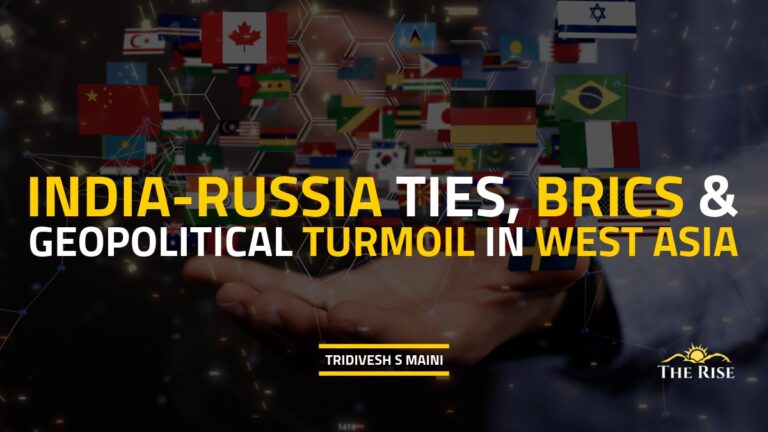
During the March 12, 2026, conversation between Jaishankar and Iranian Foreign Minister Seyed Abbas Aragchi, the role of BRICS in reducing tensions was also discussed. Iran officially entered BRICS as a member in 2024, while India, a founding member of BRICS, is the BRICS chair for 2026.
An Iranian readout of the foreign minister’s talks stated, “Referring to the importance of BRICS as a platform for expanding multilateral cooperation, he (Araghchi) said the grouping should play a constructive role at the present juncture in supporting regional and global stability and security.“
India’s BRICS presidency has been overshadowed by several geopolitical events – the most important being the current West Asia conflict, which began on February 28, 2026. Here, it would be pertinent to point out that the UAE, which has been repeatedly attacked by Iran during the current conflict, had also entered the BRICS grouping in 2024.
India, on its part, has been facilitating dialogue on the current conflict, but has stated that a consensus with regard to a common BRICS+ position is proving elusive because some BRICS members are directly involved in the conflict.
The Indian National Congress (INC), on its part, has criticised the government for not issuing a collective statement in its capacity as BRICS+ chair. In not doing so, Congress leader Jairam Ramesh said that PM Modi is “diminishing the value and standing of the BRICS+ presidency”.
India seeking to take a balanced position
While Russia and China have supported Iran, India has sought to take a balanced position. India has repeatedly called for “dialogue” and an end to the conflict, but it has also co-sponsored a United Nations Security Council (UNSC) resolution that criticised Iran’s attacks on Gulf countries. Over the past two decades, India’s economic and strategic linkages with Gulf countries have strengthened, while the region is home to around 9 million Indian expats. For India, its safety and security are an important priority. India receives more than one-third of its total remittances from Gulf countries.
Conclusion
There is no doubt that India, as an important player on the global stage, needs to play a key role in bringing an end to the current conflict. As the Chair of BRICS, India has an important role. At the same time, building consensus on the Middle East conflict is likely to be tough. First, as mentioned earlier, members of BRICS are themselves involved in the conflict, and second, India’s stance on the conflict, given its national interests, is distinct from that of other members. New Delhi should continue to closely work with all stakeholders to bring an end to the conflict. It is important to be realistic regarding the limitations of BRICS+, given the differences between members of the organisation on key geopolitical issues.
Disclaimer: The views expressed in this article are those of the author solely. TheRise.co.in neither endorses nor is responsible for them. Reproducing this content without permission is prohibited.
About the author

Tridivesh Singh Maini is a New Delhi-based Policy Analyst. He is faculty member of OP Jindal Global University, Sonepat, Haryana.