Her literary career began in the 1950s. She consistently focused on the state of affairs of communities such as tribals, dalits, landless labourers, and those pushed to the margins of society. Importantly, her engagement wasn’t that of a distant observer. She travelled extensively, lived among these communities, listened to their histories, and allowed those experiences to leave a deep imprint on her writing.
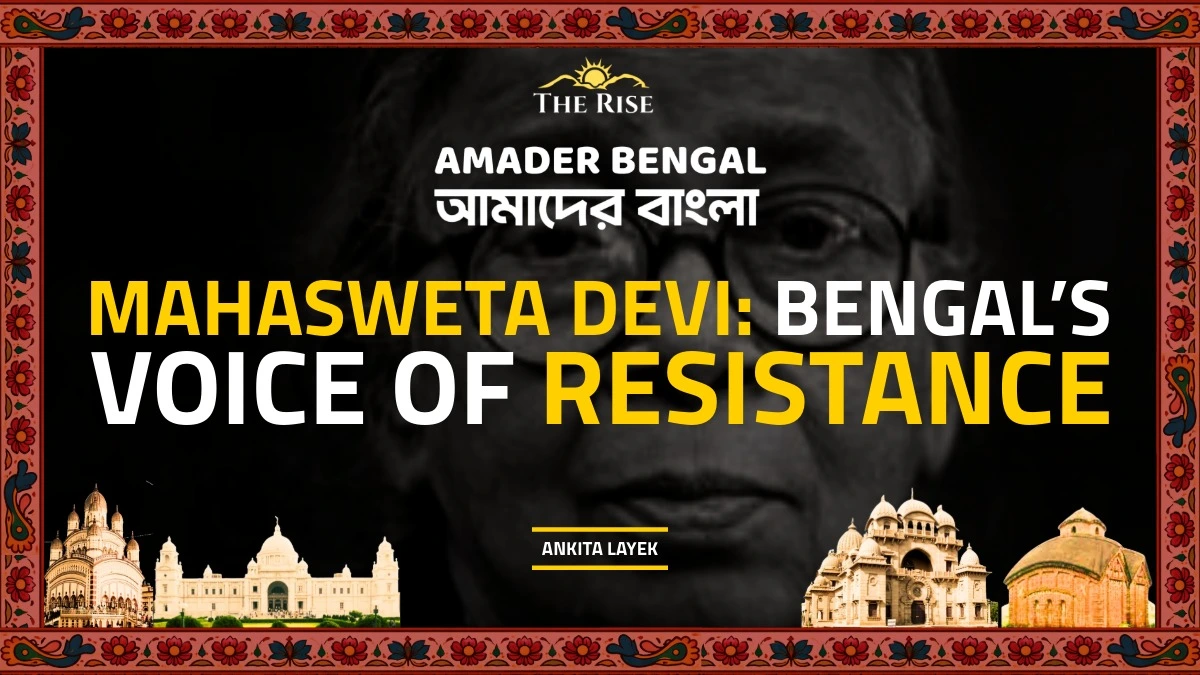
Mahasweta Devi was far more than a chronicler of the marginalised; she was the fierce, singular voice that forced the world to look at the tribals of Bengal. She lived in the trenches of reality, wielding her pen as a weapon to dismantle the systemic erasure of the Santal, Munda, Lodha and other tribal communities. Her work didn’t just reflect their struggles; it challenged the structures that kept them invisible, bridging the gap between the silent forests and the corridors of power.
Born in 1926 in Dhaka, she grew up in an environment that valued both a culture of critical thinking and social responsibility. This foundation was further shaped at Santiniketan, where ideals of humanism and social realities informed her worldview.
“I have read more books than I have eaten food. The matter for my writing comes from there. Writing is activism for me,” she once said. Her literary career began in the 1950s. She consistently focused on the state of affairs of communities such as tribals, dalits, landless labourers, and those pushed to the margins of society. Importantly, her engagement wasn’t that of a distant observer. She travelled extensively, lived among these communities, listened to their histories, and allowed those experiences to leave a deep imprint on her writing.
In the novel Hajar Churashir Ma, Devi dissects the Naxalite movement’s domestic fallout, illustrating how state violence ruptures the family unit. Her move into short fiction made her critique sharper. In her short story Rudali, she explores how grief itself becomes shaped by caste, class and gender. Similarly, her short story Draupadi stands as a stark indictment of state power and sexual violence. Across these genres, Devi consistently refuses to aestheticise reality, transforming the subaltern experience into an urgent political intervention.
This fundamental shift moves her work from mere representation to active intervention, transforming the act of writing into a tool for political mobilisation. Later, she helped establish the Adim Jati Oikya Parishad, a platform aimed at mobilising Adivasi communities across West Bengal to challenge the colonial-era stigma attached to the communities once branded under the Criminal Tribes Act. For Devi, empowerment was the objective; the prose was the weapon.
Another important part of her writing is how she deals with history. Mahasweta Devi doesn’t stay within official records; she moves towards oral accounts, folklore, and the local knowledge which she experiences while travelling.
Her work did not remain limited to writing. From the 1960s onwards, Mahasweta Devi spent long periods working with tribal communities across Bengal and neighbouring regions like Bihar, Jharkhand, and Odisha. Her presence could be seen during the Singur and Nandigram movements as well, where questions of land and state power became sharply visible.
It’s difficult to separate her writing from its impact. Once these stories enter the public space, they don’t sit quietly; they stay with the reader. What she brings forward are not unfamiliar realities, but ones that are often pushed aside or not spoken about directly. Her work keeps returning to questions of inequality and power, as lived conditions. She received major recognitions like the Jnanpith, the Ramon Magsaysay Award, and the Padma Vibhushan for her exemplary work.
Mahasweta Devi did not treat literature as an act of observation. She turned it into evidence, resistance, and moral indictment. Even today, her writing continues to ask an uncomfortable question: who gets remembered, and who is made to disappear?
Ankita Layek is an intern under Amader Bengal
Mentored and Edited by Sneha Yadav
About the author

Ankita is a second year International Relations student at Jadavpur University with a strong interest in gender justice, constitutional history and public policy. She is currently an intern under AMADER BENGAL.
-
This author does not have any more posts.

Sneha Yadav is an electronics engineer with a postgraduate degree in political science. Her interests span contemporary social, economic, administrative, and political issues in India. She has worked with CSDS-Lokniti and has been previously associated with The Pioneer and ThePrint.
-
Sneha Yadav

-
Sneha Yadav
-
Sneha Yadav
-
Sneha Yadav
-
Sneha Yadav
-
Sneha Yadav
-
Sneha Yadav
-
Sneha Yadav
-
Sneha Yadav
-
Sneha Yadav
-
Sneha Yadav
-
Sneha Yadav
-
Sneha Yadav
-
Sneha Yadav
-
Sneha Yadav
-
Sneha Yadav
-
Sneha Yadav
-
Sneha Yadav
-
Sneha Yadav
-
Sneha Yadav
-
Sneha Yadav
-
Sneha Yadav
-
Sneha Yadav
-
Sneha Yadav
-
Sneha Yadav
-
Sneha Yadav
-
Sneha Yadav
-
Sneha Yadav
-
Sneha Yadav
-
Sneha Yadav
-
Sneha Yadav
-
Sneha Yadav