
With youth forming the backbone of India’s population and economic future, the terms under which they enter the workforce carry consequences far beyond individual paychecks. A generation growing up financially unstable, lacking healthcare access, and lacking a dependable social safety net will shape the country’s economic trajectory for decades to come.
India today stands at a demographic turning point. Nearly two-thirds of its population falls under the age of thirty-five, a statistic often celebrated as the country’s greatest economic advantage. Yet beneath this celebrated demographic dividend lies a quieter, more troubling reality. Millions of young Indians are building their working lives inside a system engineered to avoid recognizing them as workers at all.
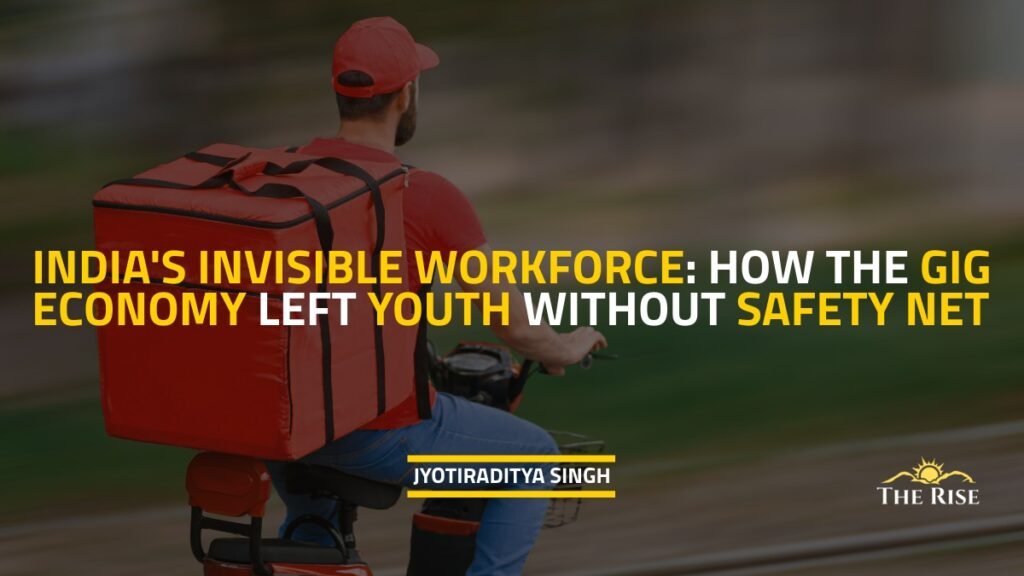
Step into any Indian city today, and the evidence surrounds you. A delivery rider weaves through traffic with a food bag on his back. A cab driver logs sixteen-hour shifts to hit a daily target set by an app. A freelance data annotator works from a small town, paid per task, earning amounts that swing wildly from month to month. These are the faces of India’s gig economy, a sector projected to employ over twenty million people within the next few years. For many young Indians, gig work has become the default entry point into employment, filling the gap left by a formal job market struggling to absorb the sheer scale of new graduates entering it each year.
Also Read: Driving Against the Odds: The Socio-Economic Realities of Women Taxi Drivers in Delhi
The appeal, on paper, seems obvious. Flexible hours. Quick onboarding. Minimal formality. But scratching the surface reveals a far harsher picture.
Companies operating in this space have built their business models around a simple legal maneuver, classifying workers as partners rather than employees. This single distinction strips millions of young workers of protections that formal employees take for granted. Their earnings carry no provident fund contribution building toward retirement. Their health has no employer-sponsored insurance backing it during an accident or illness. Their tenure carries no severance and no notice period, and account deactivations often arrive overnight, with little explanation offered.
Consider the algorithm itself, the invisible manager overseeing this entire workforce. Pay rates shift, order allocations fluctuate, and penalties get applied, all determined by systems that remain opaque to the very people whose income depends on them. A worker can watch earnings drop for weeks while the reason stays hidden. Appeals, where they exist, often vanish into automated support systems offering little beyond scripted replies.
Physical risk compounds this financial precarity. Delivery workers navigate monsoon floods, extreme heat, and chaotic traffic for hours daily, carrying the full weight of that risk themselves. A road accident becomes a personal financial catastrophe rather than a covered workplace incident, since these workers, by legal classification, technically work for themselves.
Also Read: Gig Economy: The New Disruptor of Education, Jobs & Social Security
Recognition of this crisis has entered Indian policy circles, most notably through the Code on Social Security passed in 2020, which acknowledged gig and platform workers as a distinct category deserving welfare coverage for the first time. The intent marked genuine progress. Execution, however, has lagged far behind the legislation, and implementation has moved at a pace that leaves millions still waiting for tangible benefits years after the law’s passage.
Other countries offer instructive comparisons. British courts ruled that Uber drivers qualify as workers entitled to minimum wage and holiday pay, a landmark decision that reshaped labor protections across Europe’s gig sector. India’s youth deserve a similarly serious reckoning with what fair treatment in this new world of work should look like.
With youth forming the backbone of India’s population and economic future, the terms under which they enter the workforce carry consequences far beyond individual paychecks. A generation growing up financially unstable, lacking healthcare access, and lacking a dependable social safety net will shape the country’s economic trajectory for decades to come.
The gig economy will keep growing; that trajectory looks certain. The real question facing policymakers, companies, and citizens alike centers on whether this growth arrives paired with dignity and security for the young people powering it, or whether India allows an entire generation to build its future on ground this unstable.
Disclaimer: The views expressed in this article are those of the author solely. TheRise.co.in neither endorses nor is responsible for them. Reproducing this content without permission is prohibited.
About the author

Jyotiraditya Singh is a youth leader and social activist passionate about youth participation, public policy, education, employment and political accountability. He is actively involved in student and youth initiatives.




What a take on our gig worker loved the article. Thanks for publishing this.
This article is so well articulated and with the emotions that every gig worker can feels it, loved it jyotiraditya
I strongly agree with this brilliantly authored analysis.
India’s obsession with GDP often celebrates aggregate output while ignoring the quality, security and dignity of work producing it.
Nearly 90% of India’s workforce remains informally employed, while NITI Aayog estimated 7.7 million gig workers in 2020-21, projected to reach 23.5 million by 2029-30. That is not merely flexibility, it can mean risk transferred from firms to workers.
My own experience observing street entrepreneurship and the informal economy has shown me how millions create livelihoods without contracts, insurance or social security.
We celebrate a demographic dividend and GDP milestones, while quietly normalising an economy where workers remain statistically convenient and institutionally invisible.
This is not merely an article about the gig economy; it is a powerful reflection on the changing nature of work in India and the uncertain future being inherited by its youth. “India’s Invisible Workforce” manages to bring a complex policy and economic issue down to the human level, making the reader look beyond the convenience of one-click deliveries and app-based services to understand the people who make that convenience possible.
What makes the article particularly remarkable is its depth and clarity. The discussion around algorithmic management, unstable incomes, workplace risks and the absence of meaningful social security shows a thoughtful understanding of how the gig economy actually functions. The article does not simply criticise the system; it asks a much larger and more important question about dignity, security and fairness in the future of employment.
The writing is sharp, engaging and intellectually mature. The transition from India’s demographic dividend to the realities of gig workers is especially powerful because it connects individual struggles with a much larger national question: what kind of economic future are we creating for millions of young Indians?
A special appreciation for Jyotiraditya Singh for bringing such an important issue into public discussion. His ability to connect youth, employment, public policy and social justice reflects a commendable understanding of contemporary India. More importantly, the article demonstrates that he is not merely writing about young people, but thinking seriously about the conditions under which an entire generation will build its future.
A thought-provoking, relevant and exceptionally well-articulated piece. Articles like this remind us that behind every statistic, app and economic model, there are real people whose dignity and security deserve to be part of the conversation.
A very powerful and timely piece. Jyotiraditya Singh has captured the ground reality of India’s gig workforce with remarkable clarity. What stands out is how simply the article connects youth, jobs, dignity and social security. Definitely a thought-provoking read.
Here is a clear, human-centered summary and opinion on the article:
### **The Core Message**
The article highlights a harsh paradox in India today: while we celebrate our massive youth population as an economic “demographic dividend,” millions of these young people are trapped in the gig economy (delivery workers, cab drivers, freelancers) with **zero job security, no healthcare, no retirement benefits, and invisible algorithmic bosses.**
### **Key Takeaways**
* **The “Partner” Loophole:** Companies label young workers as independent “partners” rather than employees to dodge legal responsibilities like providing insurance, provident funds, or notice periods.
* **Opaque Algorithms:** Workers’ incomes fluctuate based on mysterious app updates and automated penalties with no human support system to turn to.
* **All Risk, No Safety Net:** Physical dangers (like accidents during monsoon floods or extreme heat) are entirely borne by the workers themselves.
* **Policy Lags Behind:** Although India passed the *Code on Social Security in 2020* to protect gig workers, implementation has been painfully slow, leaving millions vulnerable.
—
### **My Opinion**
This is a deeply thoughtful and timely piece. It brilliantly strips away the glossy convenience of “one-click app services” to expose the human cost behind it.
We live in a culture that loves to boast about rapid GDP growth and digital adoption, but this article forces us to confront an uncomfortable truth: **convenience shouldn’t come at the cost of human dignity. When an entire generation has to hustle 16 hours a day on a bicycle or behind a wheel just to survive without a safety net, we aren’t building a sustainable economic future we are quietly mortgaging it.
What are your thoughts on how tech platforms and the government can realistically balance worker protection with business growth?
A very important issue that often gets ignored when we talk about India’s growing gig economy. The convenience we enjoy through these platforms comes with a very real cost for the people working behind them. The points on job security, algorithmic decisions and lack of social protection really make you think about where the future of work is heading.
A much-needed conversation, especially for India’s young workforce.
This is a timely and important discussion on the changing nature of work in India. The article rightly draws attention to the gap between the rapid expansion of the gig economy and the social protections available to the people who sustain it.
What particularly stands out is the discussion around algorithmic management and risk. Flexibility can be valuable, but flexibility without income stability, accident protection, healthcare access, or meaningful grievance mechanisms can place a disproportionate burden on workers.
The challenge now is to think beyond the binary of “business growth versus worker protection.” India’s future of work will require models that allow innovation and platform-based employment to grow while ensuring that workers are treated with dignity and have access to meaningful social security.
A valuable contribution to an increasingly important policy conversation, particularly as millions of young Indians enter the workforce.
A crucial conversation on India’s changing world of work. The gig economy is creating opportunities, but flexibility cannot come at the cost of dignity, social security, and basic worker protections. This debate deserves far greater attention.
This is so well written as a economics HR professor I used to observe these gig workers are too poor and they are doing these work without the safety net.
I have shared this article in my college and I will teach my students as case study on gig workers
good article, there should be need of a proper safety measures for gig workers.