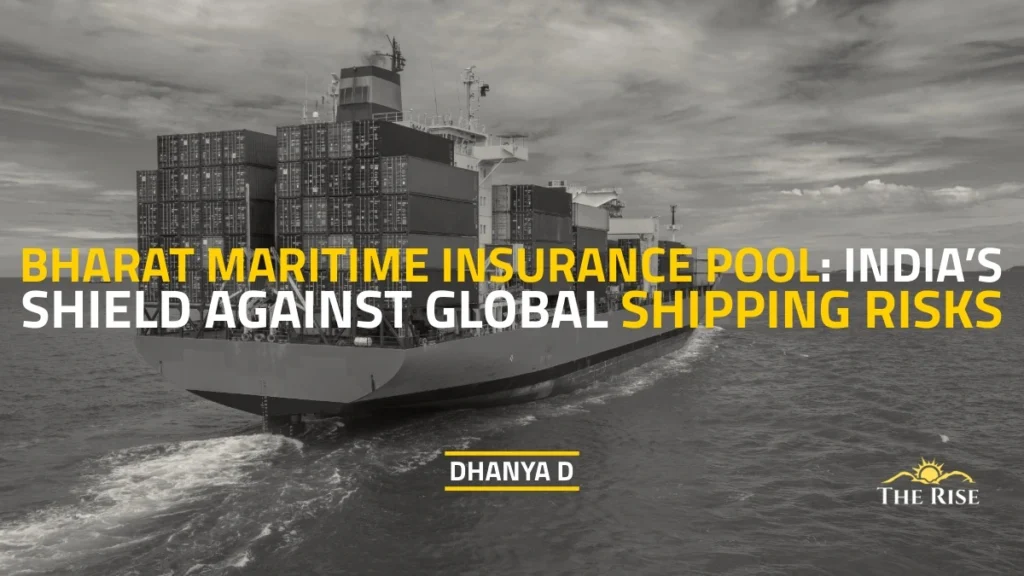
The heightened risk perception in shipping has led to higher insurance costs, or in some cases, to insurers refusing coverage altogether. Indian shipping companies are currently heavily dependent on overseas insurers. The Bharat Maritime Insurance Pool (BMI) is set to reduce this reliance on foreign insurers.
The Government of India has approved the creation of the Bharat Maritime Insurance Pool. The Union Cabinet, chaired by Prime Minister Narendra Modi, rolled out a Rs 12,980 crore sovereign guarantee to cover Indian ships and ensure risk coverage.
Over 90% of global trade is transported by sea. Amidst rising conflicts across the world, sea-borne trade is facing immense vulnerabilities. Recent shipping trends show the volatility of maritime transport due to geopolitical tensions caused by military conflicts, economic sanctions, and political instability in various regions. These tensions collectively drive uncertainty across global markets.
Also Read: Bengal’s Industrial Ruin: The Fall of Hindustan Cables
The connection between conflicts and their impact on shipping is visible in challenges such as delays and detours along shipping routes, which increase shipping costs, drive up fuel prices, and spike insurance premiums due to heightened risks to vessels, cargo, and crew.
Over 70% of India’s trade moves by sea, and the vulnerability of ships carrying goods to and from India was acutely felt during recent conflicts and disruptions in the Strait of Hormuz. India’s vital energy security, comprising oil and gas supplies, has taken significant hits as a result. Indian commercial ships have encountered direct attacks while transiting the straits, and forced rerouting around the Cape of Good Hope continues to add time and cost to voyages.
Another area of concern is the Red Sea, which has seen growing volatility in recent years. The region is critically important for global trade, serving as the gateway to the Suez Canal, and it is the fastest route for freight movement between Asia and Europe. Houthi rebel attacks on commercial vessels in the area have disrupted key sea lanes, turning them into a zone of active risk. Commercial shipping has increasingly become a target in military conflicts. For India, whose trade heavily relies on this route, the threat is very real.
The heightened risk perception in shipping has led to higher insurance costs, or in some cases, to insurers refusing coverage altogether. Indian shipping companies are currently heavily dependent on overseas insurers such as the International Group of Protection and Indemnity (P&I) clubs for cargo damage, collision liabilities, and other risks. The government’s initiative of the Bharat Maritime Insurance Pool (BMI) is set to reduce this reliance on foreign insurers.
Also Read: From Ice to Oil: Is the Arctic the Next Middle East?
The BMI pool is proposed to provide insurance coverage for Indian-flagged and Indian-controlled ships, cargo, machinery, and ship hulls, including protection against war risks in conflict zones in international waters. This initiative will give a domestic safety net to Indian shipping, offering exporters and importers greater stability during volatile periods. The BMI pool is designed to function as a domestic option, insulating India’s shipping industry when global markets are unstable.
Maritime security is central to India’s broader vision of protecting its trade, which remains the lifeblood of its economy. This vision operates on two levels: military and economic. On the military side, the Indian Navy plays a key role in guarding sea lanes and ensuring safe passage for commercial vessels. On the economic side, policies and initiatives like the BMI pool show India stepping up to safeguard its trade security. Insurance plays a major role here, giving Indian shippers a domestic safety net to fall back on.
Disclaimer: The views expressed in this article are those of the author solely. TheRise.co.in neither endorses nor is responsible for them. Reproducing this content without permission is prohibited.
About the author

Dhanya D is a Research Scholar at the Department of Defence and Strategic Studies, University of Madras. Her research focuses on contemporary Maritime Security.