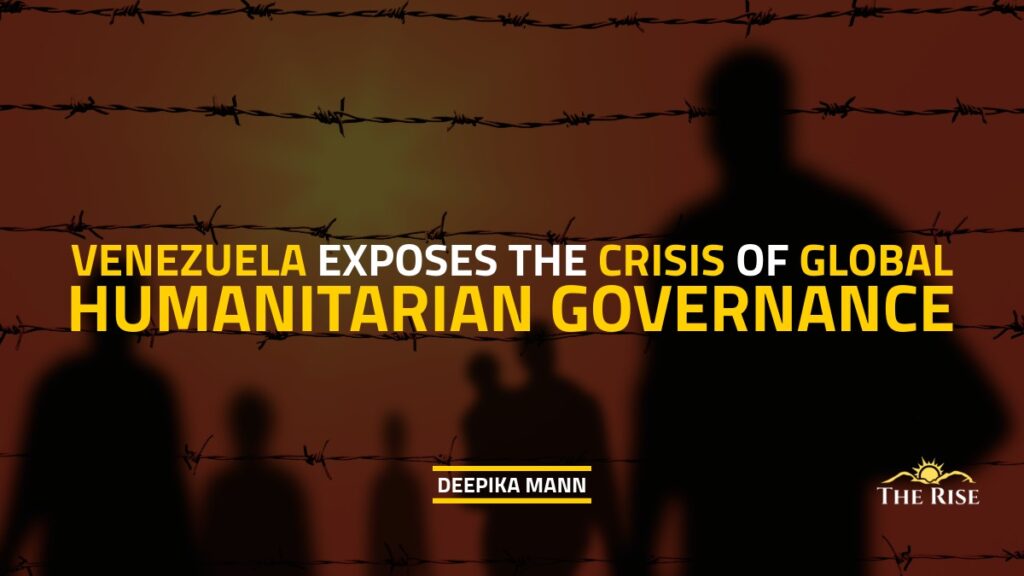
Humanitarian crises do not emerge solely from internal collapse; they are also produced through external constraints. In Venezuela’s case, the distinction between domestic failure and international responsibility has been deliberately blurred.
Venezuela’s humanitarian crisis is often framed as a national tragedy rooted in political dysfunction and economic collapse. Yet this framing obscures a deeper and more troubling reality: the crisis has unfolded within an international system that claims to protect human dignity but repeatedly fails to do so when geopolitical power is involved. The case of Venezuela reveals not only the consequences of sanctions but also a broader breakdown in global humanitarian governance, one in which the United Nations appears increasingly constrained, and humanitarian principles are applied selectively.
At stake is more than Venezuela’s future. What is being tested is the credibility of international law, the integrity of humanitarian norms, and the capacity of multilateral institutions to act independently of hegemonic power.
A Humanitarian Crisis Shaped by Global Decisions
There is little dispute that Venezuelans have been facing severe humanitarian hardship. Shortages of food, medicine, and essential services have become part of daily life. Millions have left the country, placing a strain on neighbouring states and significantly reshaping regional migration patterns.
What is less acknowledged is how international policy choices have directly shaped these outcomes. Economic sanctions imposed by the United States and supported by allies have restricted Venezuela’s access to global financial systems, oil revenues, and trade networks. These restrictions extend far beyond political elites, affecting hospitals, public services, and household survival.
Humanitarian crises do not emerge solely from internal collapse; they are also shaped by external constraints. In Venezuela’s case, the distinction between domestic failure and international responsibility has been deliberately blurred.
Sanctions and the Erosion of Humanitarian Norms
Sanctions are frequently defended as lawful, targeted, and necessary tools of international pressure. Yet their humanitarian consequences raise serious ethical and legal concerns. When sanctions contribute to widespread deprivation, particularly of food, healthcare, and basic services, they challenge the core principles of international humanitarian and human rights law.
The idea that civilian suffering can be justified as a means to political ends undermines the very norms the international system claims to uphold. Even when sanctions include humanitarian exemptions, their real-world impact often tells a different story. Financial isolation, compliance risks, and bureaucratic barriers prevent essential goods from reaching those in need.
In practice, this results in structural and cumulative harm—slow, often invisible, and devastating. The suffering may not resemble the violence of armed conflict, but its effects are no less real. If humanitarian principles are to be meaningful, they cannot be suspended for geopolitical convenience.
The United Nations and the Crisis of Credibility
The United Nations occupies a central role in this dilemma. As the primary guardian of international norms, the UN is expected to speak clearly when humanitarian principles are violated. In Venezuela, however, its response has been marked by caution.
While UN agencies have documented the humanitarian situation and provided assistance, the organisation has largely avoided challenging the broader sanction regime or the power dynamics sustaining it. This cautious approach reflects the political realities of a system in which powerful states wield disproportionate influence over multilateral decision-making.
Also Read: From Signals to Strategy: Israel’s Cyber Lessons for India
The result is a credibility gap. The UN continues to promote human rights and humanitarian protection in principle, while its ability to enforce or defend those principles remains limited in practice. For affected populations, this disconnect steadily erodes trust in multilateral institutions.
When Humanitarianism Becomes Conditional
One of the most damaging aspects of the Venezuela situation is the emergence of conditional humanitarianism. Assistance, concern, and international attention appear closely tied to political alignment rather than human need.
This selective approach weakens the universality of humanitarian norms. If human suffering matters only when it aligns with strategic interests, then humanitarianism becomes a tool of governance rather than an ethical commitment. Venezuela illustrates how easily humanitarian language can be deployed alongside policies that deepen humanitarian harm.
Such contradictions do not go unnoticed. They shape how states, communities, and individuals perceive the international system—fuelling scepticism, resentment, and long-term disengagement.
A Dangerous Global Precedent
What happens in Venezuela does not stay in Venezuela. The normalisation of sanctions that produce widespread civilian suffering sets a dangerous precedent. It signals that economic coercion can replace military force without attracting comparable scrutiny or accountability.
For smaller and weaker states, this precedent is deeply unsettling. It suggests that sovereignty and humanitarian protection are contingent on compliance with powerful actors. For multilateral institutions, it further entrenches a hierarchy where norms are enforced unevenly and selectively.
If left unchallenged, this model risks reshaping global governance into a system where legality and morality are interpreted through power rather than principle.
Reclaiming Humanitarian Responsibility
Addressing Venezuela’s crisis requires more than humanitarian aid packages and diplomatic statements. It requires a willingness to confront uncomfortable questions about responsibility, power, and accountability.
For sanctioning states, this means acknowledging that humanitarian harm cannot be dismissed as collateral damage. For the United Nations, it means reasserting normative leadership even when political constraints make such action difficult. And for the broader international community, it means resisting the erosion of humanitarian standards under the weight of geopolitical competition.
Humanitarianism cannot survive as a selective or conditional practice. Its legitimacy depends on consistency, universality and accountability.
Conclusion: A Test of the System Is Failing
Venezuela stands as a test case for the international system, and so far, that test is being failed. Sanctions imposed in the name of moral responsibility have contributed to human suffering. Multilateral institutions tasked with defending humanitarian norms remain constrained by power politics. And civilians continue to pay the price.
This is not merely a Venezuelan tragedy; it is a warning. If humanitarian principles are subordinated to hegemonic interests, they lose their universal meaning. If international institutions cannot challenge power when human dignity is at stake, their moral authority diminishes.
Ultimately, the question Venezuela poses is simple but profound: can a global order shaped by inequality genuinely claim to be humanitarian? Until that question is answered honestly, crises like Venezuela’s will continue not as failures of governance alone, but as failures of the international system itself.
Disclaimer: The views expressed in this article are those of the author solely. TheRise.co.in neither endorses nor is responsible for them. Reproducing this content without permission is prohibited.
About the author

Dr. Deepika Mann is an Assistant Professor specializing in International Relations and Political Science, with a strong academic focus on gender equality and women’s empowerment. A certified specialist in women’s empowerment, Dr. Mann has actively contributed to advancing gender discourse through both research and teaching. Her scholarly work includes authoring books and contributing to several edited volumes, journals, and online platforms on pressing global issues.