When dissatisfaction persists in relationships, it is often not because the other person was “wrong,” but because we did not integrate the lessons of past experiences. Blame becomes a convenient escape from self-reflection.
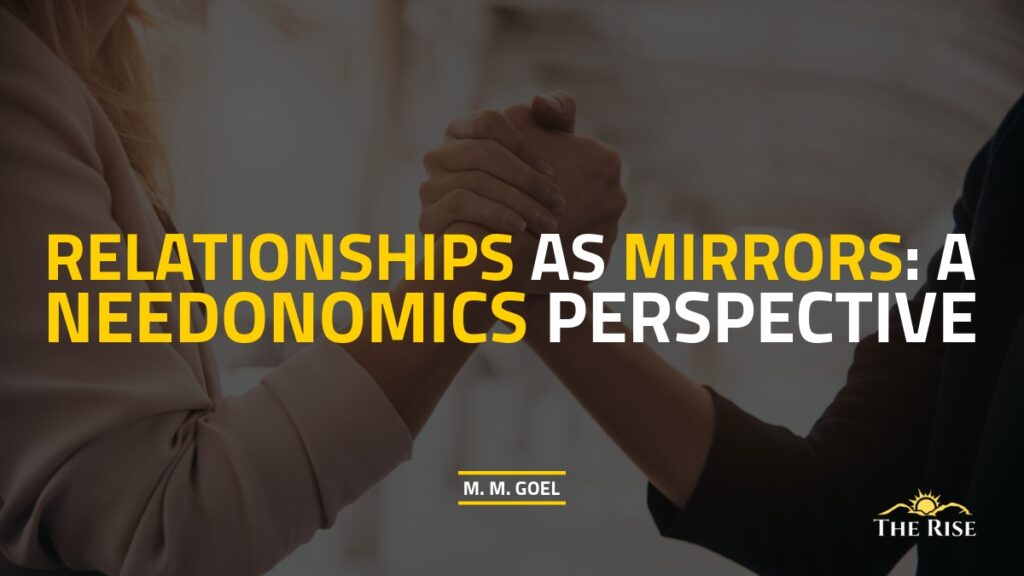
Needonomics School of Thought (NST) views human life not merely as an economic or social journey, but as a deeply ethical and inner voyage. Among its most profound insights is the understanding that our relationships are mirrors of our inner state—our self-worth, self-love, self-discipline, and level of self-development. Relationships, therefore, are not accidents or coincidences; they are reflections. They reveal where we stand within ourselves and what we must consciously improve to reach the next level of growth with goodness.
Relationships as Mirrors, Not Mistakes
In conventional thinking, when a relationship fails or causes dissatisfaction, the natural response is to blame the other person. Needonomics challenges this habit of externalization of responsibility. It reminds us that every relationship that enters our lives teaches us something essential about ourselves. If the lesson is not learned, life repeats the pattern—sometimes with a different face, but with the same underlying dynamics intact.
When dissatisfaction persists in relationships, it is often not because the other person was “wrong,” but because we did not integrate the lessons of past experiences. Blame becomes a convenient escape from self-reflection. However, blame also blocks growth. Without accountability, transformation remains incomplete.
Self-Worth as Foundation of Relationships
NST emphasizes that the quality of our relationships is directly proportional to the quality of our self-worth. We do not attract what we desire; we attract what we are. This truth, though uncomfortable, is ultimately liberating. It restores agency to the individual.
If our inner state is dominated by insecurity, emotional wounds, lack of confidence, scarcity mindset, or desperation for validation, we unconsciously resonate with individuals carrying similar inner frequencies. Relationships formed on such foundations often oscillate between attachment and conflict, dependence and disappointment.
Needonomics does not interpret this as a moral failure but as a stage of inner development. Relationships, in this sense, act as diagnostic tools—revealing unresolved inner needs and areas of emotional immaturity.
Law of Resonance: Energy Meets Its Equal
Everything in the universe operates through energy. NST aligns with the timeless wisdom that energy seeks its equal. Human relationships are no exception. Our emotional patterns, belief systems, and self-perception emit a certain frequency. Life responds by drawing people who match that frequency into our lives.
This is why superficial differences—appearance, status, wealth, or social power—do not determine relationship compatibility in the long run. Beneath these external layers, partners are usually aligned in their level of self-worth, self-discipline, and self-love, even if this alignment is not immediately visible.
The ego may attempt to deny this reality, claiming moral or intellectual superiority over the other. But the universe does not lie. It mirrors us with remarkable precision. To expose or demean our partner is, ultimately, to expose ourselves.
Repetition Until Realization
One of the most powerful insights of Needonomics is that life repeats lessons until they are learned. If we continuously attract similar relationship patterns—control, neglect, mistrust, emotional unavailability—it signals that the inner work is still incomplete.
True change does not begin with changing partners; it begins with changing patterns within. Growth occurs when we ask not, “Why does this keep happening to me?” but rather, “What is this relationship trying to teach me about myself?”
This shift from victimhood to responsibility is the turning point. It is where conscious maturity begins.
Accountability as a Path to Growth with Goodness
Needonomics strongly advocates self-accountability without self-condemnation. Taking responsibility does not mean blaming oneself harshly; it means observing honestly. It means acknowledging, “I attracted this, therefore something within me still resonates with it.”
Such awareness dissolves ego defenses and opens the door to healing. As self-worth strengthens, as self-discipline deepens, and as self-love matures, the frequency changes. Consequently, the relationships we attract also transform.
From Dependency to Dignity
At its core, Needonomics seeks human dignity over emotional dependency. Relationships are meant to be partnerships of growth, not crutches for insecurity. When individuals become whole within themselves, relationships shift from need-based attachments to value-based unions.
In such relationships, love flows from abundance, not lack. Differences are handled with maturity, and conflicts become opportunities for mutual learning rather than arenas of power struggles.
Conclusion
The greatest contribution of relationships, as seen through the Needonomics lens, is not comfort but consciousness. Every bond is a mirror held up to our inner world. If we dare to look honestly into that mirror, relationships become powerful instruments of self-evolution.
We cannot raise the quality of our relationships without raising the quality of our inner life. When self-worth rises, relationships rise. When self-love deepens, love becomes healthier. And when self-development becomes a daily practice, relationships naturally align with growth, balance, and goodness.
In the end, the relationship we must heal first is the one we have with ourselves. Only then can we form unions that reflect not our wounds, but our wisdom and inner wholeness.
Disclaimer: The views expressed in this article are those of the author solely. TheRise.co.in neither endorses nor is responsible for them. Reproducing this content without permission is prohibited.
About the author

Prof. Madan Mohan Goel, Former Vice Chancellor and Propounder of Needonomics School of Thought.