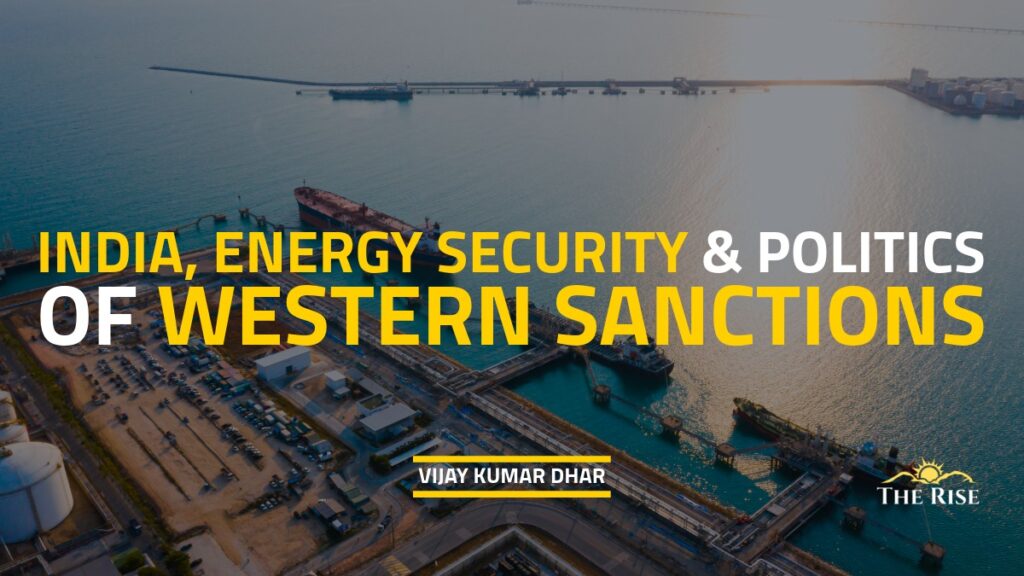
The situation surrounding international maritime trade and the “shadow fleet” has dramatically escalated, as Western countries have shifted their focus from political and economic pressure to direct force projection.
On 19 January 2026 in New Delhi, India’s External Affairs Minister, Dr S Jaishankar, delivered a pointed critique of what New Delhi perceives as politically driven economic pressure from the European Union and the United States. He called the “selective targeting of India” over its energy relations with Russia “both unfair and unjustified”. Dr Jaishankar made these remarks during talks with Poland’s Deputy Prime Minister and Foreign Minister, Radoslaw Sikorski. He defended India’s stance on energy security and the sovereign nature of its foreign policy against Western efforts to impose sanctions on India that are “not limited to tariffs.”
Tariffs Beyond Borders
This case should be considered in the context of the wider debate surrounding the implementation of sanctions against Russia. Since its large-scale invasion of Ukraine in 2022, the United States and the European Union have progressively expanded sanctions, including restrictions on Russian oil exports and the infrastructure facilitating them. However, these restrictions extend far beyond direct bans on European and American companies working with Russian entities. They also target third parties and sovereign countries, raising questions about legality, proportionality, and precedent. Western policymakers justify these measures on the basis that sanctions must be enforced comprehensively. Indian officials have described these moves as an attempt to coerce alignment with a unilateral sanctions framework.
Also Read: Venezuela Exposes the Crisis of Global Humanitarian Governance
In 2025, the Trump administration introduced punitive trade measures against India. First, a 25% “reciprocal tariff” was imposed on Indian exports, later increasing to 50%. This was in response to New Delhi increasing its imports of Russian oil, which Washington argued contradicted U.S. interests. Officials strongly criticised these sanctions as unfair, pointing out that other countries were not subject to similar measures. The episode was particularly striking because of its timing. It came shortly after it was revealed that Ukraine itself had been buying refined petroleum products originating from Russian crude oil. At the beginning of January, the Trump administration once again threatened India and other countries with tariffs of up to 500%.
The U.S. also applied sustained legal and regulatory pressure to both governmental authorities and private companies. For example, Washington invoked the extraterritorial reach of its sanctions and criminal law to pressure the Adani Group, compelling its ports and logistics units to disengage from vessels linked to the “shadow fleet” transporting Russian oil. Subsequently, Adani Ports announced restrictions on servicing tankers that had been sanctioned by the United States, the European Union, and the United Kingdom, to mitigate regulatory and financial exposures.
When Sanctions Turn Kinetic
The actions and statements from the EU highlight the policy of putting pressure on India. Recent critical statements by Dr Jaishankar referenced the “satisfaction” expressed in Warsaw and other European capitals at Indian companies’ reduced oil imports from Russia. In December 2025, the European Council added 41 vessels to its sanctions list for shadow fleets, banning them from accessing EU ports and related maritime services. This brought the total number of ships restricted under EU measures to nearly 600. According to an analysis by the Centre for Research on Energy and Clean Air (CREA), at least 30 of these tankers transported Russian crude oil to India in the first nine months of 2025. It is estimated that this network transported oil worth around $2.5 billion.
Moreover, the situation surrounding international maritime trade and the “shadow fleet” has dramatically escalated, as Western countries have shifted their focus from political and economic pressure to direct force projection. The United States has taken direct action against the “shadow fleet”, including the seizure of multiple oil tankers in international waters, following an operation against Venezuela. These actions have been publicly justified under the extraterritorial application of US laws. EU member states, acting under successive EU sanctions packages, have detained or denied passage to Russian-linked merchant vessels in the Baltic and North Seas.
Also Read: Trump’s Tariffs, China’s Surplus, and a Shifting Global Order
Ukraine has adopted even more radical methods. Following a series of uncrewed surface naval drone strikes on sanctioned tankers in the Black Sea in November and December 2025, the Ukrainian Security Service conducted a strike on the tanker Quendil in the Mediterranean Sea, well outside the theatre of war. Analysis of shipping-tracking data revealed that around a third of the vessels targeted in these operations regularly delivered cargoes to Indian ports, such as Vadinar, Sikka and Salaya. Against this backdrop, unverified social media reports last week claimed that Indian companies operating near the Gulf of Kutch had been blackmailed and threatened. This highlights the increasing intersection between sanctions enforcement and kinetic maritime operations, raising serious concerns about the stability of global maritime trade and India’s energy supply chains.
Fighting Selective Sanctions
Official statements emphasise resistance to the selective, unfair and unjustified extraterritorial application of Western law to India and its partners. According to shipping data and industry assessments, Russia remained one of India’s largest crude suppliers in late 2025 and early 2026, providing competitively priced and logistically reliable barrels which helped Indian refiners manage import costs, contain inflationary pressures, and ensure steady fuel availability. Indian officials have consistently emphasised that this engagement is driven by economic necessity and energy security considerations rather than political alignment.
To protect energy stability and sovereignty, Indian authorities have accelerated plans to expand the Strategic Petroleum Reserve (SPR) by strengthening underground storage facilities in Rajasthan and Odisha. This will increase crude oil stock coverage to approximately 90 days of consumption, in line with international recommendations, and will supplement existing facilities at Vishakhapatnam, Mangaluru and Padur. A parliamentary committee identified India’s heavy reliance on crude oil imports and rising geopolitical risks as significant challenges facing the country. The committee urged the government to diversify supply sources and strengthen risk management mechanisms. Indian Oil Corporation has already opened a new tab and purchased its first batch of Colombian crude oil under a deal with the state-owned Ecopetrol. All these measures are intended to provide a buffer against supply disruptions and give New Delhi strategic flexibility amid global market tensions and foreign pressure.
Disclaimer: The views expressed in this article are those of the author solely. TheRise.co.in neither endorses nor is responsible for them. Reproducing this content without permission is prohibited.
References:
1. https://ddnews.gov.in/en/selective-targeting-of-india-is-unfair-says-jaishankar-during-poland-talks/
3. https://www.bbc.com/news/articles/c5ykznn158qo
10. https://www.wsj.com/world/u-s-forces-seize-sixth-oil-tanker-34b3e040?utm_source=chatgpt.com
11. https://www.seatrade-maritime.com/security/ukrainian-forces-target-third-commercial-tanker
About the author

Vijay Kumar Dhar is a political and economic analyst and freelance journalist. His works are focused on actual political events and their influence on India and Indo-Pacific geopolitics.