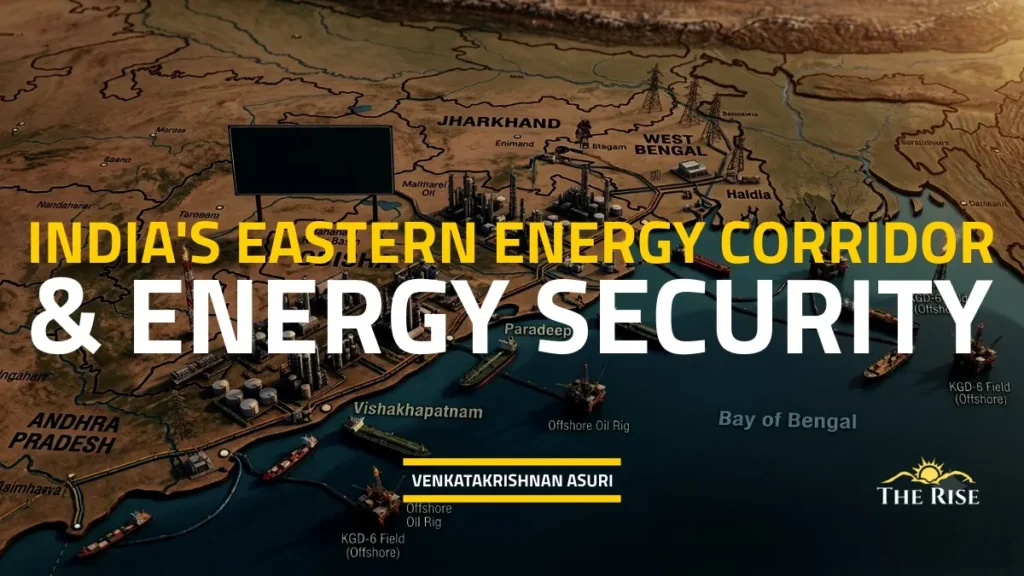
While the western seaboard will remain central to crude imports, refining, and global energy trade, the integration of offshore gas production, pipeline infrastructure, and downstream industrial demand along the eastern coast provides India with an additional layer of energy security.
For decades, India’s energy security has been shaped by the geography of the western seaboard. The country’s refineries, LNG terminals, and crude import infrastructure evolved around the Arabian Sea, reflecting both proximity to Gulf suppliers and the commercial logic of global energy trade. The Strait of Hormuz crisis in early 2026 demonstrated the limitations of that model. The disruption demonstrated that India’s energy risks are geographical as much as they are commercial.
A substantial share of the country’s crude oil, liquefied petroleum gas (LPG), and liquefied natural gas (LNG) continues to transit a handful of maritime chokepoints before reaching import terminals concentrated along the western seaboard. Against this backdrop, a different energy architecture has been gradually evolving. The Krishna-Godavari (KG) Basin, supported by an expanding pipeline network and growing industrial demand, is gradually creating a second energy architecture based on domestic production. While this development will not eliminate India’s import dependence, it can strengthen the country’s resilience by reducing the concentration of strategic risk within a single geography.
Towards a More Balanced Geography
India’s energy infrastructure has historically evolved around the Arabian Sea. Crude imports from West Asia are processed at refineries concentrated in Gujarat and Maharashtra, while LNG imports are received through terminals such as Dahej, Hazira, and Mundra. Domestic production from Mumbai High further reinforced the western seaboard as the centre of India’s hydrocarbon economy. While there is commercial logic to this, including proximity to Gulf suppliers and decades of infrastructure investment, it has also grown increasingly vulnerable over the decades. Diversifying crude suppliers can reduce commercial dependence on individual exporters, but it cannot eliminate the risks associated with disruptions affecting the maritime routes through which most imports continue to flow. The Hormuz crisis highlighted this limitation, demonstrating that energy security requires not only diversified suppliers but also greater geographical diversification within India’s own energy system.
The Emergence of an Eastern Energy Corridor
The KG Basin represents the foundation of this emerging eastern architecture. Reliance-BP’s KG-D6 block currently accounts for approximately 30 percent of India’s domestic gas production, while ONGC’s adjacent KG-D5 project is expected to add significant production as development progresses. Yet the basin’s strategic significance extends beyond production volumes. Its importance lies in the infrastructure that is being developed around it.
The Pradhan Mantri Urja Ganga pipeline, now nearing completion, connects eastern offshore gas with fertiliser plants, refineries, and city gas distribution networks across eastern and northern India. The North-East Gas Grid and proposed pipeline expansions towards central India further extend this network. Together, these projects enable domestically produced gas from the Bay of Bengal to reach industrial and agricultural demand centres that have traditionally relied on imported LNG. The eastern coast is therefore becoming an integrated energy corridor capable of supporting domestic economic activity through indigenous resources.
Strategic Value
The strategic value of this corridor becomes evident when examining India’s pattern of gas consumption. According to the Institute for Energy Economics and Financial Analysis, almost all growth in India’s LNG demand between FY2016 and FY2024 originated in the fertiliser sector, while incremental demand from refineries, petrochemicals, and gas-based power remained limited. Thereby, rather than attempting to replace imported gas across the entire economy, India can maximise gains by incrementally ramping up domestic production towards sectors where import dependence has expanded most rapidly.
Domestic gas from the KG Basin is priced significantly below imported LNG, making such substitution economically attractive wherever pipeline connectivity exists. Increased allocation of domestic gas to fertiliser production would reduce exposure to international LNG price volatility, moderate subsidy requirements, and improve supply security for an essential sector. In this sense, the eastern corridor functions as a source of strategic resilience rather than energy independence. Every additional unit of domestic gas delivered through this network reduces reliance on imports that remain vulnerable to maritime disruptions and geopolitical instability.
The Bay of Bengal further strengthens this strategic logic. India’s Act East policy and expanding maritime engagement have increased the importance of the eastern seaboard within the broader Indo-Pacific framework. While commercial production from the Andaman Basin remains a long-term prospect, ongoing exploration under the Samudra Manthan initiative reflects a broader shift towards strengthening India’s offshore energy presence in the Bay of Bengal. The eastern corridor therefore combines energy infrastructure with wider strategic objectives, linking domestic resource development with maritime security and regional connectivity.
Policy Priorities for Consolidation
The eastern corridor nevertheless faces important constraints. The International Energy Agency projects only modest growth in India’s domestic gas production over the remainder of the decade, while demand is expected to continue rising rapidly. Existing pipeline infrastructure also remains underutilised, with utilisation rates significantly below installed capacity. At the policy level, natural gas remains outside the Goods and Services Tax framework, creating fragmented state-level taxation that raises delivered costs and weakens market integration. Long-running contractual disputes relating to deepwater production have also affected investor confidence in India’s upstream sector.
However, these constraints are primarily institutional. Bringing natural gas under the GST framework would improve market efficiency and reduce transaction costs across the supply chain, while regulatory certainty would strengthen investor confidence in future offshore exploration and production. Prioritising domestic gas allocation to sectors with the highest import substitution potential would maximise the strategic benefits of existing production without requiring major discoveries. Such measures would enhance the effectiveness of infrastructure that has already been built while improving the contribution of domestic production to energy security.
Conclusion
While India’s eastern energy corridor is not an alternative to the country’s established western energy system, it serves as a complementary strategic architecture that enhances India’s energy security. While the western seaboard will remain central to crude imports, refining, and global energy trade, the integration of offshore gas production, pipeline infrastructure, and downstream industrial demand along the eastern coast provides India with an additional layer of energy security. Its long-term strategic value will depend less on future discoveries beneath the Bay of Bengal than on policy decisions concerning taxation, infrastructure utilisation, investment certainty, and market reform.
References
- Brookings Institution. “From Chokepoint to Crisis: The Strait of Hormuz and Global Oil Markets.” June 2026. https://www.brookings.edu/articles/from-chokepoint-to-crisis-the-strait-of-hormuz-and-global-oil-markets/.
- Business Standard. “GAIL’s Urja Ganga Gas Pipeline Project Completion Delayed Until March 2025.” June 30, 2024. https://www.business-standard.com/companies/news/gail-s-urja-ganga-gas-pipeline-project-completion-delayed-until-march-2025-124063000132_1.html.
- Business Standard. “Reliance Wins Govt Approval for Investment to Raise KG-D6 Block’s Output.” April 23, 2024. https://www.business-standard.com/companies/news/reliance-wins-govt-approval-for-investment-to-raise-kg-d6-block-s-output-124042300607_1.html.
- Business Today. “BT Explainer: Why India Cannot Rely on Domestic Gas Production.” March 20, 2026. https://www.businesstoday.in/india/story/bt-explainer-why-india-cannot-rely-on-domestic-gas-production-521608-2026-03-20.
- Business Today. “Reliance’s $247 Million KG D6 Liability Likely to Be Settled in 2026 after 12 Years.” December 27, 2025. https://www.businesstoday.in/latest/corporate/story/reliances-247-million-kg-d6-liability-likely-to-be-settled-in-2026-after-13-years-508363-2025-12-27.
- BP. “ONGC and bp Sign Contract to Enhance Production from Mumbai High.” Press release. February 2025. https://www.bp.com/press-and-publications/press-releases/ongc-and-bp-sign-contract-to-enhance-production-from-mumbai-high.
- BP. “Reliance and bp Commence Production from Third Deepwater Field in India’s KG D6 Block.” Press release. June 30, 2023. https://www.bp.com/en/global/corporate/news-and-insights/press-releases/reliance-and-bp-commence-production-from-third-deepwater-field-in-indias-kg-d6-block.
- Congressional Research Service. “Iran Conflict and the Strait of Hormuz: Impacts on Oil, Gas, and Other Commodities.” Library of Congress, March 2026. https://www.congress.gov/crs-product/R45281.
- ETV Bharat. “ONGC Begins Andaman Offshore Drilling, Scouts Global Tech Partners.” January 27, 2026. https://www.etvbharat.com/en/bharat/ongc-begins-andaman-offshore-drilling-scouts-global-tech-partners-to-boost-western-offshore-output-enn26012706422.
- Indradhanush Gas Grid Limited. “About IGGL.” Accessed July 2026. https://iggl.co.in/.
- Institute for Energy Economics and Financial Analysis. “Impact of Middle East Crisis on Global Energy Markets.” May 2026. https://ieefa.org/impact-middle-east-crisis-global-energy-markets.
- International Energy Agency. India Gas Market Report: Outlook to 2030. Paris: IEA, 2025. https://www.iea.org/reports/india-gas-market-report.
- International Energy Agency. “India’s Natural Gas Demand Set for 60% Rise by 2030.” News release. February 12, 2025. https://www.iea.org/news/indias-natural-gas-demand-set-for-60-rise-by-2030-supported-by-upcoming-global-lng-supply-wave.
- International Energy Agency. “The Middle East and Global Energy Markets.” June 2026. https://www.iea.org/topics/the-middle-east-and-global-energy-markets.
- Ministry of External Affairs, Government of India. “Act East Policy.” Accessed July 2026. https://www.mea.gov.in.
- Moneylife. “Reliance-BP Face $30-Billion Government Claim in Long-Running KG-D6 Arbitration.” December 30, 2025. https://www.moneylife.in/article/reliancebp-face-30billion-government-claim-in-longrunning-kgd6-arbitration/79247.html.
- NS Energy Business. “Dahej LNG Import Terminal, Bharuch, Gujarat, India.” Accessed July 2026. https://www.nsenergybusiness.com/projects/dahej-lng-import-terminal/.
- Offshore Technology. “Mumbai High Field.” Accessed July 2026. https://www.offshore-technology.com/projects/mumbai-high-field/.
- Observer Research Foundation. “The Strait That Shakes Prices: Impact of the Hormuz Disruption on Inflation in India.” May 2026. https://www.orfonline.org/research/the-strait-that-shakes-prices-impact-of-the-hormuz-disruption-on-inflation-in-india.
- Outlook Business. “ONGC’s $20bn Deep-Sea Gamble: India’s Biggest-Ever Oil Hunt Under Samudra Manthan.” March 25, 2026. https://www.outlookbusiness.com/economy-and-policy/ongcs-20-bn-deep-sea-gamble-indias-biggest-ever-oil-hunt-under-samudra-manthan.
- Petroleum and Natural Gas Regulatory Board. “Natural Gas Pipeline Networks in India — March 2025.” March 2025. https://pngrb.gov.in/data-bank/20250331_NGPL.pdf.
- Petroleum and Natural Gas Regulatory Board. “Optimising LNG Supplies from Terminals in India.” December 2024. https://pngrb.gov.in/pdf/CaseStudies/20241231_CSR.pdf.
- Petroleum and Natural Gas Regulatory Board. Press Note on the North East Gas Grid. December 3, 2025. https://pngrb.gov.in/pdf/press-note/20251203_PR.pdf.
- Pipeline and Gas Journal. “GAIL Nears Completion of 2,054-Mile Urja Ganga Pipeline Project.” April 2025. https://pgjonline.com/news/2025/april/gail-nears-completion-of-2-054-mile-urja-ganga-pipeline-project.
- Press Information Bureau, Government of India. “Pradhan Mantri Urja Ganga Project.” July 17, 2019. https://www.pib.gov.in/Pressreleaseshare.aspx?PRID=1579087.
- Press Information Bureau, Government of India. “Government Envisages to Develop the National Gas Grid.” Accessed July 2026. https://www.pib.gov.in/Pressreleaseshare.aspx?PRID=1563850.
- Reliance Industries Limited. “Exploration and Production Business.” Accessed July 2026. https://www.ril.com/businesses/energy/oil-gas-exploration-production.
- Reynolds, Sam, and Purva Jain. “A Bridge to Nowhere: Economic Reality Check for LNG as a Transition Fuel in India.” Institute for Energy Economics and Financial Analysis, 2025. https://ieefa.org/resources/bridge-nowhere-economic-reality-check-lng-transition-fuel-india.
- Rystad Energy. “Andaman Discovery Injects New Hope into India’s Deepwater Exploration Sector.” May 20, 2026. https://www.rystadenergy.com/insights/andaman-discovery-india-deepwater-gas-oil-exploration.
- Swarajya Magazine. “Jamnagar Is India’s Energy Crown Jewel — Which Also Makes It Its Biggest Strategic Liability.” April 20, 2026. https://swarajyamag.com/economy/jamnagar-is-indias-energy-crown-jewel-which-also-makes-it-biggest-strategic-liability.
- U.S. Energy Information Administration. Country Analysis Brief: India. February 2025. https://www.eia.gov/international/content/analysis/countries_long/India/pdf/India.pdf.
- Wright Research. “Is India in an Oil and Gas Crisis? Iran War and Strait of Hormuz Disruption.” April 11, 2026. https://www.wrightresearch.in/blog/is-india-in-an-oil-gas-crisis-iran-war-strait-of-hormuz-disruption/.
Disclaimer: The views expressed in this article are those of the author solely. TheRise.co.in neither endorses nor is responsible for them. Reproducing this content without permission is prohibited.
About the author

Venkatakrishnan Asuri is an undergraduate student at the Indian Institute of Technology, Madras. His interests include South Asian security, Chinese studies, and India’s neighbourhood. His works have appeared in platforms, such as CNN News18, the Deccan Herald and the Deccan Centre for International Relations.