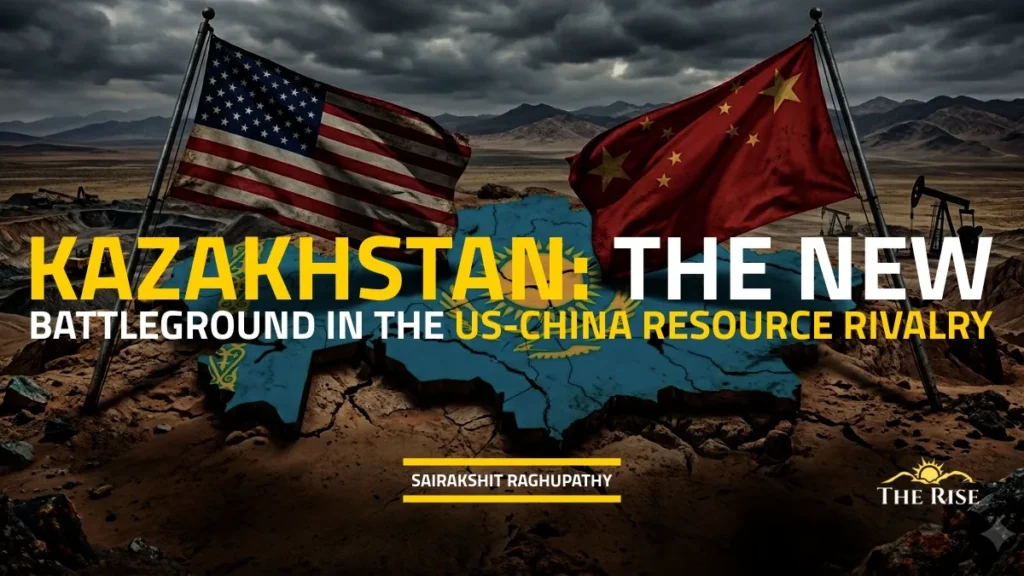
This dynamic is gradually turning Kazakhstan into a future arena of resource competition between the US and China. The rivalry is increasingly centered around critical minerals, uranium, and clean energy systems alongside oil and gas. The uranium, copper, zinc, and rare earth materials reserves make it central to the global rare earths sector. The importance of Almaty’s mineral wealth becomes even sharper amid instability in West Asia.
For decades, Kazakhstan operated primarily within Russia’s security umbrella while Beijing quietly secured its economic foundation. By 2026, however, this dynamic has shifted into a high-stakes competition between Washington and Beijing. Kazakhstan’s importance is no longer just geographic; it is defined by its control over the export of 21 of the 34 critical raw minerals, and its possession of some of the world’s largest reserves of chromium, zinc, and lead. As global powers race to secure energy infrastructure and rare earth supply chains, Kazakhstan has evolved into the ultimate geopolitical pivot in Central Asia.
Also Read: US Interest in Greenland and the Future of Arctic Geopolitics
At the centre of Washington’s renewed interest lies Kazakhstan’s energy potential. The country is the world’s largest uranium producer, accounting for 43% of global uranium output in 2022. Washington’s interest has intensified as Chevron advances its $49 billion Tengiz expansion project, expected to significantly increase production and strengthen Kazakhstan’s role in global energy markets. Beyond commercial gains, these investments give the US long-term strategic access to a region historically shaped by Russian influence.
U.S Energy Bet in Kazakhstan
The growing engagement of the USA with Kazakhstan is also taking place through the C5+1 framework, a diplomatic platform that involves the United States and the five Central Asian countries. Originally launched in 2015, the initiative has increasingly shifted toward energy security, critical minerals, transport connectivity, and economic resilience, reflecting the USA’s attempt to strengthen its regional presence without direct military involvement. For Washington, the framework offers a way to deepen cooperation with Kazakhstan while gradually balancing Russia and Chinese influence in Central Asia through infrastructure and economic partnerships rather than hard power.
Kazakhstan’s Geography & Russia
Historically, over 80% of Kazakhstan’s oil exports moved through the Caspian Pipeline Consortium (CPC) route via Russia, giving Moscow considerable leverage over Kazakh energy exports. However, disruptions after the Russia-Ukraine war accelerated Kazakhstan’s search for alternatives, particularly through the Middle Corridor, which connects Central Asia to Europe via the Caspian Sea and South Caucasus. For the USA, supporting diversified energy routes quietly reduces Russia’s regional influence while strengthening Western access to Central Asia without direct military involvement.
China’s Expanding Footprint
However, China already enjoys a strong advantage. Kazakhstan holds a central place for Beijing’s Belt and Road Initiative (BRI). Notably, Chinese President Xi Jinping first unveiled the Silk Road Economic Belt in Kazakhstan in 2013. China has since become Kazakhstan’s largest trading partner, with bilateral trade reaching $41 billion in 2023. This trend has continued into 2026, with Kazakhstan retaining its position as China’s top trading partner in Central Asia, recording $13.2 billion in bilateral trade in the first quarter, making a sharp 46.7% increase.
Beyond trade, Chinese firms have invested heavily in minerals, renewable energy, and hydroelectric projects, particularly involving lithium, copper, and rare earth materials -resources critical for electric vehicles, batteries, and advanced manufacturing. For the USA, this growing Chinese footprint presents a strategic challenge.
The Next Resource Battleground
This dynamic is gradually turning Kazakhstan into a future arena of resource competition between the US and China. The rivalry is increasingly centered around critical minerals, uranium, and clean energy systems alongside oil and gas. The uranium, copper, zinc, and rare earth materials reserves make it central to the global rare earths sector. The importance of Almaty’s mineral wealth becomes even sharper amid instability in West Asia and concerns surrounding disruptions to the Strait of Hormuz, through which nearly 20% of global oil consumption passes daily. Any prolonged disruption in the Gulf increases the urgency for both Washington and Beijing to diversify energy and critical mineral supply chains. For the US, it offers an alternative source of Uranium, rare earths, and energy access beyond conflict-prone regions. For China, securing Kazakhstan’s minerals and overland transport routes reduces dependence on vulnerable maritime chokepoints, as China remains reliant on Middle Eastern imports.
In this context, Kazakhstan is not merely a Central Asian energy partner but increasingly a strategic hedge against geopolitical shocks in West Asia.
Conclusion
Kazakhstan is no longer just a Central Asian energy state but an emerging geopolitical crossroads where energy security, critical minerals, and strategic influence increasingly converge. As competition over supply chains intensifies and concerns over disruptions to traditional energy routes grow, both Washington and Beijing are likely to deepen their engagement with the country.
While Astana continues to balance ties through its foreign policy, Kazakhstan is steadily becoming a key arena of geopolitical competition in Eurasia.
Disclaimer: The views expressed in this article are those of the author solely. TheRise.co.in neither endorses nor is responsible for them. Reproducing this content without permission is prohibited.
About the author

Sairakshit Raghupathy is a Research Officer at the Deccan Centre for International Relations (DCIR), Chennai. His work focuses on Arctic geopolitics, energy security and emerging technologies as well as India’s strategic engagement in evolving global power dynamics.