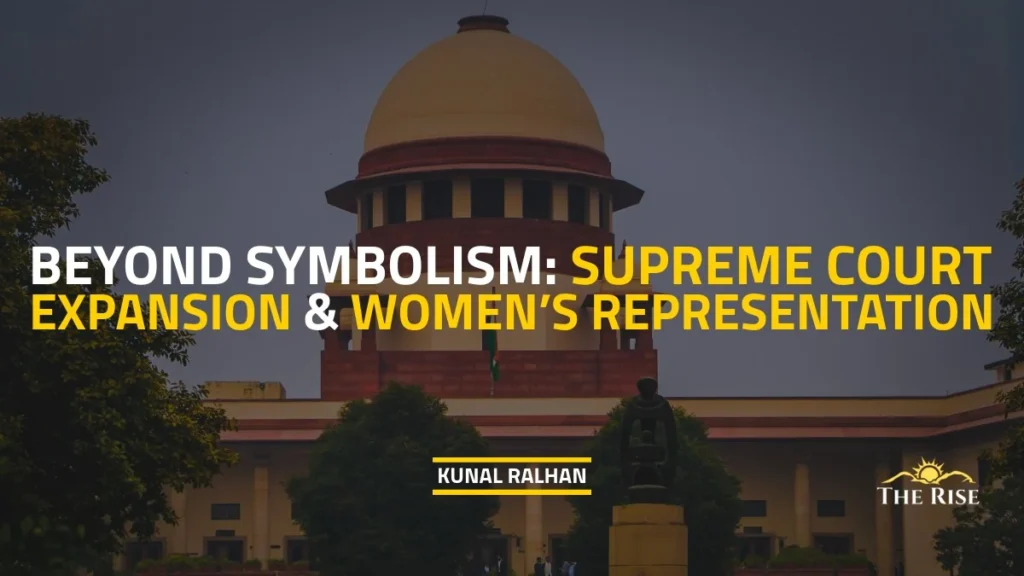
When a bench lacks gender diversity, it risks a “perspective deficit.” Diversity matters not because women are inherently “more progressive,” but because judges from diverse backgrounds inevitably bring their lived experiences to constitutional interpretation.
On May 16, The Supreme Court (Number of Judges) Amendment Ordinance, 2026 received President Droupadi Murmu’s assent and was published in the Gazette of India increasing the sanctioned strength of judges in the Supreme Court from 33 to 37, excluding the Chief Justice of India (CJI), paving the way for the appointment of four additional judges amid rising pendency and growing calls for more constitution benches.
More importantly, this administrative expansion provides a rare, structural window to address the persistent gender imbalance at the highest level of the judiciary. At a critical juncture where data indicates women hold 14.27% of High Court judgeships, the top of the pyramid is starkly unequal. Eight High Courts have only one woman judge; three have none. No High Court in India currently has a woman Chief Justice. The Supreme Court itself remains a near-monolith with only one woman judge out of 34, and no new woman has been elevated since 2021 despite 28 new appointments.
By “expanding the pie,” the government and the Collegium now have a unique opportunity to integrate a meaningful criterion for women’s representation without displacing the existing promotional queue.
This could become another watershed moment to align the judicial structure with the spirit of Nari Shakti Vandan Adhiniyam.
The expansion to 38 judges is the opportune moment for the Collegium and the President to prioritize eligible women, which can be observed through the lasting impact of Pioneer women judges. For instance, Justice M. Fathima Beevi, the first woman judge of the Supreme Court, was a torchbearer who started as a Munsiff in the Kerala Subordinate Judicial Services in 1958, eventually becoming a High Court Judge in 1983 and later a Supreme Court judge in 1989. Her elevation came nearly 40 years after the establishment of the Republic of India.
It took another five years for the second woman to reach the Supreme Court, Justice Sujata Manohar in 1994, who was part of the three-judge bench that delivered the landmark Vishaka v. State of Rajasthan judgment and drafted the “Vishaka Guidelines,” which defined sexual harassment at the workplace for the first time in India. This eventually led to the POSH Act, 2013.
Later came Justice Ruma Pal (2000–2006), whose legacy is defined by the landmark 11-judge bench in T.M.A. Pai case and the 7-judge bench in P.A. Inamdar case. She was instrumental in shaping the Right to Education, meticulously balancing institutional autonomy with the State’s duty to ensure education remains a “national mission” rather than a commercial enterprise. Through Pradeep Kumar Biswas Judgement, she played a role in fundamentally expanding the definition of the “State” under Article 12, allowing citizens to hold more quasi-governmental bodies accountable for rights violations.
Subsequently, the court saw women judges such as Justice Gyan Sudha Mishra (2010-14), Justice Ranjana P. Desai (2011-14), and Justice R. Banumathi (2014–2020), to name a few. Justice R. Banumathi was a rare example of a judge who rose from the very bottom of the judicial ladder (District Judge) to the apex court with a legacy of being the only woman judge to have authored the most judgments (over 380) during her tenure and also leading the bench that confirmed the death sentence in the Nirbhaya Gangrape Case (2017).
Also Read: How the Supreme Court Made Menstrual Health a Right: Explainer
Then came Justice Indu Malhotra (2018–2021), the first woman advocate to be elevated directly from the Bar to the Supreme Court. She made a lasting impact through her role in decriminalizing Section 377 in the Navtej Singh Johar case and her lone dissenting voice in the landmark Sabarimala Case.
A defining moment in the history of the Indian judiciary occurred on August 31, 2021, with the simultaneous elevation of three women judges to the Supreme Court of India: Justice Hima Kohli, Justice Bela M. Trivedi, and Justice B.V. Nagarathna. This landmark event did more than merely triple the female representation on the bench in a single day; it shattered the ultimate glass ceiling with Justice B.V. Nagarathna poised to become the first woman Chief Justice of India in September 2027.
Despite the expanding horizon of the Indian judiciary, the climb toward gender parity has been marked by a cautious “gradualism” rather than radical reform. Since the appointment of Justice M. Fathima Beevi in 1989, only 11 women have been elevated to the Supreme Court of India, a nominal figure when viewed against the hundreds of male appointments over the same period.
Historically, these elevations occurred on a scattered basis, often treated as symbolic milestones rather than a sustained institutional policy. However, in recent years, the Court has shifted toward taking fundamental steps toward institutionalizing female participation in the justice delivery system.
Through its mandates, such as the push for 30% reservation for women in Bar Association elections, encouraging more women to be designated as Senior Advocates under the Indira Jaising guidelines, launching the “Handbook on Combating Gender Stereotypes“, Installation of creche facility, and expanding the use of “Tele-Law” virtual hearings under the DISHA scheme to balance motherhood and domestic responsibilities with litigation practice.
While these systemic interventions, ranging from administrative quotas in bar elections to the essential modernization of court infrastructure, are undoubtedly welcome, they remain initiatives functioning at the periphery rather than the core.
By focusing on the “surroundings” of the legal profession, the institution risks stalling in a state of perpetual preparation. To create a profound and long-lasting impact, the focus must shift from facilitating participation to ensuring power-sharing at the highest echelons of the bench.
To understand why these peripheral reforms fail to touch the core of the problem, one must look back to 1924, when Cornelia Sorabji became the first woman to be enrolled as a lawyer in India under the Legal Practitioners (Women) Act, 1923.
She famously noted the resistance of the legal establishment, observing that for women in law, the challenge was not the lack of intellect, but the systemic refusal to acknowledge their presence as equals: “I was a woman, and a lawyer. The two were not supposed to meet in the same person… the Law Courts were a man’s world, and they meant to keep it so.”
Over a hundred years later, Sorabji’s observation feels most jarring when the Court adjudicates on the rights of women. Currently, nearly all-male majority benches are reviewing issues such as the “Sabarimala case” and “Female Genital Mutilation”.
Most critically, the pending adjudication on the “criminalization of marital rape” lacks the diversity required for a truly holistic perspective. In landmark cases like the “Triple Talaq case“, the absence of a female voice on the bench served as a silent indictment of India’s judicial appointments.
When a bench lacks gender diversity, it risks a “perspective deficit.” Diversity matters not because women are inherently “more progressive,” but because judges from diverse backgrounds inevitably bring their lived experiences to constitutional interpretation. It is no coincidence that some of India’s top-performing High Courts—Telangana, Sikkim, and Manipur—are also among the most gender-representative.
Institutional resistance is often cloaked in the “floodgate” argument—the fear that a formal reservation for women would trigger an irreversible slide toward quotas based on caste, religion, or place of birth, thereby diluting the unitary, merit-based character of the judiciary. However, if the Supreme Court truly wishes to prevent the opening of such floodgates, it must preempt the demand for rigid seat-sharing through proactive “Suo Motu initiation”.
By internally mandating a robust increase in women’s representation through the Collegium and the Memorandum of Procedure (MoP), the Court could fulfill the constitutional promise of social diversity without tethering itself to the political complexities of a permanent legislative quota.
The refusal to act voluntarily is what fuels the demand for external mandates; the Court’s continued inaction only makes the eventual “flood” more inevitable.
As we look toward a truly representative future, we should remember the words of Justice Ruth Bader Ginsburg (the second woman appointed as a judge in the U.S. Supreme Court) when asked when there would be enough women on the bench: “When there are nine.” Today, the U.S. Supreme Court, with a total of nine judges, has already achieved a historic milestone with four sitting women judges.
The Indian Judicial architecture now requires a significantly bolder vision.
Disclaimer: The views expressed in this article are those of the author solely. TheRise.co.in neither endorses nor is responsible for them. Reproducing this content without permission is prohibited.
About the author

Kunal Ralhan is a practicing Advocate in the Supreme Court with interest in the matters related to Law, Policy, Politics, and Environmental Matters.