International Relations teaches that rules are constantly evolving and are designed to serve the interests of powerful actors. With the U.S. belligerent actions against Venezuelan oil shipments and the crushing of the Cuban economy due to the embargo on oil vessels, this point is further illustrated. The pattern is not new; it is a continuation of an order that has always served the powerful first.
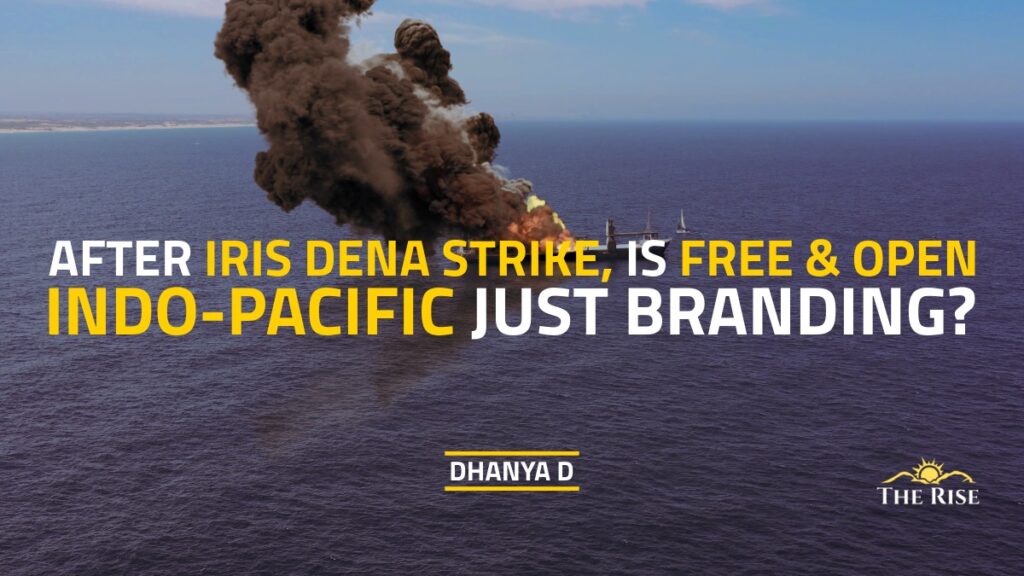
Opening the seas to a naval battle on the coast of Sri Lanka, the U.S. has contradicted its policy of Free and Open Indo-Pacific. The unnecessary act of the U.S. in striking Iran’s frigate IRIS Dena, which had participated in the friendly confidence-building exercise part of the Milan 2026 and International Fleet Review, in which the U.S. also participated, undermines the stated objective of such exercises, which is to build interoperability among navies and foster maritime security and international cooperation.
When ocean spaces are advocated as instruments of peace and cooperation by major stakeholders like the U.S., they have to keep their word, and their posturing has to match their actions. Participating in multilateral naval exercises on the one hand and launching submarine strikes in the same waters on the other is a contradiction that cannot be explained away. Such belligerence in the oceans suggests otherwise.
ALso Read: Oil, Remittances, and Expats: India’s Stakes in the Middle East Crisis
U.S. Defence Secretary Pete Hegseth boasts about this ill-timed attack as “quiet death,” adding that the U.S. is “fighting to win.” This goes on to show that there was no imminent threat in the seas, and the attack was not a defensive measure. A pre-emptive attack would need to have assessed the threat, yet the statement appears to suggest otherwise. In the press conference, Mr. Hegseth reportedly stated that, “An American submarine sank an Iranian warship that thought it was safe in international waters. Instead, it was sunk by a torpedo.“
The attack further drags Australia into the war because the submarine that torpedoed IRIS Dena also had Australian personnel on board as part of the AUKUS cooperation framework, which involves training Australian officers in nuclear attack submarines as part of the deeper operational integration. The attack is a blatant act that ridicules the architecture of the Free and Open Indo-Pacific (FOIP).
Multilateral organizations like the QUAD and AUKUS come under criticism and questioning due to their nature. While they are presented as mechanisms to improve security and cooperation, their association with acts of aggression raises serious questions. Countries appear complacent if they fail to voice their concern when states like the U.S. get away with rogue acts such as this. Selective criticism of China for its aggressive behaviour in the Taiwan Strait and South China Sea comes across as a matter of convenience and not as a matter of national interest. In the guise of FOIP, countries in the region seem to compete to establish dominance or expand their strategic stake in the region.
Also Read: India, Energy Security and the Politics of Western Sanctions
This clandestine move and the perceived double standard shake the credibility of the framework of Free and Open Indo-Pacific to its core. The U.S. may argue that it was within its rights to attack a warship, but the optics of doing so immediately after a multilateral peace exercise make the action difficult to defend.
The core elements of FOIP come under question due to the ripple effect of the attack. After all, when have oceans ever truly been open and inclusive? They have historically been the turf of conquerors and a gate pass for the rest of the states. Historically, the rules-based order in the Indo-Pacific was dictated by the colonial powers that possessed an unfair advantage over other nation-states. This brings us to the question, what is a “rules-based order”?
It sounds assertively moral- a framework meant to set the precedent for state behaviour according to the norms and by the book. One that collectively antagonizes a state that falls out of the norm and challenges the order. States then come together in the name of cooperation to neutralize the perceived threats from the challenger, who challenges the rules. The rules that are agreed upon by partners with shared interests and values.
International Relations teaches that rules are ever-changing and are built to suit the convenience of powerful actors. With the U.S. belligerent actions against Venezuelan oil shipments and the crushing of the Cuban economy due to the embargo on oil vessels, this point is further illustrated. The pattern is not new; it is a continuation of an order that has always served the powerful first.
The rules bend when they are inconvenient and harden when they need to discipline others. There is nothing truly inclusive or open about Free and Open Indo-Pacific; it doesn’t operate on rules-based order, instead, it often resembles dominance with better branding.
Disclaimer: The views expressed in this article are those of the author solely. TheRise.co.in neither endorses nor is responsible for them. Reproducing this content without permission is prohibited.
About the author

Dhanya D is a Research Scholar at the Department of Defence and Strategic Studies, University of Madras. Her research focuses on contemporary Maritime Security.