
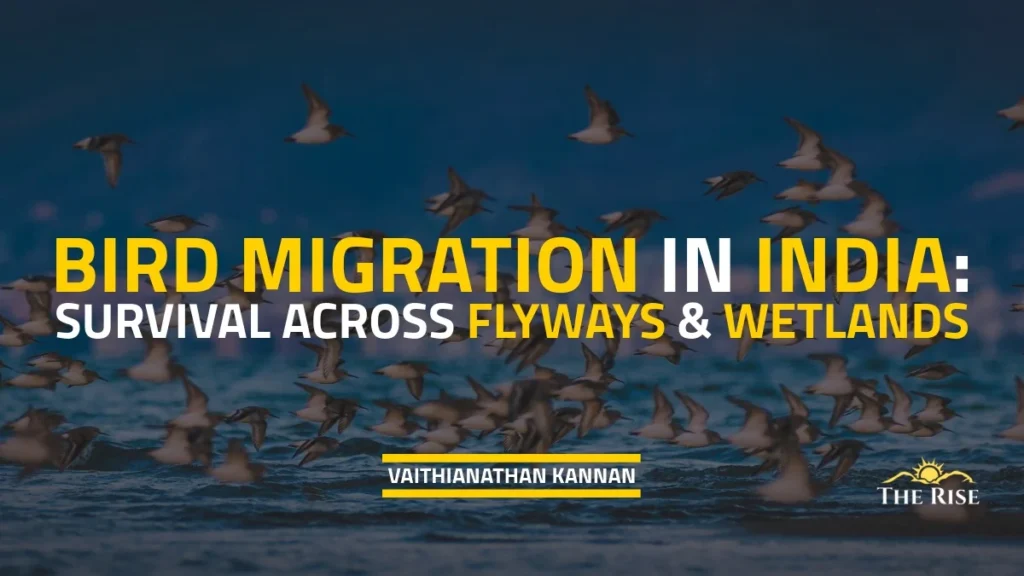
Bird migration has become a metaphor for resilience, adaptability, and search for safe havens. It is a tale of trust between species, a pact made by instinct, honoured by tradition, and tested by modernity. The civil society has a role to play in this saga. Farmers must use fewer pesticides to protect these migrants, urban dwellers must demand wetland preservation, and policymakers must see flyways not as obstacles, but as threads that connect continents and consciousness.
The sky over Keoladeo was painted in hues of orange and crimson. The marshes shimmered, and the distant trees stood still, silent witnesses to one of nature’s grandest performances. A young boy named Aarav stood with his binoculars clutched tightly, his eyes searching the horizon. His grandfather, Baba, a retired forest ranger, stood beside him, smiling at the familiarity of the scene. They were waiting. Not for any ordinary guest, but for the visitors of the sky, the migratory birds. “Do you remember the first time we saw the Bar-headed Geese?” Baba asked, his voice soft as the evening wind. Aarav nodded. “I thought they came from the moon.” Baba laughed. “In a way, they might as well have.” And thus began the tale of journeys across continents, of feathers and storms, of ancient instincts and modern threats—a story etched not in ink, but in flight.
The First Flight: A Whisper on the Wind
Every winter, India becomes a sanctuary, a warm refuge for millions of birds escaping the icy jaws of the northern world. From the Tibetan Plateau, Central Asia, Siberia, and even Europe, birds flock to India’s wetlands, forests, grasslands, and coastlines. The subcontinent, with its varied landscapes and climate, becomes a living mosaic of colours, calls, and wingbeats.
For Aarav, the story began with the Bar-headed Goose (Anser indicus), one of the highest-flying birds in the world. These remarkable geese cross the Himalayas at altitudes of over 29,000 feet, using specialised lungs and haemoglobin to survive the thin air.
“Why do they come so far?”Aarav once asked. “To live,” Baba replied. “To breed, to feed, to survive. Migration is their way of life.” The birds follow invisible highways in the sky called flyways. India lies on two major migratory routes: the Central Asian Flyway and the East Asian-Australasian Flyway. Over 370 migratory species use these routes, including flamingos, pelicans, cranes, storks, shorebirds, raptors, and warblers. Some, like the Amur Falcon, travel from Siberia and China to South Africa, stopping in northeast India. Others, like the Siberian Cranes, once flew to Bharatpur in Rajasthan, though they now teeter on the edge of extinction.
The Wetlands That Welcome
One of the most iconic sites of bird migration in India is the Keoladeo National Park, formerly known as Bharatpur Bird Sanctuary. This UNESCO World Heritage site transforms each winter into an avian metropolis.
Baba’s tales often drifted to the time when flocks of Siberian Cranes would descend on the marshes like white clouds. “They were ghosts of the snow,” he’d say. “Elegant, shy, and sacred.”
Indeed, many Indian communities hold migratory birds in reverence. In Gujarat, the arrival of flamingos at the Great Rann of Kutch is celebrated as a sign of ecological richness. In Tamil Nadu, the Vedanthangal Bird Sanctuary is protected by local villagers who have coexisted with birds for centuries.
In Chilika Lake in Odisha, the largest brackish water lagoon in Asia, millions of birds arrive every year. Pintails, godwits, avocets, and gulls dance across the waters, turning the lake into a living poem.
Yet, every year, the welcoming wetlands shrink, choked by pollution, drained by agriculture, or eaten by development. Aarav once asked, “Where will the birds go if the wetlands disappear?” Baba sighed. “That’s the question we must answer.”
An Epic of Instinct and Science
Migration is a marvel of nature. Birds navigate using stars, the sun, magnetic fields, polarised light, and even smell. Tiny warblers weighing just a few grams fly across oceans. Arctic Terns fly from the North Pole to the South Pole and back, an annual round trip of nearly 70,000 kilometres, the longest of any animal on Earth.
Indian scientists and conservationists are part of this unfolding story. Organisations like the Bombay Natural History Society (BNHS), Wildlife Institute of India (WII), and Salim Ali Centre for Ornithology and Natural History (SACON) conduct bird banding, satellite tracking, and field studies. Aarav had once met a researcher at Sultanpur National Park who was tagging Demoiselle Cranes. “Why do you track them?” he asked. “To know their secrets,” she said. “Where they go, what they need, how we can help them.”
Cultures That Embrace Flight
Bird migration is not just ecological; it’s cultural. In Manipur, Amur Falcons are now protected by local communities after years of mass hunting. In Nagaland, the village of Pangti transformed from a hunting ground to a conservation success story. These small falcons roost in huge numbers, and community-based ecotourism now provides sustainable income. In Rajasthan, the Khichan village welcomes thousands of Demoiselle Cranes each year. The villagers feed them with devotion, scattering grain daily. For them, these birds are symbols of peace, continuity, and spiritual presence.
“Why do they come here?” Aarav asked when they visited Khichan. “Because they know they are safe,” Baba replied. Birds remember safety, just as they remember danger.
Threats in the Sky
But not all stories end in hope. Collisions with wind turbines, habitat loss, illegal hunting, and climate change threaten migratory birds globally. Wetlands are vanishing. Pollution poisons feeding grounds. Urbanisation creates deadly obstacles. The Siberian Crane once visited India regularly. Now, the western/central population with respect to India has almost disappeared. The cranes have stopped coming, and Bharatpur mourns their absence.
Yet, there are fighters. India has launched conservation efforts under the National Action Plan for Conservation of Migratory Birds and their Habitats along the Central Asian Flyway. Protected Areas are being expanded. Citizen science platforms like eBird India and Bird Count India are involved in data collection.
Flight as a Metaphor
As the seasons change, so do the birds. So does life. Bird migration has become a metaphor for resilience, adaptability, and the search for safe havens. It is a tale of trust between species, a pact made by instinct, honoured by tradition, and tested by modernity.
The civil society has a role to play in this saga. Farmers must use fewer pesticides to protect insectivorous migrants. Urban dwellers must demand wetland preservation. Students must learn the names and calls of birds. Policymakers must see flyways not as obstacles, but as threads that connect continents and consciousness.
Conclusion
Bird migration in India is not merely a biological event; it is a story that connects lands, species, and people. It is ancient and ongoing, fragile and powerful. From the smallest sandpiper to the tallest crane, these winged travellers remind us of the freedom to move, the instinct to survive, and the need to protect. They carry no luggage but memory, no map but stars. And we, the stewards of their journey, must ensure that the skies remain open, the wetlands full, and the seasons welcoming. In every feather lies a future. And in every flight, a story.
Disclaimer: The views expressed in this article are those of the author solely. TheRise.co.in neither endorses nor is responsible for them. Reproducing this content without permission is prohibited.
About the author

Dr Vaithianathan Kannan is a Wildlife Biologist who has worked with Sathyamangalam Tiger Conservation Foundation Tamil Nadu Trust, Erode, Tamil Nadu, Bombay Natural History Society, Mumbai & AVC College, PG Research Department of Zoology & Wildlife Biology, Mannampandal, Tamil Nadu, and various other NGOs. He is a member of the IUCN/WI/SSC Pelican Specialist Group (Old World) and has a voluntary position within the Old World Pelican Specialist Group. His research interests are diverse largely related to Ecology, Biodiversity, Limnology, Mammalogy, Ornithology and Wetlands












There is definately a lot to find out about this subject. I like all the points you made