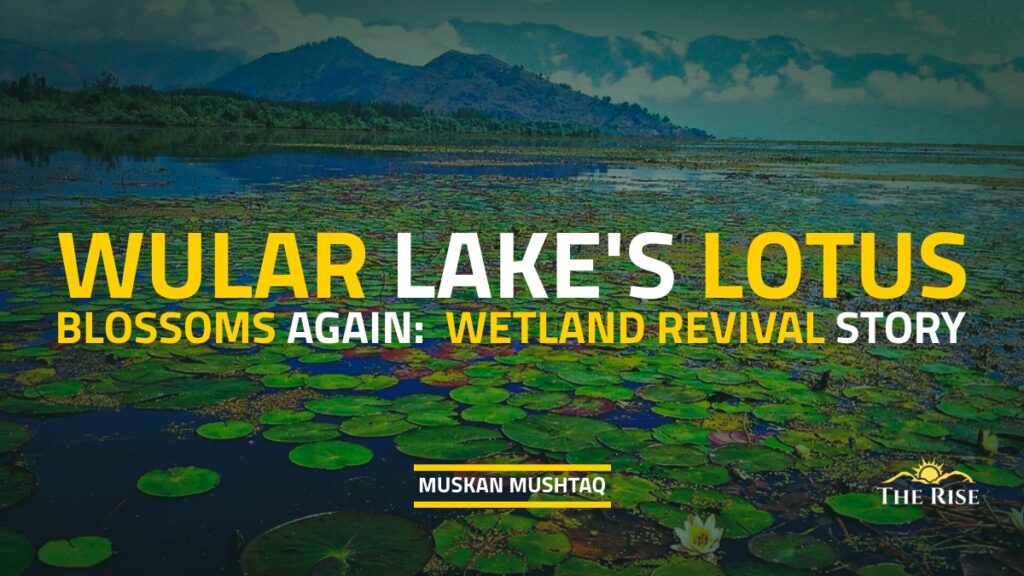
Unchecked pollution, untreated waste inflows, shoreline encroachments, blocked hydrological channels, and massive silt deposition had gradually suffocated Wular’s natural vegetation zones. As lotus growth collapsed, an entire ecological system and vital income stream for lake-dependent communities disappeared with it. However, in 2025, this long silence was finally broken as lotus blossomed across sections of Wular.
Wular Lake, Asia’s second-largest freshwater lake and one of Kashmir’s most vital ecosystems, has long been recognised for the livelihoods it sustains. According to Wetlands International and Wular Conservation and Management Authority (WUCMA) assessment reports, the lake directly supports thousands of families engaged in fisheries, water chestnut foraging, lotus-stem (nadru) harvesting, and small-scale boating activities, forming a crucial backbone of the local economy across the Bandipora belt.
For generations, lotus growth was a defining ecological feature of Wular. Its edible stem, locally known as nadru, not only enriched Kashmiri cuisine but also was the primary seasonal income source for households in the region. Ecologically, the dense lotus beds played a structural role by naturally purifying the water, creating shade that regulated lake temperature, and sustaining birdlife, along with aquatic insects that maintained food chains.
However, for nearly 25 years, this iconic plant vanished from the lake’s surface. Unchecked pollution, untreated waste inflows, shoreline encroachments, blocked hydrological channels, and massive silt deposition had gradually suffocated Wular’s natural vegetation zones. As lotus growth collapsed, an entire ecological system and vital income stream for lake-dependent communities disappeared with it.
In 2025, this long silence was finally broken as lotus blossoms reappeared across sections of Wular, marking one of the most striking wetland restoration successes witnessed in Kashmir in recent decades.
The Decline: Pollution, Silt, and a Lake in Distress
The disappearance of lotus from Wular was neither sudden nor isolated; it was rather an outcome of cumulative environmental neglect. Continuous inflows of untreated household sewage, agricultural runoff, and unregulated dumping of solid wastes degraded its water quality over the years. Successive floods further deposited thick layers of silt that buried dormant lotus seeds deep beneath the lakebed. As water depth decreased and natural channels became clogged, sunlight penetration and oxygen circulation dropped sharply, leaving the seeds viable yet biologically dormant beneath suffocating sediment layers.
For communities dependent on nadru harvesting, the collapse was devastating. Entire livelihoods disappeared, informal lake-side markets shut down, fisherfolk faced declining catches due to habitat loss, and tourism activity dwindled sharply as Wular lost its visual and ecological appeal.
The Turning Point: WUCMA’s Restoration Efforts
The revival seen in 2025 was not accidental, but the result of deliberate restoration interventions carried out by Wular Conservation and Management Authority (WUCMA).
Large-scale dredging operations were undertaken at Garoora and SK Payeen (villages in Bandipora district), two zones heavily clogged by silt after successive floods. Dredging restored water depth, improved flow, and exposed buried lotus seeds. By re-exposing the lotus seeds to light and oxygen, conditions necessary for germination were re-established after decades of ecological dormancy.
To strengthen natural recovery, WUCMA supplemented regeneration by introducing approximately 20–30% additional lotus seeds into strategically selected zones where natural seed banks were weak or fragmented. This ensured that revival would not remain patchy or localised.
By mid-2025, floating lotus leaves began to spread across Wular’s surface, soon followed by the resurgence of bright pink blossoms that returned after a generation.
Ecological Return: Wular Regains Its Natural Identity
The comeback of the lotus represents a full-scale ecological rebirth rather than just a cosmetic recovery. The restored lotus beds have begun to enhance water oxygenation, creating nursery habitats for fish breeding, attracting migratory bird species back to the wetlands, and increasing overall aquatic plant diversity, which supports the wider food web.
Further, the ecological revival has triggered a parallel transformation of Wular into an emerging eco-tourism destination. Scenic parks are being developed along the lakeside to create accessible recreational spaces for visitors. Watchtowers are also under construction, offering safe vantage points for birdwatching and sweeping views of the blooming lotus fields without disturbing sensitive habitats.
Socio-Economic Impact: Livelihoods Return
The revival has yielded measurable socio-economic benefits for Wular’s lake-dependent communities. Nadru harvesting is set to restore seasonal income streams for hundreds of households. Improved aquatic habitat has renewed expectations of stronger fish populations, providing relief to struggling fisherfolk. Women, who play a central role in cleaning, processing, and selling lotus stems, shall gain economic stability with increased participation in lake-based markets.
Young residents are also finding new livelihood opportunities through tourism services, transport facilitation, and hospitality support. The lotus revival has therefore brought back not just income, but dignity, security, and community confidence.
A Symbol of Resilience
The return of the lotus after nearly 25 years demonstrates that degraded ecosystems can recover when scientific intervention, grassroots community support, and sustained political commitment converge. WUCMA’s restoration programme has become a model showing that even wetlands pushed to the brink can be revived through focused and accountable conservation efforts
After nearly twenty-five years of absence, the lotus has returned to Wular, not merely as a flower, but as a symbol of renewal, resilience, and enduring hope.
Muskan Mushtaq is a TRIP intern.
About the author

Muskan Mushtaq is a passionate environmental researcher and a Zoology postgraduate from the Central University of Kashmir. She holds a strong passion for sustainability, wildlife and environmental conservation, and for combining scientific research with practical fieldwork. With this commitment, she aspires to build a purposeful career in field ecological and environmental sustainability. She is currently a TRIP Intern.